Posts tonen met het label Social change. Alle posts tonen

september 21, 2012

Islam Spelled Backwards: A Lesson In History

The characterization of Islam as backward has a long
history. Yet such representation fails to grasp the
genesis of the backward cultural frame or the direction
of the profits generated by it. Islam is not as such
by definition, it always functions within a context .
Muslim agitation over 'insulting' imagery is nothing new. It is as present in the media as advertisement. I can't turn on my television or pick up a newspaper without bumping into the latest analysis, opinion, or tirade. Chances are that you experience the same. That is why I first decided not to contribute on this issue. Surely, the facts are by now well-known: a distasteful depiction of the Muslim prophet invoked outbreaks around the world. The violence stirred debate on the compatibility of Islam and 'modern' values like freedom of speech. All too often, the friction which exists between Islam and liberal democracy is reduced to a Clash of Civilizations. 'Islam is a backward belief incapable of allowing democracy to flourish', such is the stance. On the other side of the debate, religious extremists eagerly adhere to this logic of collision. They invert the Western insult to a threat. I dealt with this perspective before. Still, mainstream media fail to grasp the real forces at play. They either subscribe to populist name calling or conjure up an image of the 'backyard Muslim'. The latter to remind us that many Muslims are valuable members of the community. What lacks is a coherent framework to combat the superficial clash put forth.

Religion is often used - misused - as a guise for real social conflict. Indeed conflicting interests have been masked by ideological differences throughout history. Today Islam is coupled to backwardness, but during the 16th century this role was allotted to Catholicism. At the dawn of modern Europe, religious conflicts tore apart political units at most levels. The rise of Protestant movements challenged the old order. Protestantism came in many a form, from the rather modest Anglicanism to radical Dutch Remonstrants. After the dust of the Thirty Years War settled, Protestantism had triumphed in those regions that would do most well in economic terms: the Dutch Republic, England, Scotland, and to some extent France which had the Huguenot legacy. Catholicism strengthened its position in Spain, the Italian states and Poland. These more peripheral areas saw a refeudalization as opposed to the forward surge of (proto-)industry in the Protestant nations. My point? If today's rhetoric was to be applied on this historic case, the conclusion would be that Catholicism is backward while Protestantism is not. Such a view has indeed been suggested. Yet, I prefer a vision that takes into account the gameplay behind the curtain of theological discussion.
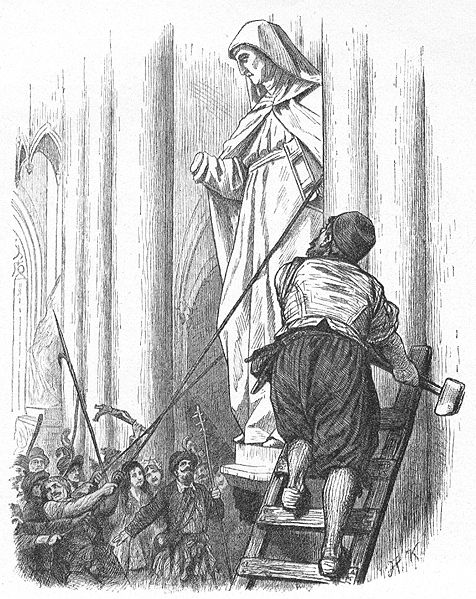
The 'Breaking of the Images' in the Low
Countries is quite comparable with Muslim
aggression toward idols. Yet one we call
progressive while the other is a sign of
anti-cultural sentiment?
Letting ideological dissent account for different social and economic realities is not a balanced view. On the other hand, one must be aware of deriving all cultural patterns from material conditions. Protestantism might more easily reach concord with progressive ideas than Catholicism, since the later has been a defining factor in a former order. But this only is a function of exactly that former constellation. It guaranteed that Protestantism could ally with socially progressive forces. Or better: that socially progressive forces could ally under the umbrella of Protestantism. New nobility, gentry, commercial entrepreneurs tried to secure their interests by assaulting Church property and the privileges of the old nobility. Another major factor was the buildup of a state machinery and the financial resources needed. The refeudalization, weaker state machineries and primacy of Catholicism in 'backward' Medieval Europe served the further rise of the 'strong states'. Baltic and Central Europe became a grain basket, producing much needed cereals of which the trade was monopolized by the Netherlands. Spain imported bullion from the New World to feed the growing economic activity in the northwest. Local aristocracies and the financial reserves of Italian city-states provided a market for Dutch and English cloth.

We have to view the position of the Islam in a similar logic. If the countries of the Middle East and Northern Africa are backward, it is not due to some primordial nature of Islam. Religion at best delivers an arsenal of symbols and values through which social and political forces act. Not so long ago the countries in those regions were ruled by an elite which promised modernity and progress. In reality people were oppressed, kept backward while a ruling few grew rich in serving foreign interests - the interests of the strong states. The Arab Spring was a reaction against this broken promise. And current uproar, all in the name of Islam, is in fact an internal struggle following regime collapse. Part of the old elite tries to reinvent itself, renew its promise. Islamist forces combat them by combatting their example, the Western liberal democracies. Does this make Political Islam a force of progress? I doubt it. Surely its current form is anti-Western, an enemy of the current installment of imperial privileges. The rise of Islamist regimes eats away at the hegemony of the West and brings the world further in touch with a growing multipolar reality. It will however not free the majority of the Muslim population, nor bring them material progress.


maart 01, 2012

What lies beneath: Implicit attitudes and emancipation

In the previous post I addressed the issue of traditional gender roles. Inspired by a publication of the Belgian Institute for the Equality of Woman and Man, I argued that gender roles are constraining to the personal freedom. Here I want to illustrate this point more thoroughly: Gender roles are a mostly social phenomenon, while it is often portrayed as a natural order. This makes that any deviant behavior is considered abnormal, even when superficially tolerated. There always exists implicit psychological pressure to adjust to the norm, regardless of whether explicit social pressure accompanies it. The psychological bias is deeply ingrained within our minds, as I will show. I can however not do this without first mentioning the illicit nature of this pressure and thus of the constraints. We are not sufficiently aware of how indoctrinated we truly are. And, as stated in the previous post, it is in this subtlety that lies the real danger.

On to the proof now, as big declarations about brainwashing make me sound more like a lunatic than I am comfortable with. A key notion in need of understanding is that the human brain is the ultimate instrument of deceit: we succeed to fool ourselves with the most powerful illusions time and time again. People can say that they oppose traditional gender roles, even believe that they do, while subconsciously they have a positive attitude toward them. As long is this conflict does not surface the person in question doesn't notice. A quick example: people can speak noble of tolerance toward homosexuality until their son 'needs to say something'. Same so with multiculturalism and the daughter introducing her new boyfriend Ali.

That people are not aware of implicit attitudes is widely accepted in social psychology. An instrument has been designed to measure such attitudes, the implicit association test (IAT). The test was created by Harvard psychologists in 1998 and caused a real revolt in methodology. I suggest not to find out how it works untill you have taken one yourself. It is a solid instrument though and some stunning results have been discovered using it:


The above image illustrates the preference of whites over blacks (left) and the attitude toward traditional gender roles (right). Both measured once by self-observation trough a list of questions (explicit) and once using IAT (implicit). Apparently women are not as emancipated as they themselves claim to be. Sure they are free, they have made their own choices, etc. Subconsciously they are still compelled to follow the gender roles though. Socialization at its best here. I included the example of blacks and whites in the United States because it shows that even blacks have a more positive attitude toward whites than toward their in-group. Seemingly the black community is based on a contrast with whites, a socially produced (!) contrast that places blacks at the bottom end of the comparison. A contrasts blacks too agree upon, albeit without being aware of it.

IAT research strengthens my view that there is a merit in stressing the harm done by the less visible or even invisible dynamics. We must acknowledge that the continuous portrayal of socially produced inequality as natural blocks the way to true emancipation. We must expose the triggers of mental oppression and fight them openly. To end this post I wish to thank J.J. Ekins for his comments on the previous post. They were a genuine stimulus for me to build upon. To all other readers: feel free to engage, to formulate your own thoughts, etc. A little polemic makes my blog more than an exercise in writing.

februari 26, 2012

Gender equality in Belgium: The IGVM report

A few days ago the Belgian Institute For the Equality of Woman and Man (IGVM) published its second report on gender statistics. The report is an instrument that lists numerous indicators of inequality between genders. The first gender statistics report was published in 2006. Since that time a lot of progress has been made in my little country. Especially at the indicators of education and academic careers the emancipation is really visible. A lot of problems still remain though. The hardest conclusion to digest - also the one the press covered most intensely - is that for every houseman there still are 32 housewives. Classic gender roles are indeed more firmly embedded in our open societies than you might imagine. The group of men who are participating in the household is growing, albeit at a slow rate. In the end the combination of a working job with tasks around the household still falls mainly on women. Housemen are a marginal group both within the population of men and the population of house cats. This is a trend that persists even in younger generations.

In Belgium we have a great system of time credit formulas: social security arrangements that allow working people to do less hours or even take a few months off to raise the children, care for an ill family member, etc. It is a sad reflection though that mainly women make use of these formulas. I understand that an instinct for caring might be more characteristic of woman, but not to such statistic extremes. There is no denying that a cultural pattern is at work here. And this is a real pity since the IGVM explicitly states in its report that "a more equal distribution of (caring) tasks within the household is a necessary condition for greater equality in other domains" (IGVM, 2012a).

To conclude I wish to point out that the inequality evident from the numbers has two main reasons. One is the ongoing enforcement of gender stereotypes onto children. Examples are all too evident: girls between 12 and 18 engage significantly more in household activities than boys of the same age, sports are still considered a boy's thing while we buy girls a doll for their birthday, etc. The IGVM report confirms the role of such practices which are to me no less than indoctrinating, limiting the free choice of children. I dare to say indoctrinating because how else would you call the natural representation of a constructed social order? The second problem links up to this in a direct fashion: most people see no problem. Most Belgian citizens do not recognize gender roles as a severe limitation to either freedom or emancipation. Gender roles may  not be as rigid as they once where, the danger lies exactly in their subtlety. What remains slumbering under the surface is hard to contest, but it can spread its poison nonetheless.

Sources:

IGVM (2012a). Press release 'Females and males in Belgium: Equal in 2012?' (Dutch). Consulted on February 22, 2012 (http://igvm-iefh.belgium.be/nl/binaries/Persbericht%2021feb2012_tcm336-163732.pdf).

IGVM (2012b). Females and males in Belgium. Gender statistics and indicators (Dutch). Consulted on February 22, 2012 (http://igvm-iefh.belgium.be/nl/binaries/GenderStat_N_Hfdst1-8_tcm336-161101.pdf).

februari 22, 2012

Policy approaches on abusive substances

This post is going to be a real practical one: there isn't a single adult out there who isn't involved. I am going to talk about what policy society ought to pursue when facing abusive substances. The trigger to write this was a family discussion on the legalization of soft drugs. The post will however encompass a wider variety of abusive substances. Including tobacco and - the emotionally even more sensitive - alcohol. Feel free to comment on the reasoning below or share your own views with us!

Before going to dictate the state what laws it should adopt I have to say a word or two on social control of abusive substance usage in general. What a person ingests, inhales or injects is often portrayed as a private matter. Users claim the right to abuse their own body. Yet reality shows that personal abuse is not at all a personal issue. Users create costs for others, directly trough exposure and indirectly by the impact on health care costs and economic productivity. A drunk is not a valuable asset to society, to state it bluntly. But the costs to society don't stop at this one generation. The current image and status of usage influences future usage too. I am sensitive for the idea that 'it is still my body' but there is no good in denying several millennia of social evolution. You do live with other people and that should count for something.

So what strategies are available to our respective governments? A first extreme is to come down hard on usage. But prohibition will only shift the demand to a black market. This causes society to miss possible revenue from taxes and having a harder time reaching out to users. Criminalizing by law also causes prices to mount (due to a less accessible supply) and triggers a rise in criminal activity. At the other end of the prohibition-tolerance spectrum we find complete legalization of whatever you feel like getting high on today. As stated above that would bring social costs. It also lowers the threshold to even more wicked substances. In my eyes such a policy gives the completely wrong signal by freeing the personal needs from all social boundaries.

Tackling the image of alcohol and other
abusive substances might be the way.
It should be clear by now that I am not in for freeing the egotist genie from its social constraints. But just as legalization, prohibition ignores social reality. That is why I want social control to be a force for the better without being all totalitarian/bitch-like. So what does an effective middle road approach look like? One element is taxation. The main idea behind a surplus tax for abusive substances is that it should discourage usage. It also raises money to recover some of the social costs. At once it becomes clear that taxation is an incomplete instrument if no directives for spending the tax money are laid out. The argument that cigarettes are a milk cow for the state is too often misused, but this is a legitimate concern. After all, the burden of such taxes tend to fall on the more vulnerable groups within a society. The idea of good practice directives should be extended to the suppliers of such products. Labeling needs to provide clear information, certain limits are imposed, etc. The European Union is in fact working on a proposal for the sale of tobacco products: the goal is to let them all come in dull-looking packages and put them somewhere out of sight.

I think it ideal to exercise strong pressure on the image of abusive substances. All by all easy to get, but hard to engage into the activity morally. A moral criminalization so to say. This guilt-approach makes people think about their behavior and, in time, change will occur. From this point of view Europe is on the right track concerning tobacco. Not so much for soft drugs though and not at all for alcohol. (Of note: I don't use any of the aforementioned substances, nor any that could at this time be reasonably considered abusive. Without a doubt this reflects in my views, though I am confident that it provides me a unique position to see things too.)

februari 05, 2012

A Marxist analysis of Political Islam

After the Arab Spring revolts, elections in Tunisia, Egypt and Morocco all point toward a victory for Islamist parties. This tendency worries Western observers, who perceive Political Islam as a major uncertainty at best. These recent events, together with insights I received after talking with Muslim friends here Belgium, compelled me to blog on the matter. Is Political Islam a threat or a treat? To whom is it so and why? These are the questions that concern us. Also bear in mind the difference between Islam as such and Political Islam; the latter being an ideological current that seeks to shape society by participating in the political process.

Is Political Islam opposed to imperialism or capitalism?
Can it, as a set of ideas, formulate an answer to them?
Before anything else, Islam is a religion. And as such based on dogma - an absolute and undeniable truth that is given and exists outside of humanity. It also is a mechanism of socialization, replicating cultural patterns (values and attitudes) over generations. Cultural patterns always are historical entities, they are a product of their time. From a Marxist point of view, archaic patterns limit the scope by which people can realize their potential. Traditional Islam thus is a boundary on further emancipation. From this follows that Political Islam as it exists today is fundamentally anti-Western. Speaking in a cultural sense, that is. 'Western values' linked to modernity (freedom of religion, emancipation of women, etc.) are in conflict with the current traditional interpretations given by Political Islam.

The anti-Western attitude is however not a characteristic of Political Islam by definition. Islam can be united with modernity. So in no way am I making the case for Islamophobia or a clash of civilizations. The contradiction is one in the field of ideas, and ideas change along with the circumstances that allows them to exist. The traditional interpretation of Islam that thrives today reflects underlying material realities: Islam can be used as a means of mobilization and propagation in support of or against ruling elites, whether they'd be domestic (Ben Ali, Mubarak) or foreign (Israel, United States). Given the current circumstances, a traditional anti-Western and anti-modern interpretation is most lucrative; it is also the way of the least resistance.

Is there really a clash of civilizations à la Huntington?
Or is it actually just a clash of state/class interests?
Political Islam is thus a tool to real interests; as an ideology in itself it does not seek to alter material conditions. That Political Islam is conceptually poor can be seen in what it articulates: serving in a community and taking part in rituals is paramount. Charity toward the poor is encouraged, but the recognition of struggle against one's material conditions as legitimate is missing. Political Islam is an empty box and indeed not 'political' at all. Because Islam offers no adequate framework to criticize material conditions or structures, it is not even anti-imperialist or anti-capitalist. Sure, Islam isn't too keen on rents (making money with money) but this is a mere aspect of financial economics. In no way can Islam be used to address capitalism as a mode of production. The same it goes for the international political organization.

Does this mean that a Muslim can not be against imperialism or capitalism? Of course not, it only means he can not be so on grounds of his religious beliefs. Islam can well be mixed with other views from conservatism, liberalism, etc. But the political aspects of his reasoning would lie outside Islam. The only questions that thus remain are: (1) To what extend can Islam be consistently unified with other (modern) ideologies? (2) Supposed that a modern formulation of Islam would not be meaningless, would it be useful? From my Marxist perspective on religion, the answer is quite clear-cut. I do nonetheless look kindly to efforts linking Islam with modernity.

Any thoughts, questions, or other relevancies? Please do share in the comments section! :p

januari 21, 2012

American elections, economic crisis and the future world

The upcoming United States presidential election promises to be most interesting. America is at a crossroads: it can continue down a road of careful progress or it can try to secure the system it currently leads. The latter might create some successes in the short run, but the ultimate demise of the current world-system is inevitable. Even more vulnerable is the dominant position of the United States within that system. As I shall continue to argue, American politics would do better by using their achievements to sustain progress in stead of holding it back. Now it would do violence to reality to state that these two policies are parallel to the Democrat-Republican divide. It can however not be denied that, in recent years, the two parties have polarized. This can be seen in the charts on the right. It is also evident from the heavy resistance of some against the approaches of incumbent president Barack Obama.

AN HISTORICAL PERSPECTIVE
This political polarization is a result of the waning position of the United States as hegemon within the world-system. The concept of hegemonic power is complex and much debated. For issues of space I shall refer to the related concept of superpower: the States have a significant more means to steer the direction in which the world goes. For a long time, and certainly since the demise of the Soviet Union, it policed international society on its own. Examples are the creation of the WTO and increased U.S. unilateralism. No-one can stay in power forever though; contenders are always on the rise. The unique American position has been under fire ever since the seventies. In that decade, the stabile Bretton Woods financial system was abolished, Europe acted more independently and the 'Third World' began to manifest itself as a unique set of nations. Also the loss of the Vietnam War caused heavy resentment to future foreign ventures of a military nature.

Between 1970 and 2010 the American GNP doubled
while middle income wages only rose by 20%
The end of the Cold War, and indeed the 'end of history' perceived by some, is an intermezzo of temporary nature. It only shows that the hegemon has overcome the systemic contradictions for the time being. How did the States overcome these? The answer was found in shifting the burden: the world was put on a diet of neoliberal recipes to safeguard the system of its own destruction. Working class people earned a smaller share of their productivity and Third World nations were trapped in a cycle of restructuring and loans. By cutting the prices of input - labor and raw materials - more profit could be generated to relaunch the system.

THE LOGIC BEHIND TODAY'S TAMPERING
In this light today's sputtering of the economic machine is nothing new. Another phase of contest for the system ánd the hegemon are announced. Indeed the cures prescribed are not very original: we nationalized the messy risks of the banks (they can keep the profits though) and the national governments are going to cut spending. Meanwhile environmental policies are under pressure because you don't have money to save the planet when you have to save the banks (depends on your priorities I guess). Another factor is in play here too: more sustainable production equals more costly production, read 'less profitable'.

A cartoon from The Huffington Post expressing the logic.
The benevolent hegemon, as the U.S. was portrayed in the nineties, is not so benevolent anymore. The establishment has launched an offensive: Obama is to concerned about the environment, healthcare is 'socialist', the Chinese need to increase the value of their currency, etc. It all comes down to the same thing: production must get cheaper, cheaper at the expense of equity and sustainability. They want to pass the bill to the people and the planet. The waning superpower is trying to safeguard its capital - the ultimate basis of its superiority - in various ways. Another most curious part of this wicked strategy is the uneven stress on the public debts of eurozone-countries. Washington and also London are kept strategically of the radar while their situations are fairly comparable. As a nice bonus to the euro taking part of the heat, the social achievements in continental Europe are pressured too.

EMANCIPATION FOR THE FUTURE
But there is reason to keep up hope. (About time that phrase showed up :p). Scoffing at Obama and his 'evil socialist scheme' together with the fuss about Occupy Wall Street are emancipating people across the States. If the Democrats continue down a more progressive road they might turn America from a conservative bastion to a leading reformer on the world stage. In Europe the struggle is going on as well, both within the institution of the Union as on the national level. What Europe do we want? What America do we want? These questions are being raised today. And by looking for an answer we are discovering what kind of world, what sort of society we want to be a part of...

NOTE: The graphs on polarization where retrieved from Polarized America? (Kenworthy, 2010). First hand sources are mentioned by the author.

januari 17, 2012

Rattle those chains!

Western democracies often label themselves as 'free'. But what does it mean to be free? How free are we really? With this post I do not seek to refute the liberties enjoyed by citizens in the West. I simply wish to reflect upon the nature of those liberties; I want to investigate if liberty is synonymous with freedom. In the tradition of some earlier posts I want to promote a view rooted in marxist thought - what follows thus is a marxist conception of freedom.

There are a few difficulties in grasping an abstract philosophical notion like 'freedom'. We need to overcome these before we can judge todays freedom, and point out future directions. The latter should be the ultimate goal of our reflections. Now how to deal with the problems we face? How to know freedom? As always, starting in the field of practice proves to be useful: in the West we are free in a relative fashion, relative to contemporary authoritarian societies and relative to our own past social order. This notion of relative freedom has its (theoretic) opposite in an absolute freedom. I added theoretic between brackets because freedom can never be absolute. Absolute freedom only exists in the realm of fiction, where it is often attributed to divine beings. Mortals however will always be subject to boundaries; as material substance human beings have to abide the rules of physics. Next to the laws of nature, other limitations exist: geographic conditions, material capacities, social structures, etc. Even the expectations themselves can impose boundaries as expectations are formed within a social context - our scope of possibilities can be limited by dominant cultural values.

Mankind is however no passive slave of his conditions; throughout history we gained knowledge over nature and applied tools to overcome our limitations. Agriculture lead to increased carrying capacity of the land, language allowed for better coordination, etc. Sometimes our instruments of liberation imposed new boundaries, as was the case with economic modes of production (feudality, capitalism) or the creation of unity (culture, religion, nationalism). Karl Marx' famous example is the organization of society under the state - a strong mechanism for overcoming our natural condition but a strong boundary on further development as well. In fact, Marx thought it was such a big roadblock that he saw revolutionary overthrow of the state as only possible way forward. A bit radical, but considering the circumstances at his time not a strange conclusion at all.

Our liberal freedom is built upon the unfreedom of others.
Historic ánd continued exploitation make up pour welfare;
Speaking of evolution, we can discern an evolutionary pattern away from the initial 'anarchic' freedom. This natural condition was described by Hobbes as the fight of all against all; Darwin called it the struggle for survival. It is a natural freedom of social boundaries that we luckily left behind us. Ever since civilization came about, history has unfold as a history of emancipation from our boundaries. The modern day western society is quantitatively more free than say China's or Iran's. Qualitatively they are all the same: they are communities build upon tools to lift us out of natural anarchy but impose new limitations. They are filled with tools of oppression (political correctness, gender constructs) and tools of exploitation (a capitalist market economy).

One might argue that western democracies do not pose the same physical obstacles as raised by 'unfree' societies. True, but our liberal freedom - manifested in welfare and security - is based upon the exploitation and unfreedom of others: the bottom billion in the third world, the cheap Chinese workers, etc. Our freedom is stolen freedom and simply shifts the burden. The goal should be to take the next qualitative jump from liberal freedom to actual freedom. We ought to build a fair society in which the explicit goal is true maximum freedom for all, not just limited freedom reserved for some.

december 19, 2011

Les blues de Bruxelles

The recent update included the possibility where I would blog on 'urgent matters' in spite of me lacking time. This post already exploits that built-in glitch in my otherwise quite firm schedule. The topic once again is the protest against Kabila's re-election as president of Congo. This connects to former posts in which I made a brief sketch of the candidates and commented on Europe's waning commitment to promote democratic values.

Congolese in Matonge with a sign praising the Belgian
anti-establishment party N-VA, of which Bart (de) Wever
is the chairman. They are blatantly missing the point...
This post is a result of my indignation toward anti-Kabila protests in Belgium. Ever since the results of the Congolese presidential elections have been announced, people have been protesting in the Congolese Matonge neighborhood of Brussels. People of Congolese origin are unhappy that Belgium tolerates Kabila's alleged election fraud. They wave Flemish nationalist flags (?!) and they accuse the Belgian establishment. They are totally missing the point! The Congolese in Belgium are fitting themselves an identity that does not exist. As they see it, the West supports Kabila's oppression out of economic self-interest. This view of course can not account for the lack of unity within Congo. I do not deny that economic patterns play a defining role. Complex reality can however not be reduced to a one-on-one relationship of Western exploitation and Congolese dictatorship.

Congolese waving a Flemish flag during the protests.
This can well be considered a strange sight in Brussels.
Colonial inheritance, Cold War dynamics and modern day globalization trough interplay shaped the Congolese economy to what it is today: an inconsistent amalgam of Western-dominated resource extraction, feudal farming methods and an informal petty market in urbanized regions. The Congolese economy is directed at meeting external demand and as such can not realize domestic development. The people of Congo are forced to fall back on the local community to satisfy their basic needs. This causes commitment to a regional identity created along ethnic and cultural divides. Since an economic base is lacking, no civil community or indeed 'nation' can develop.

Without nationhood the central government lacks the legitimacy it needs to be effective. In addition local patterns of clientelism and ethnic tensions are projected into the government institutions. Different groups became engage in a struggle for power over the state, an instrument of which each community wants to avoid that it gets used against its own security concerns. Where the state fails to provide public good, local communities struggle for power. This is the case in Congo - there is no Congolese nation, no Congolese citizenship, no Congolese identity.

The protesters in Brussels are trapped by the modernity paradigm. They blame Western egotism but remain trapped in a liberal discourse of progress and citizenship. I encourage them to tackle the real economic causes which lie underneath. Even if this means recognizing that part of the fault lies with local Congolese interests and the understandable but backward reliance on a closed identity.

december 16, 2011

On sustainable growth

Conclusions at COP-17 in Durban, South Africa were meager. True, the Kyoto Protocol to combat greenhouse emissions is prolonged. And surely commitments have been made to get a binding environmental treaty operational by 2020. Even if this outlook becomes reality, it can be classified under the label of 'too little too late'. Besides, emerging economies like China and India remain averse to far-going and legally binding measures. The other champion of environmental pollution, the United States, would have to ratify any such agreement in Congress. I seriously doubt that with its economic power waning, the States will make ecological commitments.

Bridging leftist ideas on the capitalist economic system with
ecological approaches that take into consideration the well-
being of the planet, provide useful insights for our future.
Up till today politicians have handled a strange logic in dealing with the climate crisis: the economic environment is taken as given, and from thereon we see what green measures we might take. That's bullocks, you can't negotiate with the climate! We must take into consideration the boundaries of our planet's ecosystem - without compromise. And from thát point on we should investigate what economic model is suitable. This radical shift has to take place in our minds and the minds of our political leadership.

We need to put an end to the parasitic way in which our economy relates to the environment. On a global scale, the political level must interfere in the sphere of economics. The pattern of consumption among prosperous citizens needs to shift drastically; away from unnecessary waste and luxury and toward investment in a green revolution. Parallel to the sustainable switch a big push is needed to close the ever-widening gap between rich and poor. The reason for this is twofold:

(1) Poor strata in a world dominated by market forces are confronted with unequal access possibilities. They are cut of from land, food and water even though such vital resources are abundant. Indeed it can be proven that such shortages are caused by unequal access rather than objective scarcity. As a result poor people will resort to clearing forests, burning cheap coal, etc. - this further exploiting the planet.
(2) Rich strata will make brainless consumption choices. They waste money to unneeded stuff simply because to them the marginal gain of a single euro/dollar is low. If the money thrown away had been invested in alleviating poverty, it would have contributed to a socially and environmentally sustainable world.

The essence: welfare should on a global scale be invested in the shift toward an ecologically sustainable society, which includes closing the gap between rich and poor. More growth at expense of the planet (and the poor) is in the long run devastating. Growth shall be sustainable or it shall not be at all.

november 29, 2011

Turning the lens around

Recently I told a good friend of mine about the concept détournement. I was quite amazed that he didn't know it, since it is a valuable contribution to anyone's mindset. Therefore I wish to share it on my blog. Détournement is a French term that translates as 'deflection' or 'distortion'. It was developed as a technique in the 1950s by a group of radical artists and thinkers called the Letterist International. Founder and exponent of this movement was Guy Debord. He described détournement as "using spectacular images and language to disrupt the flow of the spectacle". This sounds more difficult than it actually is, as it comes down to using imagery handed to you by common culture and deflecting its message so that it becomes critical of that culture.

Big corporations and their unethical practices are often the
target of détournement messages. Especially since the most
dominant field for this technique is anti-consumerism.
As an artistic technique, détournement is closely related to other forms of art you might know better. A parody, for instance, takes common imagery and symbols to construct a new message often critical of that which is parodied. Parallels can also be found with Pop Art, which expresses a critical attitude against a high arts-low arts division. To speak of détournement, however, something more is needed: the goal of the trick must be social change. Détournement is rooted in Marxist thought and as such it seeks to alter society for the better. While the filosofical concept might be marginal in terms of popularity, manifestations are nonetheless visible. Just think of so-called culture jamming; groups of activists who create satirical and cynical messages on consumerism and globalization.

For people who like heavy material on détournement and the surrounding structure of theory, I recommend Guy Debord's The Society of the Spectacle. This work deals with the idea that, in a state of advanced capitalism, mass media and dominant cultural patterns oppress human potential. The eponymous film is enjoyable if you're into Marxist social theory. For all the others I refer to more accessible - less radical - material of people such as Noam ChomskyNaomi Klein or even Michael Moore. They all make use of détournement or promote similar ideas.
My favorite piece of détournement art by street artist Banksy. If you have no idea what this is about,
check out this picture. It was taken during the Vietnam War, after an American napalm-strike...

november 16, 2011

The rise of social media: A conservative revolution

The title of this post is inspired by my love for the oxymoron: a figure of speech that combines contradictory terms. After all how can a revolution be conservative? Well, consider the latest revolution in the way we communicate. There is the increasing importance of mobile communication, we have a proliferation of social network sites, and let us not forget the blog, of course. When you are just like me skeptic towards this digital (r)evolution people tend to classify you as 'conservative' or 'backwards'. Yet I dare to argue that not the critics but the revolution is conservative. At first this statement might sound silly but allow me to explain.

The communication revolution that brought about chat services and facebook is just a next step ahead on the road to modernization. I wont argue against that. However, it is just a next step down a certain road. It might be modernization, but it is mainly the intensification of an already existing process. Look at it from an historical viewpoint: way back, when man still had an oral culture, few individuals controlled the information stream trough tradition. Over time, various communication revolutions (writing, printing, etc.) have freed the individual from this control. The balance in society shifted from traditional/communal thought to more modern/individual modes of expression. New ways of communicating actually liberated the private sphere from community control and brought about the modern individual. So far so good. But now for more recent changes in our communication: the rise of mass media and, subsequently, of social media. In effect, this evolution is sucking us back into the communal world of before. Television and social network sites seem to stress the dominant value patterns in society. Two mechanisms are at work here: first of all our identity becomes increasingly fragmented. We have become hyper-individuals who associate with numerous groups at a time. This is not bad per se, since I like to see the influence of say religious or ideologic dogma waning. At the same time however this leaves us vulnerable for the second mechanism: the socialization of dominant values.

How contradictory it may seem, growing individualism brought us to a point where people become socially inert. The majority of us no longer questions things in a fundamental way. As a society we do not care for change or justice, we have become indifferent towards our own future. People are more empowered than ever, but at the same time they have lost a critical awareness. Therefore I advocate an alternative use of the tools that currently enslave us to a pensée unique; I want the digitalized media to be used for liberation and true empowerment. The essence of my plea is captured beautifully by this quote from Edward R. Murrow on television:

Unless we get up off our fat surpluses and recognize that television in the main is being used to distract, delude, amuse, and insulate us, then television and those who finance it, those who look at it, and those who work at it, may see a totally different picture too late. [...] if they are right, and this instrument is good for nothing but to entertain, amuse and insulate, then the tube is flickering now and we will soon see that the whole struggle is lost. This instrument can teach, it can illuminate; yes, and it can even inspire. But it can do so only to the extent that humans are determined to use it to those ends. Otherwise it is merely wires and lights in a box.

Feel free to replace 'television' with 'twitter' or 'facebook'. I could go on for [p]ages, but this post is getting long and complex enough. If you feel the need to more thorough explanation, I can point to Amusing Ourselves to Death by Neil Postman. Or you might enjoy the ideas of bright chaps like Herbert Marcuse and Antonio Gramsci. Feel free to use the comments section too!