Posts tonen met het label China. Alle posts tonen

december 04, 2011

A dragon and its cave: China's environmental policy

Before I start, an important notice to my more regular readers: you might notice a drop in activity the next two months or so. This due to the holidays, examination period and preparation for my paper. The past two weeks I have been writing some scraps that can be turned into articles with ease. Just to make sure that, even without much time, I never run out of interesting material to post.

Now, after monetary and economic policy, this final post in the 'dragon nation' series will focus on China's environmental policies. China is often portrayed as a big polluter who doesn't want to see its economic growth constrained. The People's Republic is indeed the biggest carbon emitter in absolute numbers. When emissions are however expressed in terms relative to say population or wealth, the West still does a lot worse. Additionally, the United States and Western Europe pollute a lot more than their own ecology can cope with. Thus an 'ecological debt' is created to countries who's environment is polluted by the excess of the West.
The per capita carbon emissions from various countries. Just compare India and China (left) to Belgium or the States.
The ecological debt surely puts things in perspective; industrialized and industrializing countries suffer the same ailments. The question now is whether China undertakes efforts to mitigate its impact. In its most recent five-year plan, the Chinese Communist Party emphasized energy efficiency and laid out a strategy for cleaning the air. A lot of uncertainty remains, but the Chinese government is working on market-based mechanisms to combat climate change. An emissions-trading system and green taxes are among the favored techniques. The national strategy in the making draws upon regional experiments with carbon-trading and petroleum taxes.
China profits from betting on sustainability. It already is
the leading producer of solar panels and CF light bulbs.
Now why does China seek to implement this shift? One thing most debaters agree upon is that economic motives are driving the process. China is the leading manufacturer of compact-fluorescent light bulbs and solar panels already. Its industries profit from energy-efficiency goals. Yet the so-called green technologies might cause ecological stress in their production and disposal processes, a factor too often ignored. Another motive for China is that it needs to crick up its credibility if it wants to keep enjoying cash inflows from the Clean Development Mechanism. This tool, created under the Kyoto Protocol, allows industrialized countries to invest in carbon-reducing initiatives abroad. The emission reduction then goes on account of the investor. China received a lot of such funding in the past but its biggest investor, the European Union, wants to revise its policy before 2013.

As always, the picture looks more complex upon careful examination. China isn't the environmental boogieman we often blame it too be. Though its efforts are economically motived, I for one expect China to do a lot in the future.

november 26, 2011

A dragon and its younglings: State-owned enterprises

Today I finally present the second article in my 'dragon nation' series. As explained in the previous installment, the aim is to tackle some misconceptions surrounding the oft-mystified Chinese policy. This time I investigated the claim that reforms in China have made it a capitalist economy. Hereto I focused on the state-owned enterprises and their role in the Chinese economy. Well-aware that a complete image requires much more, I would still like to draw some conclusions.

Under impulse of Deng Xiaoping, China moved beyond Maoist recipes and reformed its way out of Third World status. I will not discuss the Chinese economic reform into detail. Much more interesting is to see how much 'Chinese characteristics' there really are in Deng's socialist market economy. After all, once reform was initiated, liberal theorists expect(ed) the People's Republic to move ever-closer to the western model of capitalism. The attachment to ideological references they dismissed as futile shadow-discourse; a canalization of Chinese nationalism at most. How solid is this view?

The Chinese government protects the state-owned enterprises. Favored
companies are effectively shielded from competition by perverse policy.
In 2001, China joined the World Trade Organization (WTO). In this the Chinese establishment subjected itself to the liberalization of its international trade relationships. While this surely is a big move, the power of state-owned enterprises within China's domestic market is still overwhelming. Indeed, ten years after the country's admission to the WTO, state-owned enterprises are stronger than ever. The Chinese government ensures a dominant position for its partners; favored companies abide and in return their share in the market is protected. The authorities realize this by applying rules with a double standard and by obstructing the take-over of domestic companies by foreign ones.

For a detailed analysis of how the state shamelessly obstructs market forces I can recommend this article from The Economist. Now our focus shifts again to the WTO: while domestic suppliers have a guaranteed playing field, they have it easier to export their services/products. The WTO strives toward free trade between its member states and, while it is true a foreign company can access the Chinese market, it is shielded from actual demand. Meanwhile Chinese firms, enjoying subsidized/enforced demand at home, can well-compete for the demand in Europe and the United States. China is thus far from a capitalist country. Much more it resembles a covert form of state-capitalism or even modern mercantilism. Regardless of the label, the state and indeed politics are a most determining factor in China's enterprise environment.

november 14, 2011

A dragon and its treasure: The Chinese yuan

The title of this post refers to the Chinese People's Republic as a dragon. Chinese economic policy is almost as mythical as the creature often used to portray the nation. Incredible growth, enormous exports, vast amounts of financial reserves and yet lead by a party that calls itself 'communist'. In a series of three posts I would like to examine some of the myths that surround Chinese economic policy. First up is the supposedly undervalued currency and its perverse effects on global trade.

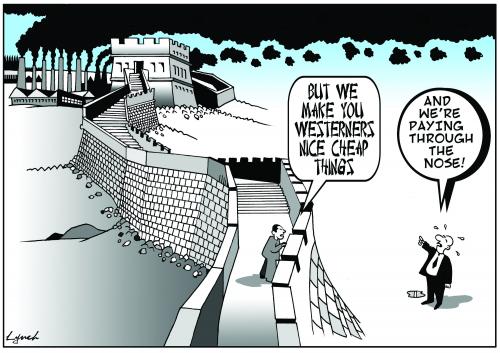
The Chinese leadership is often accused of keeping the yuan, the currency of the China, artificially low. An undervalued currency holds a significant advantage: it suppresses domestic prices of raw materials and labor. In essence you make domestic production artificially cheap, compared to foreign production. This causes  Chinese rubbish to be priced too low and thus to sell better than American, Japanese or European rubbish. The Chinese government rejoices when it checks its export numbers. Other industrialized countries are less happy for they see their trade balance - the worth of export minus import - become less balanced.

The trade balance of countries around the world, based on IMF statistics for 1980-2008. Notice the high deficit for the United States, which is largely benefited Japan in the eighties and China since WTO-admission in 2001.
The question that keeps us busy is twofold: is China keeping its coin artificially cheap and, if so, then how do we deal with it? The grievances of China's trading partners are without a doubt legitimate. It needs however to be said that, ever since 2007, the Chinese government has taken measures to adjust its underpriced coin. Indeed since June 2011 the yuan has appreciated over 7% against the dollar. And considering the spread between China's inflation rate and the much lower one of its trading partners, relative costs in China have risen even more. All this show us that the yuan is not as much undervalued as it used to be.

Myth 1: "The Chinese yuan is kept artificially low
and thus the Chinese policy distorts global trade"
Yet China-bashing is more popular than ever, especially in the United States. On October 11, the US Senate approved a bill that allows its government to take measures against what it deems undervalued currencies. This strategy might be politically successful as it might get one votes from people who lost their manufacturing jobs allegedly due to cheap Chinese imports. Yet from an economic point of view the results would be devastating. A trade war between two economic behemoths, who are also each other's principal foreign debtor/creditor, will disrupt today's fragile economy even further. To ward cheap Chinese products from your market would by the way mostly harm the consumer. And China only needs to challenge such a policy before the WTO to enforce free trade. After all the international economic regime regards undervalued currencies to be a prerogative of the IMF.

Then should we stay inert and leave the matter be? There is something to say for abstaining from action. Though the yuan is far from flee-floating, it is steadily gaining in value. A more 'flexible' yuan offer chances for China to hasten the reorientation of its economy from exports to domestic consumption. This is something the Chinese authorities recognize and seek to achieve, even more so when a global recession might be just around the corner.