Posts tonen met het label Elections. Alle posts tonen

oktober 02, 2012

Four Years of Obama: An Evaluation

Incumbent president Barack Obama. I am rooting for the
guy even though this article doesn't avoid criticism.
Republican criticism of U.S. president Barack Obama has been harsh. At the Republican convention in Tampa, vice presidential nominee Paul Ryan characterized life under the Obama administration as planned out by the government. 'A country where everything is free but we are not', he stated. Clearly the Republicans are not amused by what the past legislation brought forth. Sure, the differences between the two parties seem wider than ever; polarization seems to grasp the sphere rather well. Yet a lot of progressive Democrats too are dissatisfied with their president. Voters on the left who supported Obama in 2008 have grown disillusioned. It is to this part of the electorate that the Democrat directed himself when he argued that 'when you give up now, nothing will change'.

Does Obama follow a centrist line? Is he the Republicans' little bitch? Or a socialist crook, as Tea Party types claim? In spite of all 'election speech' I do believe in the good intentions of Obama. And when reflecting upon his realizations (or the lack thereof) we must always keep in mind that a president can only do so much. In making policy, Obama has been winged by a Republican-dominated Congress. As a result, the output of four years Obama is always the output of a four year game between all relevant actors.

THE PROGRESSIVE CANDIDATE
Whether the past legislature can be dubbed 'left' or 'right' depends on which policy branch is under consideration. One field in which Obama made a difference is the emancipation of the gay community. He repealed the DADT policy which barred homosexuals from the army. As a major influence on the public opinion he also openly approved of gay couples. I consider this a big step forward in what I consider to be a backward country regarding such issues. (If this judgement seems harsh, please consider that I live in Belgium. Same-sex marriage is totally legal here and even our PM is homosexual!). Sure, Republicans aren't all united on this issue. But I do believe that a Republican president would have made a difference, if only in his silence.

On a side note: Obama is black. Perhaps it is lame to see this as a positive quality, but I can't help thinking it makes a difference. It is something like a first female head of state: not necessarily an indication of real emancipation but a strong token of progress nonetheless.

Obama might well be the 'greenest' president the States
ever have seen. A tendency his party can capitalize on, as
a lot of moderate voters have environmental concerns too.
The branch in which Obama made the biggest difference is, I belief, the environmental policy. His administration protected the Grand Canyon from uranium mining, supported green industry, enacted stronger protections against poisonous substances, etc. Again Democrats and Republicans come in various flavors when the environment is concerned. Yet the duo Romney-Ryan campaigns with dismantling such protections as the Clean Air Act and Clean Water Act. Their approach completely denies climate change, as does a frightening large portion of their party's officials. Climate change is a debate in its own, but massive amounts of toxins and greenhouse gases can't be very wholesome. To claim that such pollution has no effect - you tell me who believes in fairy tales?

The following might be striking, but with that I have covered Obama's biggest achievements. What about the social policy, you may ask? What about saving the economy? There is no denying that the president did a decent job governing in difficult circumstances. I am however not convinced that a Republican candidate would have made a significant difference. Of course this is counterfactual, and thus not solid. But allow me to make a case.

SOCIO-ECONOMIC CENTRIST
The economy got stimulated with a 800 billion plan in 2009. One third of this amount was however implemented as tax cuts. Cuts are less stimulating than outright public investment since people will have the incentive to save up for the hardship to come. Especially the left was not too happy with this design, but then again it were the Republicans in Congress that needed to be courted. Perhaps McCain (or another generic Republican candidate) would have added a bigger portion of tax cuts. Perhaps the benefits would go to a higher income group than the middle class Obama favoured. But these measures would only be less effective in stimulating the real economy as a whole. And after all, there are only so many ways to revive an economy in a limited scope of time.

With the tax cuts mentioned, I would like to take the time to tackle one of the biggest myths created by the American right. The tax burden didn’t massively increase under the Obama administration. True, the president set out to revoke Bush’s tax cuts for the rich. But this never came about. Too bad I say. And his more leftist supporters would surely agree, a failure. On the other hand taxes were reduced for the middle classes, mainly with the stimulus program. Neutral economic institutes set the current U.S. tax rate at the lowest in decades!
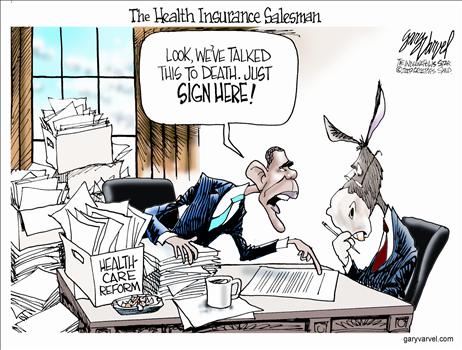
The health care reform, often dubbed 'Obamacare', is
subject to much debate. A look at recent history puts
much of the consternation in perspective, though.
On to that other eyesore for conservatives: Obamacare. Republicans are angered, yet it concerns a reform they thought about for years themselves. Its very blueprint - as is by now well known - was implemented by no less than Mitt Romney as governor of Massachusetts! The so-called Heritage model, created by one of the biggest conservative think-thanks, obligates Americans to buy an insurance with a private company. Those who can’t afford one are entitled to subsidies. As a counterweight, insurance companies can’t turn anyone down. But why would they if the state just bought them 30 million of new customers?! Republicans can't be too mad as their ultimate nightmare was avoided: a public insurance option after European fashion. Such an option was present in a failed plan once presented by Nixon. And why did Nixon fail? The Democrats wanted more. Now they themselves presented less, and short-sighted Republicans call it socialism.

If Obama is a communist he knows damn well how to hide it. Sure, he nationalized the car industry. But only for a while. And while Romney suggested to drop GM and Chrysler, I heavily doubt any president would have the guts. It sure wouldn’t do him any good in the polls. As for Wall Street, saving behemoth financial institutions with tax payer money can hardly be called called socialist either. For one there weren't any real options here. And second, the government asked nothing in return. No accountability, no caps on bonuses or management wages. The families who lost their homes due to malpractices outside their control could count on far less support...

A MIXED RECORD
Other hot topics Obama-supporters bring up are migration and foreign policy. The DREAM act was a nice gesture. Most Republicans wouldn't dream of coming up with such a proposal. And indeed they complain it will only encourage illegal immigration. This may be, but the Obama administration is also responsible for doubling border patrols. Obama seeks to reduce the influx while dealing with the illegal community already present. Not too shabby, I must concur. The war in Iraq ended. For Afghanistan the end is in sight. No real victory is achieved in my eyes, yet there is nothing any president could do to help. Obama is however not the softy hawkish Republicans think him to be: under his administration more drone strikes were ordered. Also, Guantanamo remains in use and the Patriot Act still stands.

I conclude by pointing out that there is a growing number of disillusioned voters since Clinton. People who care deeply for strong environmental and social policies. They supported Obama before, and he needs them again now. I am not sure if he deserves them though, since on crucial matters - economic and social - there has been no significant difference.

maart 18, 2012

The American Voter: US Political Culture Explored

I worked really hard on this post and wondered if I would finish it by the US presidential elections of 2012. Luckily for me it is done well before. So here it is: some reflections on the American voter, backed with numbers and fancy sources. This post is not so much on ordeal, rather it functions as a set of ideas that frame the upcoming elections. Feel free to feel inspired and please share any thoughts! :p

Political culture is hard to define, yet it offers an attractive explanation for national differences concerning political behavior such as voting. 'The French are such', 'Americans do not think that way', etc. I am confident you have heard some like those before. There are indeed a lot of differences, but they are in my opinion not given. First of all political culture is dynamic: it can change over time (see the graph below). This is evident from the declining trust in political institutions with Americans. Second, the creation of and changes in political culture are the result of historical development. The trust is influenced by education levels, economic climate and central figures with their vigor or scandal.
Now how unique is the American political culture? Ronald Inglehart, famous amongst political scientists, was a driving force behind thinking about post-materialism: a value pattern focussing on self-realization relative to self-preservation. By adding traditionalism/secularism as a second dimension, Inglehart identified different cultures. He found an Anglo-Saxon value pattern which scores very high on self-realization and moderate on the second dimension. This is expressed in various features of American political culture: the perceived exceptionalism, the belief in popular judgement and the typical conception of freedom. All these elements are rooted in the history of the American state and society: fleeing religious or political persecution, resistance against the English crown, the autonomy of the states, etc.

(It needs to be said that the dominant political culture in the United States is perhaps more of an imposed value pattern rooted in the Anglo-Saxon and Protestant inheritance. Values differ along various lines, of which ethnicity might well be one. In how far the political culture is shared by say Afro-Americans or Latinos is hard to say. Even more difficult is it to draw conclusions as to how 'American' American political culture is.)

'American' political culture: a combination of influences or
the dominance of white Anglo-Saxon Protestant values?
The above should enable us to situate the American political culture and place it in its historical context. On to the voter now, as the upcoming election is the essence of this article. United States politics is largely spared from the increasing fragmentation that has Europe in its grip. Even in the UK they need to form coalitions now, despite the majoritarian mode of voting. This does however not mean that voting behavior didn't change in the States. Like everywhere in the West, identification of the voters with a single party has been diminishing. The electorate is increasingly motivated by what is called 'retrospective voting': casting your ballot based on specific issues, the image of parties/leaders and the economic climate.

Studies from the sixties up till now show that only up to a fifth of the American population is motivated by ideological reasons when casting the vote; about 40% defines politics in terms of group interests (classes, ethnicity, etc.) and 25% rewards or punishes the establishment based on the general tendency of the economy and society as a whole. The others are, sadly, apathetic: they don't give a ----. Furthermore, an overwhelming eight out of ten voters show no temporal stability in their ideological preferences. However in times of crisis and change the electorate becomes more ideological in its thought than its leaders, pushing for extremes. If these results don't seem to tell you anything, read this paragraph over once again whilst thinking about Obama's success in 2008. Now repeat that exercise with the possible Republican nominees for this year in mind.

Sources:
Converse, P.E. (1964). The nature of belief systems in mass publics. In D.E. Apter (Ed.), Ideology and discontent (pp. 206-261). New York: Free Press.
Hague, R. & Harrop, M. (2010). Elections and voters. In Comparative government and politics: An introduction (pp. 179-202). Basingstoke: Palgrave.
Hague, R. & Harrop, M. (2010). Political culture. In Comparative government and politics: An introduction (pp. 121-137). Basingstoke: Palgrave.
Inglehart, R. (1997). Modernization and postmodernization: Cultural, economic and social change in 43 countries. Princeton: Princeton University Press.
Inglehart, R. (1999). Postmodernization erodes respect for authority, but increases support for democracy. In P. Norris (Ed.), Critical citizens: Global support for democratic governance (pp. 359-392). Oxford: Oxford University Press.
Putnam, R. (2002). Democracies in flux: The evolution of social capital in contemporary society. Oxford: Oxford University Press.
Sears, D.O. & Funk, C.L. (1990). The role of self-interest in social and political attitudes, Advances in experimental social psychology, 24, pp. 1-91.

januari 21, 2012

American elections, economic crisis and the future world

The upcoming United States presidential election promises to be most interesting. America is at a crossroads: it can continue down a road of careful progress or it can try to secure the system it currently leads. The latter might create some successes in the short run, but the ultimate demise of the current world-system is inevitable. Even more vulnerable is the dominant position of the United States within that system. As I shall continue to argue, American politics would do better by using their achievements to sustain progress in stead of holding it back. Now it would do violence to reality to state that these two policies are parallel to the Democrat-Republican divide. It can however not be denied that, in recent years, the two parties have polarized. This can be seen in the charts on the right. It is also evident from the heavy resistance of some against the approaches of incumbent president Barack Obama.

AN HISTORICAL PERSPECTIVE
This political polarization is a result of the waning position of the United States as hegemon within the world-system. The concept of hegemonic power is complex and much debated. For issues of space I shall refer to the related concept of superpower: the States have a significant more means to steer the direction in which the world goes. For a long time, and certainly since the demise of the Soviet Union, it policed international society on its own. Examples are the creation of the WTO and increased U.S. unilateralism. No-one can stay in power forever though; contenders are always on the rise. The unique American position has been under fire ever since the seventies. In that decade, the stabile Bretton Woods financial system was abolished, Europe acted more independently and the 'Third World' began to manifest itself as a unique set of nations. Also the loss of the Vietnam War caused heavy resentment to future foreign ventures of a military nature.

Between 1970 and 2010 the American GNP doubled
while middle income wages only rose by 20%
The end of the Cold War, and indeed the 'end of history' perceived by some, is an intermezzo of temporary nature. It only shows that the hegemon has overcome the systemic contradictions for the time being. How did the States overcome these? The answer was found in shifting the burden: the world was put on a diet of neoliberal recipes to safeguard the system of its own destruction. Working class people earned a smaller share of their productivity and Third World nations were trapped in a cycle of restructuring and loans. By cutting the prices of input - labor and raw materials - more profit could be generated to relaunch the system.

THE LOGIC BEHIND TODAY'S TAMPERING
In this light today's sputtering of the economic machine is nothing new. Another phase of contest for the system ánd the hegemon are announced. Indeed the cures prescribed are not very original: we nationalized the messy risks of the banks (they can keep the profits though) and the national governments are going to cut spending. Meanwhile environmental policies are under pressure because you don't have money to save the planet when you have to save the banks (depends on your priorities I guess). Another factor is in play here too: more sustainable production equals more costly production, read 'less profitable'.

A cartoon from The Huffington Post expressing the logic.
The benevolent hegemon, as the U.S. was portrayed in the nineties, is not so benevolent anymore. The establishment has launched an offensive: Obama is to concerned about the environment, healthcare is 'socialist', the Chinese need to increase the value of their currency, etc. It all comes down to the same thing: production must get cheaper, cheaper at the expense of equity and sustainability. They want to pass the bill to the people and the planet. The waning superpower is trying to safeguard its capital - the ultimate basis of its superiority - in various ways. Another most curious part of this wicked strategy is the uneven stress on the public debts of eurozone-countries. Washington and also London are kept strategically of the radar while their situations are fairly comparable. As a nice bonus to the euro taking part of the heat, the social achievements in continental Europe are pressured too.

EMANCIPATION FOR THE FUTURE
But there is reason to keep up hope. (About time that phrase showed up :p). Scoffing at Obama and his 'evil socialist scheme' together with the fuss about Occupy Wall Street are emancipating people across the States. If the Democrats continue down a more progressive road they might turn America from a conservative bastion to a leading reformer on the world stage. In Europe the struggle is going on as well, both within the institution of the Union as on the national level. What Europe do we want? What America do we want? These questions are being raised today. And by looking for an answer we are discovering what kind of world, what sort of society we want to be a part of...

NOTE: The graphs on polarization where retrieved from Polarized America? (Kenworthy, 2010). First hand sources are mentioned by the author.

december 19, 2011

Congolese elections and European values

A few days before the Congolese were to choose their new president, I blogged about the candidates. Last week the results of those elections were announced: Joseph Kabila succeeds himself as president of the Congo DR. He is believed to be won with little under half of the votes. However, he is not believed to be so by everyone: Supporters of Étienne Tshisekedi, who came in second, called the elections a fraud. They point toward the 'irregularities' that occurred to support their case. While it is true that not everything about the election process was democracy proper, all by all the result is called credible by the authorized commission.

Belgian police forces restraining Congolese protesters in
Matonge - the Congolese district in Brussels, Belgium.
Kabila was not elected by a majority of the people and in a one-to-one race against Tshisekedi he would surely bite the dust. The incumbent president profited from the divided opposition as I predicted in my previous post. Tshisekedi's followers, and indeed the political leader himself, fail to recognize this. While in the urbanized region of the capital opposition against Kabila is strong, the majority of the nation accepts a second term. Riots in Congo or abroad (we had some trouble with protesters in Matonge, the Congolese neighborhood of Brussels) are ungrounded. I do recognize that the grievances held against the Kabila regime are just, but the election outcome is representative.

What I find a real pity is that Europe didn't send a strong signal when tensions rose. A call to 'sit back and stay calm' can hardly be called a signal, can it? I noticed that the Old Continent is no longer as agile in promoting democratic ideals. Congo is just a single dot in a much broader pattern: values are forced to take a back seat more often than should be good for our conscience. Take for instance a bilateral trade agreement between the EU and Columbia: should we really strike a deal with a regime that doesn't take too kindly to human rights? The same goes for a deal in the making with India; the Indian government refuses to accept any trade agreement that holds a clause on human rights - and the EU is actually considering to drop its standard human rights clause!

It can be expected that this tendency will grow stronger in the future, and this for two reasons: First of all, the playing field for international trade is changing drastically. Countries like India, China and Brazil gain prominence and they are not stupid enough to attach value judgements to their contracts. Also, Russia is joining the WTO soon - this nation isn't exactly a staunch defender of personal freedom either. Holding on to its noble ethics would compromise the competitiveness of the EU. A second cause might be the declining power of the Commission and the Parliament. They have lost some of their grip on foreign policy since the creation of the External Action Service. What the future might hold, I can not say, but for sure fragmented and superficial protest wont bend the forces that shape our world.

november 27, 2011

'GOP' election fever

I apologize to those of you who came here expecting something on the upcoming US primaries. Indeed 'GOP' (Grand Old Party) is a nick for our dear fellows of the Republican Party. If you wish to read about those I recommend keeping an eye on this all-American blog. My post here will be about a more recent display of election fever: the election of a 'Good Old President' in Congo-Kinshasa. Tomorrow, monday October 28, the Congolese people will elect a new president. Or they can of course extend the mandate of the incumbent one. Not many people are familiar with Congolese politics, so first up is an overview of the main candidates:

Joseph Kabila is the incumbent president of the Democratic Republic Congo. He holds the office for the People's Party for Reconstruction and Democracy. Kabila has a considerable support base with the urban population, who profited from his policies. The president, however, has a lot of opponents too. And not without reason as you might expect. Congo still has trouble in strengthening its democratic institutions and obtaining a positive economic outlook. Did you know that Congo has the highest rate of extreme hunger while, at the same time, it holds the second highest agricultural potential? Until 2010, Congo didn't even have an agricultural policy!

Joseph Kabila of the social-democratic PPRD. Incumbent president of the Congo DR.
Main opponent of president Kabila is Étienne Tshisekedi of the Union for Democracy and Social Progress. Tsishekedi has some very militant supporters who feel that the current regime did not carry out its promises. Supporters who already announced not to stand idle if Kabila succeeds himself. A major issue for victory over Kabila is that the elections consist of just one round. This might strengthen the position of Tshisekedi as most likely of all opposing candidates, due to strategic voters. Though it is more likely that the opposition will be divided and that not a single candidate will gain enough votes to trump Kabila.

Étienne Tshisekedi of the liberal-conservative UDPS
Tshisekedi has been a 'constructive opposer' in former political settings. He even made it to Prime Minister on some brief occasions. Despite his liberal and conservative views he is my personal favorite. He has a sense for realism and wants to tackle issues of corruption. I thus named my post after this 'Good Old Premmy'. Other interesting candidates are the also very popular Vital Kamerhe of the Union for a Congolese Nation and the more radical François Joseph Mobutu of the Union of Mobutuist Democracts. Both of these candidates promote Congolese unity, though with very different accents.

As you might have noticed 'construction' and 'progress' are buzzwords. All parties have inspiring names, but their capacities are all too often overrated. That is why I set my hopes on the reasonable voice of Tshisekedi. Soon enough we will get an idea of what the Congolese future looks like. Even more important than a capable candidate to win is for all losing candidates to accept their defeat, and not resort to violence. The drama we saw in the capital Kinshasa the past two days is a shame. Unfortunately, Tshisekedi too negated the prohibition on gathering earlier today. I hope this was just a stunt in his campaign and not a prelude to actual destabilization.