Posts tonen met het label International Politics. Alle posts tonen

september 09, 2012

The Decline of US Power: An Eagle Crash Landing?

Columbia, as personification of the United States, carries
civilization westward. This image represents the 'manifest
destiny' of America as well as its expansionist tendency.
The 09/11 attacks were an eye-opener, a moment of revelation. Not so much as a defining moment, but rather as part of a lengthy historic trajectory which entails the decline of US hegemony. The majority of American policy makers, however, responded with denial and anger. They remain attached to the idea of American exceptionalism. To them the American dream is a guiding light for individuals around the world, Americans have a manifest destiny. While these underlying values present useful insights, they are not an exact representation of reality. To understand the world we need to look beyond our dreams; we need to look at the history of the United States and its place in the world. This post seeks to do just that. What do we see when we trace this superpower? How is it that the terrorist attacks and the American response, a 'War on Terror', fit in this pattern?

The truth is that by the turn of the millennium the States already lost their shine. A lone superpower that lacks true might. A leader everybody stopped following. Drifting dangerously amidst a chaos it cannot control.

In the nineties the US economy seemed to do well. Productivity was high, the stock market boomed, both unemployment and inflation were low. The resulting surplus made possible the liquidation of government debt. Many Americans believed this to be an affirmation of the vision and the economic policy of their leaders. What at first seemed to be success turned out to be a bubble. But even bubbles and downturns are deceiving: the world-economy has been in relative stagnation ever since the seventies!1 For three consecutive decades, the powerful economic loci have tried to shift the losses to each other. Western Europe did well in the seventies, then Japan had its decade, and the States had their share in the nineties. Globally, however, success was dim. The global economic slowdown parallels the decline of American hegemony. Indeed this is no coincidence. And it is all but certain that the US will outshine its competitors in a resolution. An under-the-surface fear is already today shaping American policy.

Central, though not crucial, in both economic and political decline was the Vietnam War. This costly conflict exhausted the American gold reserves at a moment when both Western Europe and Japan experienced an economic upswing. With the abandonment of fixed exchange rates, US pre-eminence in the global economy came to an end. Vietnam was perhaps even more devastating in another way: it was a rejection of the status quo as established by the winning powers of WWII at Yalta. A rejection by Third World nations which wanted to pursue their own way. The social upheaval of 1968 drew upon this. Just like the people of Vietnam, protesting youth contested the collusion of the two superpowers. While the direct political consequences of this 'revolution' were minimal, its intellectual and geopolitical implications were irrevocable. Centrist liberalism, binding conservatives and radicals alike since 1848, fell of its throne. Ideological choices presented themselves as conservatives became again conservative and radicals, radical.
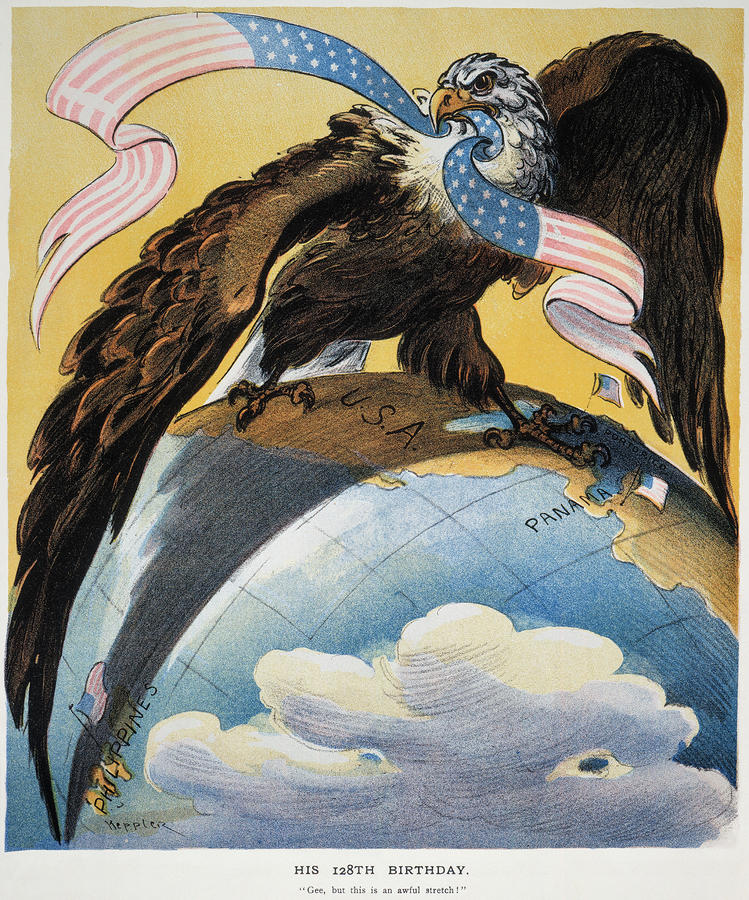
Cartoon depicting US imperialism in the Pacific and the
Americas. Military-driven maintenance of 'empire' denies
the waning hegemony and in fact strengthens this trend.
Conservative tendencies took the steering wheel under the flag of neoliberalism. With the onset of economic stagnation in the seventies, ‘developmentalist’ policies were abandoned. As a political complement violence and rejection became more widespread in the Global South. The US had to rely increasingly on brute force, in itself a sign of growing weakness. Military failures came about in Lebanon (1983) and Somalia (1992), where American troops were effectively pushed out. Success existed mainly against countries without troops, like Grenada and Panama. While the US wasn’t  paying attention, the Soviet Union collapsed. A cause of the liquidation of the Yalta agreements and internal liberalisation. In spite of all Western victory and end of ideology, the collapse of Communism meant in effect a collapse of liberalism. The Soviet threat was the only justification of American leadership over ‘the free world’. Of course the illusion of supremacy persisted, as it does in many ways up till today. As an arbiter in the Middle East the US kicked Iraq’s but in the Gulf War. Yet all the superpower could demand from a medium strength regional player was status quo. An intervention stopped the worst atrocities in Yugoslavia. But the ethnification went on and was indeed legitimized.

09/11 too proved the waning American power. It is not so much that a band of rogue fanatics with relatively little resources managed to scar the number one military power. It is the response that speaks: invading Iraq, a country that had nothing to do with the attacks, without much international consultation. This only spread anti-American sentiments, even among allies. Different voices are heard in how to deal with this reality. On the one hand there is the isolationist tendency, preaching a withdrawal into Fortress America. On the other hand there is the ‘hawkish’ macho-militarism. Both expressions of American nationalism, they share the same attitude toward others: one of fear and disdain, a belief in the superiority of the own way of life. Involvement in the quarrels of others is only permitted if we can impose our ways. Without a real possibility to bend the downward trajectory, however, the United States have chosen to ignore the trend. A policy prevailing from Vietnam till today that only hastens the decline.

1 World-economy is a term borrowed from world-systems analysis. For our usage here it can be equated to the global economy. When we say this global economy is in relative stagnation we mean that it is not expanding at as fast a rate as before, hence the 'relative'. For a general introduction to the underlying mechanism and the supposed consequences, see World-Systems Analysis: An Introduction.

Ten Years of 9/11: Rethinking The Middle East

So by now it has been eleven years, not ten. I wrote this as a guest blog for a good friend of mine. In fact that has been my first post ever to appear on Blogger. Its message is significant enough to be stressed once again. A repost is also interesting since my next contribution, due for 09/11, will place the same Middle East policy in a long term perspective. (Damn, I said no deadlines). Enjoy!

Day to day it has been ten years since Al-Qaeda struck the United States in its heart. 9/11 was certainly one of the most dramatic events of the past two decades. I do however disagree with the common view that it was one of the most significant ones. Without wanting to palliate the cruelty of the terrorist attack, I do feel its impact on world politics is not as direct as generally accepted. The effect of 9/11 was, I argue, mostly indirect and of a subjective nature. In the course of events taking place after the towers of the World Trade Center came down, America reacted with drastic measures. Washington increased its efforts in securing the safety of its citizens, sometimes by harassing those very citizens, and started a costly war on terror. It is exactly the road taken right after the attacks that would shape world politics for the next ten years. When it comes to significance for policy makers, the heavy costs of war and often problematic progress in rebuilding ‘freed’ nations like Afghanistan outweigh the September sting.

My opinion is not that 9/11 was completely irrelevant, but I do feel its impact is one constructed in the minds of both policy makers and the public at large. The terrorist act itself was sanctified as a symbol of fundamentalist hatred towards the innocent West while it was only a minority’s brutal response to America’s actions in the Middle East. This emotional misinterpretation fed and strengthened an image of  ‘us against them’. The public opinion shifted. A vision was created in which the Middle East was believed to be full of backward terrorists plotting to bring about the end of western democracy. Of course the number of oppressing regimes we supported far surpassed Islamist states, another fact gently neglected. In turn this mistaken paradigm contributed to the American answer to the attacks: war abroad and security at home. When the American people were confronted with persisting Taliban sympathies in Afghanistan and parts of Pakistan they saw their idea that the average Muslim is a warmongering fundamentalist confirmed.

Both the American answer to Muslim extremism and the distorted public opinion it partially draws upon are flawed for at least two reasons:

(1) First of all the actual causes for religious fanaticism in the Middle East are not recognized. The belief that Islam and indeed the Middle East itself is a monolith does not correspond with reality. Not  all –  not even most – Muslims agree to violence or the oppression of women. We don’t need to support militarist dictators in order to avert the rise of Islamist terrorists. An example is the young middle class that lives in Karachi, the biggest and most liberal city in Pakistan. The youth there likes to party and engage in performing arts. They proof that there exists something like a modern and self-conscious Muslim living in the Middle East. What most of us fail to see is that religious fundamentalists, such as the Taliban, gain their support by exploiting poverty. The real causes are indeed socio-economic in nature: hunger, corruption, lack of proper education, etc. Which is exactly why their support for the fundamentalists is all the bigger in underdeveloped mountainous regions.

Failing to endorse the role of socio-economic causes can have disastrous results. Take for instance the 2010 floods in Pakistan. An enlightened take on the Middle East would stress the importance of economic certainty and food supply. Because of the distorted public opinion in the West, however, the influx of financial support was substandard, worsening our credibility with a needy population. After all who wants to aid a terrorist? Another even more painful example of how counterproductive this mistake might be, has to do with the 9/11 attacks themselves: no-one dared to inquire what the motives for the attacks were. Not even the official report of the 9/11 Commission mentioned the only rational question ‘why’. Why not? Because they didn’t want to acknowledge that Al-Qaeda itself defined its terrorism as a response against US foreign policy. We don’t want people to question our policy, now do we? And so by bringing more war and destruction to the Middle East, NATO became an instrument for spreading hatred towards the West. Think of it as Newton’s third law of motion: For every action there is always an equal and opposite reaction.

(2) A second major issue is that the policy toward the Middle East has since long been dominated by a certain degree of hypocrisy. When colonization in Northern Africa and the Near East came to an end, the new nations were either ‘westernized’ or ‘Sovietized’. Experiments along the line of non-alignment were not appreciated by either Cold War camp. The resulting polarization cast its shadow over the Arab World. The US-Soviet dualism dominated conflicts such as the Arab-Israeli conflict or the internal politics of countries like Syria or Turkey. The ground shaking Iranian Islamic Revolution of 1979 breached this ideological dualism and marked the rise of political Islam. Military powers in the West however remained caught in their two-party paradigm. The US in particular failed to recognize the demise of the bipolar world order and the erosion of its own status as a superpower. (As a side note I’d like to add that the Soviet regime didn’t recognize these evolutions either, but they had quite an effective eye-opener about ten years later.) Because the US government failed to look beyond the two-party structure, it trained and funded Islamists to combat the Soviets in Afghanistan. Those very same freedom fighters used their CIA training to erase numerous innocent lives on September 11, 2001.

Ever since World War II ended, the democratic West has been supporting not so democratic regimes around the globe, first to combat ‘Communism’ and now to hold off the Islamist threat. I hope my argumentation above provided insight in how seemingly isolated events are actually part of more encompassing structures. The time is right for a new paradigm in dealing with the Middle East, one that corresponds with reality. As shown in the example concerning ‘liberal’ Karachi, Islam and modernity are compatible. In the revolutions of the Arab Spring people called for social justice, free elections and an end to corruption. These protests are directed against regimes our governments supported and thus they are directed against how we treated the Middle East in the past. It is my deepest wish that news coverage of the protests in Egypt, Libya and Syria can guide the public opinion in another direction. With a public belief in the people of the Middle East our leaders might tune foreign policy accordingly, upholding fair economic relations and stressing social advancement.

maart 18, 2012

The WTO: A Brave New World?

Often mentioned in my posts is the World Trade Organization, WTO for short. Mostly it is in a complaint about the negative side-effects of its policies and actions. The WTO was established in 1995 as the successor to the GATT-negotiations. Its goal was to realize global free trade. I noticed however that more and more the organization is used as a battleground for the resolution of national interest conflicts. The big trading blocs - United States, European Union and China - are pursuing their economic self-interest, disguising it as concerns of free trade, ecology or fair trade.

One of the first big clashes was between Europe and the Cairns Group. The latter attacked the agricultural policy of the Union. Of course this was a genuine case of protectionism versus free trade. But when Europe masked its subsidies as support for environmental development, things got really nasty. The WTO was expected to decide on the legitimacy of environmental and other 'progressive' arguments, something it had no mandate for. Indeed the WTO assesses mostly in favor of free trade. Two clear-cut cases are the Banana War and the dispute about Europe's unilateral guarantee of free trade to its poorest trading partners. In both cases Europe had nothing to gain financially itself, but the WTO ruled that such practices are 'against the spirit of freeing up world trade'. I wonder what will become of the Union's aircraft carbon tax...

With its one-sided focus on free trade the WTO can
only serve capital. There is no attention for legitimate
concerns regarding the environment or free trade...
The WTO was created in a moment that everyone believed capitalism had triumphed. A brave new world dawned, a world in which free trade was good trade, best trade. In this spirit the rules of good practice were enshrined in legislation that could only be changed by unanimous vote of the WTO members. This gave rise to what political scientist Stephen Gill calls the new constitutionalism of disciplinary neoliberalism: governments across the world have to abide the rules regardless of their orientation, resisting or retreating equals economic suicide. Truly globalization at its best here, or should I perhaps say at its worst?

Nations sometimes win, sometimes they lose. The real winner in this game is capital: it enjoys the freedom to exploit without the hinderance of border, it is free to set up governments against each other. Who gives the biggest tax cut? Who provides the juiciest subsidies? Who doesn't care that the world dies tomorrow if we can feast today? The one-sided stress of free trade is the real tragedy of the WTO. When we have global exchange we need global regulation. Not the kind of night-watchman authority the WTO provides. Perhaps the resolution lies in the blockage the organization is currently in: being stuck halfway between painful fines and equally painful import taxes can only cause irritation with the WTO's members.

februari 15, 2012

Capitalism and the global environment

As I explained at the beginning of my previous post I am spending all my free time on doing research for my paper. It came to me that if I wrote something on that, I would be able to maintain focus and keep you readers well-supplied for the next couple of days. What follows is a slimmed down summary of what I've been reading the past few months. It accounts of the exploitation of the South, its environment and the evil ways of capitalism. Enjoy!

In the West we still are under the impression that we ought to learn people in the South how to live in a sustainable way. This is evident from our leader's attitudes at international conferences and the various 'plant a three in the South'-like campaigns that are put forth as a solution to ecological crisis. As if environmental degradation in the South is the result of ignorance rather than poverty. As if we are setting a good example...

This is exactly the attitude that needs tackling: the whole idea that the North has the most progressive environmental policies is misleading. Sure, such statement holds when we are talking about quality standards of rivers and the like. But what about international trade? "Now what has trade got to do with it", you ask? Economic policy is not isolated from environmental concerns, just like the world economy is not isolated from the global ecosystem. The North consumes a majority of the natural resources that are extracted from this planet, yet most degradation that accompanies this extraction is experienced in the South. Rich countries use their purchasing power to shift the burden to the South. We cut down African rain forests in stead of American temperate woods. Now isn't it strange that third world countries suffer from deforestation while we don't see that many IKEA-closets in Kinshasa?

We can maintain both our welfare and natural richness by externalizing the environmental costs associated with production processes. We are still exploiting the South when enjoying our Starbucks coffee or blogging from our HP laptop. Not that we should be surprised at such a conclusion. Exploitation is the very mechanism that makes money go round. From its very start, the capitalist mode of production was grounded in keeping certain costs external to the one who was producing for the market. The market value in other words should not reflect the full cost of production upon society. An example: Starbucks doesn't make you pay for the biodiversity that got lost while clearing tropical forest for a coffee plantation.

"But doesn't the market tend to evolve toward some kind of balance, a correct price?" If only economists would use a little more of their time researching why the optimum is so hard to achieve, you wouldn't need to ask that question. (Economists tend to chatter along about an optimum hardly ever achieved...). If prices where to reflect the real social and environmental costs inflicted, there wouldn't be any surplus gain. The notion that under perfect competition no surplus profits are made is central to economic theory. Yet a lot of free market champions don't seem to understand that you can't get anything for free.
This is why a fair and sustainable society can never be achieved under capitalism. In a system based on the exploitation of both labor and nature, wealth can only be generated for a few at the expense of the many. If we would force our firms to internalize the full cost, the system would start to sputter. Our mode of production is one of production for sale; market value prevails over use value. Change needs to occur at the most fundamental level. Capitalism, with its insatiable hunger for more, functions as a treadmill of destruction. It must be stopped before it collapses under the gravity of its own consequences.

februari 05, 2012

A Marxist analysis of Political Islam

After the Arab Spring revolts, elections in Tunisia, Egypt and Morocco all point toward a victory for Islamist parties. This tendency worries Western observers, who perceive Political Islam as a major uncertainty at best. These recent events, together with insights I received after talking with Muslim friends here Belgium, compelled me to blog on the matter. Is Political Islam a threat or a treat? To whom is it so and why? These are the questions that concern us. Also bear in mind the difference between Islam as such and Political Islam; the latter being an ideological current that seeks to shape society by participating in the political process.

Is Political Islam opposed to imperialism or capitalism?
Can it, as a set of ideas, formulate an answer to them?
Before anything else, Islam is a religion. And as such based on dogma - an absolute and undeniable truth that is given and exists outside of humanity. It also is a mechanism of socialization, replicating cultural patterns (values and attitudes) over generations. Cultural patterns always are historical entities, they are a product of their time. From a Marxist point of view, archaic patterns limit the scope by which people can realize their potential. Traditional Islam thus is a boundary on further emancipation. From this follows that Political Islam as it exists today is fundamentally anti-Western. Speaking in a cultural sense, that is. 'Western values' linked to modernity (freedom of religion, emancipation of women, etc.) are in conflict with the current traditional interpretations given by Political Islam.

The anti-Western attitude is however not a characteristic of Political Islam by definition. Islam can be united with modernity. So in no way am I making the case for Islamophobia or a clash of civilizations. The contradiction is one in the field of ideas, and ideas change along with the circumstances that allows them to exist. The traditional interpretation of Islam that thrives today reflects underlying material realities: Islam can be used as a means of mobilization and propagation in support of or against ruling elites, whether they'd be domestic (Ben Ali, Mubarak) or foreign (Israel, United States). Given the current circumstances, a traditional anti-Western and anti-modern interpretation is most lucrative; it is also the way of the least resistance.

Is there really a clash of civilizations à la Huntington?
Or is it actually just a clash of state/class interests?
Political Islam is thus a tool to real interests; as an ideology in itself it does not seek to alter material conditions. That Political Islam is conceptually poor can be seen in what it articulates: serving in a community and taking part in rituals is paramount. Charity toward the poor is encouraged, but the recognition of struggle against one's material conditions as legitimate is missing. Political Islam is an empty box and indeed not 'political' at all. Because Islam offers no adequate framework to criticize material conditions or structures, it is not even anti-imperialist or anti-capitalist. Sure, Islam isn't too keen on rents (making money with money) but this is a mere aspect of financial economics. In no way can Islam be used to address capitalism as a mode of production. The same it goes for the international political organization.

Does this mean that a Muslim can not be against imperialism or capitalism? Of course not, it only means he can not be so on grounds of his religious beliefs. Islam can well be mixed with other views from conservatism, liberalism, etc. But the political aspects of his reasoning would lie outside Islam. The only questions that thus remain are: (1) To what extend can Islam be consistently unified with other (modern) ideologies? (2) Supposed that a modern formulation of Islam would not be meaningless, would it be useful? From my Marxist perspective on religion, the answer is quite clear-cut. I do nonetheless look kindly to efforts linking Islam with modernity.

Any thoughts, questions, or other relevancies? Please do share in the comments section! :p

januari 28, 2012

Underdog contributions to humanitarian aid

One of the courses I really enjoyed last semester is International Development Aid. 'How on Earth can you make a course out of that' you may ask? Well, admittedly it diverges from the more common formulas. In our IDA-lessons we were stormed at with figure and fact; a veritable crossfire of statistics. The goal is not to cultivate a fetish for numbers, but to visualize some underlying trends in development aid. Various mechanisms in financing and applying aid can remain hidden by manipulating the way in which various concepts are defined.

The design of our lessons was quite successful. Even to such an extent that I wish to try the formula in this post. We will be fighting the idea that humanitarian aid is a matter of the North paying to the South. Following is an armory of dates, amounts, and percentages that are to drive the enemy claim toward surrender. Enjoy!
  • In 2009, the efforts of the BRICS countries - Brazil, Russia, India, China and South Africa - totaled to an amount of 3,7 billion US dollar. That same year the joint humanitarian aid expenses of Saudi Arabia, the United Arab Emirates and Kuwait was 4,2 billion. It should be added that these are conservative estimates as certain aid flows are under-measured.
  • In 2010, the top two contributors to the Emergency Relief Fund for the Haiti earthquake were Saudi Arabia and Brazil. They respectively donated 50 and 8 million US dollar. Amongst the top ten contributers were a lot of African nations too: Nigeria gave 2,5 million while Equatorial Guinea made an effort of 2 million. Gabon, Tunisia and the Congo DR each added 1 million US dollar.
Ever heard that 'we can not help all of them'? Believe me, we aren't. Most refugees are located in the Third World!
  • Really unexpected humanitarian aid numbers for the year 2008 are: Thailand (27,4 million), Kazakhstan (9,7 million) and Iraq (8 million). A similar exercise for 2010 brings about Turkey (60,9 million), again Thailand (11,7 million) and Mexico (10,7 million).
  • Bangladesh received 70% of its 2007 humanitarian aid from non-traditional donors. In 2008 Pakistan can say the same for 85% of the aid and the Maldives even got as much as 90% of their humanitarian aid of 2009 from non-Western countries.
All numbers were lifted from reports by the independent research institute Global Humanitarian Assistance. Hopefully this post was useful to you in some way. As with a lot of figures these numbers are only a first step towards a more thorough understanding. If you are interested in North-South development cooperation, check out my earlier post on how aid really functions.

januari 24, 2012

The Iranian bomb: cause or solution to unrest?

In a previous post I explained how the conflict between Iran on the one hand and the United States on the other is in fact a security dilemma. Both sides are 'securing' their interests at the expense of creating more danger to the interests of the other. A quick recap of the facts: Iran is accused of working on nuclear weaponry by the United States and regional ally Israel. This assumption has been confirmed by IAEA reports on this case. The Iranian authorities however remain vigorously that their nuclear enrichment program is for civil ends only. My personal feel is that Iran has probably restarted its military branch of the nuclear program. A pity if you oppose nuclear proliferation like I do.

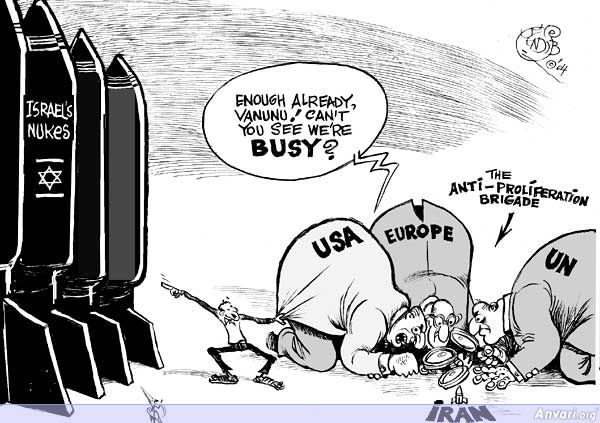
WHAT'S WRONG WITH IRANIAN NUKES?
Iran is not the only country that is going rogue with
a nuclear program. No wonder it feels insecure when
Israel and Pakistan - both US allies -  posses an arsenal.
Isn't Iran entitled to a nuclear arsenal? I'm talking about the legal entitlement here, not about the moral or humanitarian sides of the question. For this I wish to refer to the opinion on the legality of the threat or use of nuclear weapons. This statement by the International Court of Justice was to answer whether a state may use a nuclear attack or threaten to do so. The advice stated that there is no prohibition on the use of nuclear arms as such, but it would be in conflict with humanitarian law. So did the Court really rule that nukes are out of the question? Not exactly as the advice left a loophole: the Court felt that it 'cannot conclude definitely whether the treat or use of nuclear weapons would be lawful or unlawful in an extreme circumstance of self-defence'. So if a the existence of a state were at stake, the use of nuclear arms might be permitted.

In its finality this opinion is inconclusive on the use of nuclear force. In it the Court also recognized that there is no evidence for or against the legal possession of nuclear arms, thus actually allowing the continuous possession of nuclear devices. Iran is however a signatory member of the Non-Proliferation Treaty and thus committed itself to a prohibition on developing its own nuclear arsenal. This is probably the main reason Iran keeps denying that its nuclear program has a military branch; heavily sanctions might follow if Iran openly admitted any violations. It is often remarked that other states - in question Israel, Pakistan and India - have nuclear arms. These are indeed contrary to the principles of non-proliferation. But then again these three nations have not signed the above mentioned treaty. You may well consider them to be 'rogue nations' for this (I do) but fact is that they follow the rules.

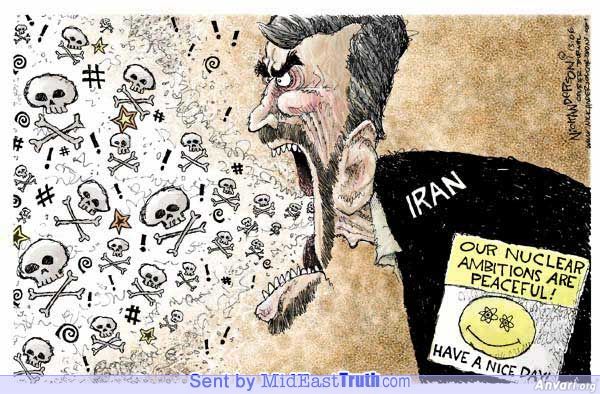
HOW NOT DO DEAL WITH IRAN
Iran remains that its nuclear program doesn't serve military
ends. That statement is likely untrue, though I do believe
that Iran is building nuclear arms for defensive reasons.
Up till today international reaction vis-a-vis the Iranian nuclear aspirations carried a certain degree of machismo. The United States, and even more fiercely Israel, have been talking about unilateral military measures. Such action is not bound to the realm of fiction: Israel acted against key facilities in the nuclear programs of Iraq (1981) and Syria (2007) before. The strategy applied against Iran is supplemented with assaults on nuclear scientists and economic pressure. The latter in the form of an embargo on Iranian oil, currently upheld by the United States and the European Union. It is my opinion that the path pursued is in its entirety a mistake. For starters the aggressive talk and action only endorse the radical voices in Iran, claiming that the West is pressuring the country toward regime change. A second setback is that the embargo will hit the people of Iran hard. If hardship for the masses is our idea of creating justice I pass for it. Not only is using this impoverishment-strategy interference with Iran's internal affairs, it is ethically most questionable too.

My feel is that Iran should not build a nuclear weapon or talk about closing of the Strait of Hormuz, the West needs to understand that aggression invokes aggression. That is the mechanism behind the security dilemma. Maybe Iran can send a message by collaborating with its fellow members at OPEC. Economic and political affirmation of the Middle East as a region in its own right would force us to rethink our strategy. And rethinking is needed. Iran certainly made some bad choices concerning its methods in the past, but its concerns are valid. As a regional power it is entitled to secure and manifest itself as long as it does not violate the rights of others.

januari 21, 2012

American elections, economic crisis and the future world

The upcoming United States presidential election promises to be most interesting. America is at a crossroads: it can continue down a road of careful progress or it can try to secure the system it currently leads. The latter might create some successes in the short run, but the ultimate demise of the current world-system is inevitable. Even more vulnerable is the dominant position of the United States within that system. As I shall continue to argue, American politics would do better by using their achievements to sustain progress in stead of holding it back. Now it would do violence to reality to state that these two policies are parallel to the Democrat-Republican divide. It can however not be denied that, in recent years, the two parties have polarized. This can be seen in the charts on the right. It is also evident from the heavy resistance of some against the approaches of incumbent president Barack Obama.

AN HISTORICAL PERSPECTIVE
This political polarization is a result of the waning position of the United States as hegemon within the world-system. The concept of hegemonic power is complex and much debated. For issues of space I shall refer to the related concept of superpower: the States have a significant more means to steer the direction in which the world goes. For a long time, and certainly since the demise of the Soviet Union, it policed international society on its own. Examples are the creation of the WTO and increased U.S. unilateralism. No-one can stay in power forever though; contenders are always on the rise. The unique American position has been under fire ever since the seventies. In that decade, the stabile Bretton Woods financial system was abolished, Europe acted more independently and the 'Third World' began to manifest itself as a unique set of nations. Also the loss of the Vietnam War caused heavy resentment to future foreign ventures of a military nature.

Between 1970 and 2010 the American GNP doubled
while middle income wages only rose by 20%
The end of the Cold War, and indeed the 'end of history' perceived by some, is an intermezzo of temporary nature. It only shows that the hegemon has overcome the systemic contradictions for the time being. How did the States overcome these? The answer was found in shifting the burden: the world was put on a diet of neoliberal recipes to safeguard the system of its own destruction. Working class people earned a smaller share of their productivity and Third World nations were trapped in a cycle of restructuring and loans. By cutting the prices of input - labor and raw materials - more profit could be generated to relaunch the system.

THE LOGIC BEHIND TODAY'S TAMPERING
In this light today's sputtering of the economic machine is nothing new. Another phase of contest for the system ánd the hegemon are announced. Indeed the cures prescribed are not very original: we nationalized the messy risks of the banks (they can keep the profits though) and the national governments are going to cut spending. Meanwhile environmental policies are under pressure because you don't have money to save the planet when you have to save the banks (depends on your priorities I guess). Another factor is in play here too: more sustainable production equals more costly production, read 'less profitable'.

A cartoon from The Huffington Post expressing the logic.
The benevolent hegemon, as the U.S. was portrayed in the nineties, is not so benevolent anymore. The establishment has launched an offensive: Obama is to concerned about the environment, healthcare is 'socialist', the Chinese need to increase the value of their currency, etc. It all comes down to the same thing: production must get cheaper, cheaper at the expense of equity and sustainability. They want to pass the bill to the people and the planet. The waning superpower is trying to safeguard its capital - the ultimate basis of its superiority - in various ways. Another most curious part of this wicked strategy is the uneven stress on the public debts of eurozone-countries. Washington and also London are kept strategically of the radar while their situations are fairly comparable. As a nice bonus to the euro taking part of the heat, the social achievements in continental Europe are pressured too.

EMANCIPATION FOR THE FUTURE
But there is reason to keep up hope. (About time that phrase showed up :p). Scoffing at Obama and his 'evil socialist scheme' together with the fuss about Occupy Wall Street are emancipating people across the States. If the Democrats continue down a more progressive road they might turn America from a conservative bastion to a leading reformer on the world stage. In Europe the struggle is going on as well, both within the institution of the Union as on the national level. What Europe do we want? What America do we want? These questions are being raised today. And by looking for an answer we are discovering what kind of world, what sort of society we want to be a part of...

NOTE: The graphs on polarization where retrieved from Polarized America? (Kenworthy, 2010). First hand sources are mentioned by the author.

december 19, 2011

Congolese elections and European values

A few days before the Congolese were to choose their new president, I blogged about the candidates. Last week the results of those elections were announced: Joseph Kabila succeeds himself as president of the Congo DR. He is believed to be won with little under half of the votes. However, he is not believed to be so by everyone: Supporters of Étienne Tshisekedi, who came in second, called the elections a fraud. They point toward the 'irregularities' that occurred to support their case. While it is true that not everything about the election process was democracy proper, all by all the result is called credible by the authorized commission.

Belgian police forces restraining Congolese protesters in
Matonge - the Congolese district in Brussels, Belgium.
Kabila was not elected by a majority of the people and in a one-to-one race against Tshisekedi he would surely bite the dust. The incumbent president profited from the divided opposition as I predicted in my previous post. Tshisekedi's followers, and indeed the political leader himself, fail to recognize this. While in the urbanized region of the capital opposition against Kabila is strong, the majority of the nation accepts a second term. Riots in Congo or abroad (we had some trouble with protesters in Matonge, the Congolese neighborhood of Brussels) are ungrounded. I do recognize that the grievances held against the Kabila regime are just, but the election outcome is representative.

What I find a real pity is that Europe didn't send a strong signal when tensions rose. A call to 'sit back and stay calm' can hardly be called a signal, can it? I noticed that the Old Continent is no longer as agile in promoting democratic ideals. Congo is just a single dot in a much broader pattern: values are forced to take a back seat more often than should be good for our conscience. Take for instance a bilateral trade agreement between the EU and Columbia: should we really strike a deal with a regime that doesn't take too kindly to human rights? The same goes for a deal in the making with India; the Indian government refuses to accept any trade agreement that holds a clause on human rights - and the EU is actually considering to drop its standard human rights clause!

It can be expected that this tendency will grow stronger in the future, and this for two reasons: First of all, the playing field for international trade is changing drastically. Countries like India, China and Brazil gain prominence and they are not stupid enough to attach value judgements to their contracts. Also, Russia is joining the WTO soon - this nation isn't exactly a staunch defender of personal freedom either. Holding on to its noble ethics would compromise the competitiveness of the EU. A second cause might be the declining power of the Commission and the Parliament. They have lost some of their grip on foreign policy since the creation of the External Action Service. What the future might hold, I can not say, but for sure fragmented and superficial protest wont bend the forces that shape our world.

december 16, 2011

On sustainable growth

Conclusions at COP-17 in Durban, South Africa were meager. True, the Kyoto Protocol to combat greenhouse emissions is prolonged. And surely commitments have been made to get a binding environmental treaty operational by 2020. Even if this outlook becomes reality, it can be classified under the label of 'too little too late'. Besides, emerging economies like China and India remain averse to far-going and legally binding measures. The other champion of environmental pollution, the United States, would have to ratify any such agreement in Congress. I seriously doubt that with its economic power waning, the States will make ecological commitments.

Bridging leftist ideas on the capitalist economic system with
ecological approaches that take into consideration the well-
being of the planet, provide useful insights for our future.
Up till today politicians have handled a strange logic in dealing with the climate crisis: the economic environment is taken as given, and from thereon we see what green measures we might take. That's bullocks, you can't negotiate with the climate! We must take into consideration the boundaries of our planet's ecosystem - without compromise. And from thát point on we should investigate what economic model is suitable. This radical shift has to take place in our minds and the minds of our political leadership.

We need to put an end to the parasitic way in which our economy relates to the environment. On a global scale, the political level must interfere in the sphere of economics. The pattern of consumption among prosperous citizens needs to shift drastically; away from unnecessary waste and luxury and toward investment in a green revolution. Parallel to the sustainable switch a big push is needed to close the ever-widening gap between rich and poor. The reason for this is twofold:

(1) Poor strata in a world dominated by market forces are confronted with unequal access possibilities. They are cut of from land, food and water even though such vital resources are abundant. Indeed it can be proven that such shortages are caused by unequal access rather than objective scarcity. As a result poor people will resort to clearing forests, burning cheap coal, etc. - this further exploiting the planet.
(2) Rich strata will make brainless consumption choices. They waste money to unneeded stuff simply because to them the marginal gain of a single euro/dollar is low. If the money thrown away had been invested in alleviating poverty, it would have contributed to a socially and environmentally sustainable world.

The essence: welfare should on a global scale be invested in the shift toward an ecologically sustainable society, which includes closing the gap between rich and poor. More growth at expense of the planet (and the poor) is in the long run devastating. Growth shall be sustainable or it shall not be at all.

oktober 30, 2011

Catching Kony: altruism or geopolitics?

Some days ago I learned that president Obama is going to send military reinforcements to Uganda. This is announced in a time when the US military presence in Iraq is almost completely reduced. The goal of the military venture is to make an end to the activities of Joseph Kony and his Lord's Resistance Army (LRA). The LRA is a renegade rebel army that seeks to overthrow the Ugandan government. It is hard to convey an image of the LRA in brief, but I'll try it nonetheless: it combines a mix(ed)-up ideology rooted in Christianity, traditional African mysticism and Acholi nationalism. The LRA recruits children in its ranks by raiding villages, accompanied by the many cruelties commonly associate with child soldiers (think rape, murder and drugs).

Entire Mid-Eastern Africa is politically troubled:
(1) Somalia as a 'failed state' and the many refugees in Kenya
(2) South Sudan, only just independent, is extremely poor
(3) The Great Lakes with the LRA and refugee camps in Goma
(4) The unstable Central African Republic with lots of violence
Would it be wise to add more military to the equation?
You can imagine how relieved I was to learn that the United States would 'finally' do something worthwhile with its military capacity. An emotional reaction and, as it turned out, a biased one. Without any doubt a monster like Kony has to be stopped. But several aspects have been left out of the picture when Uncle Sam presented its great humanitarian deed to the world. First of all, LRA activities in the region have been on a low pitch since 2007. The rebellion against the government is not what it once was and this might open the way for non-military conflict resolution. It is however the corrupted Ugandan regime that seems to put on its brake when being asked for more democracy, pluralism and liberties.

A second noteworthy fact is that the United States are already involved in hunting down Kony and other LRA leaders. So far their tactics didn't prove very successful. It is very doubtful that stronger military pressure would be a road to result. Some would even dare to say that it might undermine regional stability even further, actually endangering the common people more than was the case since 2007. But American-Ugandan ties have strengthened during the War on Terror in Somalia. Another major strategic importance of good ties with the Ugandan authorities are the oil reserves in the nearby region. Especially now that South Sudan, with considerable reserves, became independent.

What first seemed an altruist deed to protect people now looks a lot grimmer. And it is easy to buy the 'peacekeeper' story, even when being sold by a country that has a pretty nasty record of military interventions. The reason that we are tempted to do so is that we are under-informed on the Ugandan situation, and African politics in general. The lesson I learned: stay informed or stay sceptic.

oktober 20, 2011

Security issue or security dilemma?

Recently, the United States claimed they had prevented an Iranian terrorist attack. The supposed violence-in-the-making would have been directed against the Israeli and Saudi-Arabian embassies in Washington. A faction of the Iranian Revolutionary Guards - the country's politically influential elite army - would have been behind the plotting. The Iranian government denies all accusations, which they percieve as a framing operation set up by the United States itself. I will stay clear of declaring any truth. In stead, this article will offer a framework to analyse the tensed US-Iran relation, based on the classic notion of the safety dilemma.

A safety dilemma occurs when one state raises its military capacity and, by doing so, becomes a treath to a second state. This other state will have to decide whether to respond proportionally or to remain idle. When responding with armement, the first state may interpret this as a hostile signal undoing its initial effort; an arms race is started. Persuing the second option however means that a (percieved) risk is left unattended. This phenomenon, which involves a great deal of subjectivity, proves to be most usefull in explaining US-Iranian frictions.

Uncle Sam and president Ahmadinejad in a 'staring contest'
Let's start with the States. The US has a Cold War-era ally in the Middle East which isn't too loved by the Arab nations. This ally Israel is believed to possess nuclear arms, though it never formally confirmed or denied this. In adittion, the States supported Irak in its war against Iran back in the eighties. American support was given to Saddam Hussein (yes, the very same) because the Iranian regime wasn't too favorable for the West. This war, which continued from 1980 to 1988, is a bit forgotten by most of us but the terrible attrocities inflicted upon the Iranian people are well-remembered over there. It  is a scar that never fully healed and here is where trouble kicks in. Iran is still traumatized by its history. It still thinks that the main objective of the West concerning Iran is to install a friendly regime it can influence. Just like the one of the Shah before the Islamic Revolution. With a nuclear treath in Israel and ongoing military presence in Iraq and Afghanistan, Iran feels enclosed. The only way it sees out of this 'brutal imperialism' is a nuclear weapon of its own. Iran's nuclear program, together with its violent language when condamning Israel or the US, are only the stepping stone to the next degree of the security dilemma. Now the Iranian bomb in turn is seen as a treat to regional stability by the Americans.

The perception of both states is in this all more important than the facts. Does the US seek to overthrow the Ayatollahs? Is Iran being agressive in its nuclear program? Was a terrorist attack prevented or is it a framing operations after all? These questions might be interesting, but they do not reach the heart of the conflict. What really matters is that the US and Iran are engaged in a logic of confrontation; there is a lack of mutual trust. We aren't looking at a security issue, but rather at a security dilemma.

oktober 10, 2011

How aid really functions

Ever since the Second World War, several aid programs for the Third World have been called into existence. Most of these initiatives can hardly be called a success. This failure of development aid is partially due to the creative exploits made by the industrialized North. Indeed a lot of misuses exist and today's objective is to expose them.

DEFINING AID
Most important is to give a proper definition of what development aid is. The accepted standard is the 'Official Development Assistance' (ODA) as put forth by the OECD countries. A lot of spending included in ODA is highly controversial. For instance, up till 1990 it was allowed to book military aid as development assistance. Just think of all the 'developing' the United States have done in the Vietnam War... Less striking examples of such misfits include the administrative costs a country makes to deliver aid and the costs attached to the first year of shelter for refugees and asylum seekers. All these positive reductions contribute to a higher number of delivered aid while the benefits for development remain a mystery.

Military assistance is NOT development aid (or is it?)
Another curiosity is the inclusion of humanitarian aid; the kind of emergency aid raised to combat the results of a natural disaster or a food crisis. This is not development aid in a strict sense, yet it was good for almost one tenth of all ODA donated in 2008. My personal favorite amongst the ODA misfits is however debt remission. In 2008, debt remissions made up a staggering 28% of all ODA. While it is true that debt remission lightens the burden that lays on a country it remains an exploit due to the way it is used. The instrument of debt remission is addressed only to avoid default and to keep countries borrowing.

A NOBLE GESTURE
So far for cheating trough accountancy. Up to another sore now: the motives for aid. Why is it that developed countries allocate part of their wealth to the not-so-wealthy? It will not surprise you that 'contributing to a better world' is not the main incentive. A most effective way to make motives for aid visible is to take a look at who is receiving it. If development really was the goal one could expect ODA to flow mainly to the Least Developed Countries (LDC's). Yet a lot of financial means are dedicated to middle-income countries. Between the lines you may read that donor countries subsidize the local purchasing power to the benefit of their own export.

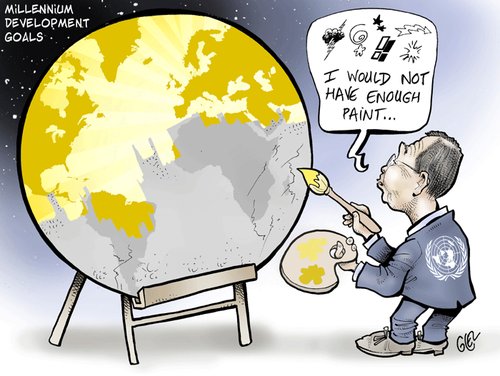
Is world-wide development even possible?
A more explicit manifestation of economic motives is the so-called 'tied aid'. This is to be understood as ODA given under the condition that the money is spent on purchases in the donor country. Old-fashioned and vulgar subsidizing. It is sound to assume that this type of aid will be applied least in the LDC's as their purchasing power is lowest. Figures show that in 2005 almost half of the ODA destined for LDC's was tied aid.

Next to economic motives, geopolitics are an important factor too. At the end of the Cold War, in 1991, Egypt and Israel had a joint share of 41% in the development assistance provided by the United States. Inescapable in this light is the war on terror which provided a new boost for geopolitically motived aid. In the period 1999-2003, means donated by OECD countries to Pakistan increased tenfold. In 2009 Afghanistan and Iraq were the biggest receivers of US paychecks.

CONCLUSION
The facts and figures displayed in this post show a grim image of development aid. Numerous multilateral efforts have been made to correct the highlighted mistakes, but to no avail. My prediction is that until 2015 - the end date for the fulfillment of the Millennium Development Goals - governments will continue as they are. In little over three years time they will come to the conclusion that it didn't work out quite as they planned. But we ought to be confident that civil organizations will remind them; that they will point out their mistakes. And just maybe 2015 can be the start of a new practice of actual development.