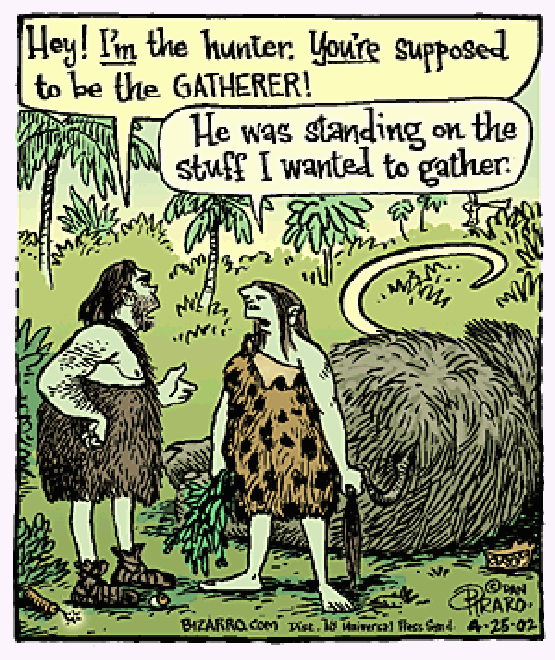
In the previous post I addressed the issue of traditional gender roles. Inspired by a publication of the Belgian Institute for the Equality of Woman and Man, I argued that gender roles are constraining to the personal freedom. Here I want to illustrate this point more thoroughly: Gender roles are a mostly social phenomenon, while it is often portrayed as a natural order. This makes that any deviant behavior is considered abnormal, even when superficially tolerated. There always exists implicit psychological pressure to adjust to the norm, regardless of whether explicit social pressure accompanies it. The psychological bias is deeply ingrained within our minds, as I will show. I can however not do this without first mentioning the illicit nature of this pressure and thus of the constraints. We are not sufficiently aware of how indoctrinated we truly are. And, as stated in the previous post, it is in this subtlety that lies the real danger.
On to the proof now, as big declarations about brainwashing make me sound more like a lunatic than I am comfortable with. A key notion in need of understanding is that the human brain is the ultimate instrument of deceit: we succeed to fool ourselves with the most powerful illusions time and time again. People can say that they oppose traditional gender roles, even believe that they do, while subconsciously they have a positive attitude toward them. As long is this conflict does not surface the person in question doesn't notice. A quick example: people can speak noble of tolerance toward homosexuality until their son 'needs to say something'. Same so with multiculturalism and the daughter introducing her new boyfriend Ali.
That people are not aware of implicit attitudes is widely accepted in social psychology. An instrument has been designed to measure such attitudes, the implicit association test (IAT). The test was created by Harvard psychologists in 1998 and caused a real revolt in methodology. I suggest not to find out how it works untill you have taken one yourself. It is a solid instrument though and some stunning results have been discovered using it:


The above image illustrates the preference of whites over blacks (left) and the attitude toward traditional gender roles (right). Both measured once by self-observation trough a list of questions (explicit) and once using IAT (implicit). Apparently women are not as emancipated as they themselves claim to be. Sure they are free, they have made their own choices, etc. Subconsciously they are still compelled to follow the gender roles though. Socialization at its best here. I included the example of blacks and whites in the United States because it shows that even blacks have a more positive attitude toward whites than toward their in-group. Seemingly the black community is based on a contrast with whites, a socially produced (!) contrast that places blacks at the bottom end of the comparison. A contrasts blacks too agree upon, albeit without being aware of it.
IAT research strengthens my view that there is a merit in stressing the harm done by the less visible or even invisible dynamics. We must acknowledge that the continuous portrayal of socially produced inequality as natural blocks the way to true emancipation. We must expose the triggers of mental oppression and fight them openly. To end this post I wish to thank J.J. Ekins for his comments on the previous post. They were a genuine stimulus for me to build upon. To all other readers: feel free to engage, to formulate your own thoughts, etc. A little polemic makes my blog more than an exercise in writing.
IAT research strengthens my view that there is a merit in stressing the harm done by the less visible or even invisible dynamics. We must acknowledge that the continuous portrayal of socially produced inequality as natural blocks the way to true emancipation. We must expose the triggers of mental oppression and fight them openly. To end this post I wish to thank J.J. Ekins for his comments on the previous post. They were a genuine stimulus for me to build upon. To all other readers: feel free to engage, to formulate your own thoughts, etc. A little polemic makes my blog more than an exercise in writing.