Posts tonen met het label Third World. Alle posts tonen

september 20, 2012

Press Freedom on the African Continent

A free press is considered crucial in building a strong democracy. If journalists are not allowed to collect and present opinions freely, how can true discussion ever come about? A critical press driven by debate is a cornerstone of emancipation. While in most African countries there is a broad selection of papers and radio stations to choose from, governments pressure journalists and press owners to shape the content. Working independently as a journalist can get you arrested, tortured and even killed. Underneath is a map of the Africa Liberal Network, a major advocate for liberal freedoms on the continent; it shows the situation as of 2012. On their website you can find an interactive copy showing rank and score of each country.


Amnesty International, the world's biggest advocate of human rights, listed the major crackdowns on African journalism in Amnesty In Actie ('Amnesty In Action') - the magazine for their Belgian members. A short but shocking selection:

Gambia : Ebrima Manneh, journalist for the Daily Observer, was arrested in 2006. He has been missing ever since. Court ruled recently that he was to be released and his family to be compensated. This ruling has been ignored by the authorities. That various papers had their websites hacked or have been closed down doesn't give much hope either.

Somalia : In 2011, three prominent figures of independent press have been assassinated. Among them was Abukar Hasan Mohamud Kadaf, former director of the independent radio station Somaliweyn. Since 2006 already 27 reporters have been killed. So far, none of these murders came before court.

Malawi : A new law gives the Minister of Information (oh yes, definitely need one of those) the power to forbid a publication if it should be 'in conflict with the common good'. Of course this law is used mainly to silence critical voices.

The list is in fact pretty long. I will leave it at these ones. If you want to partake in one of Amnesty's fine writing or mailing actions, visit their website. Now while as a whole Africa does terrible, the worst place for a journalist is not situated in Africa. The deadliest country is in fact Pakistan (SOURCE). Followed by Mexico, the Philippines, Brazil and Russia.

februari 15, 2012

Capitalism and the global environment

As I explained at the beginning of my previous post I am spending all my free time on doing research for my paper. It came to me that if I wrote something on that, I would be able to maintain focus and keep you readers well-supplied for the next couple of days. What follows is a slimmed down summary of what I've been reading the past few months. It accounts of the exploitation of the South, its environment and the evil ways of capitalism. Enjoy!

In the West we still are under the impression that we ought to learn people in the South how to live in a sustainable way. This is evident from our leader's attitudes at international conferences and the various 'plant a three in the South'-like campaigns that are put forth as a solution to ecological crisis. As if environmental degradation in the South is the result of ignorance rather than poverty. As if we are setting a good example...

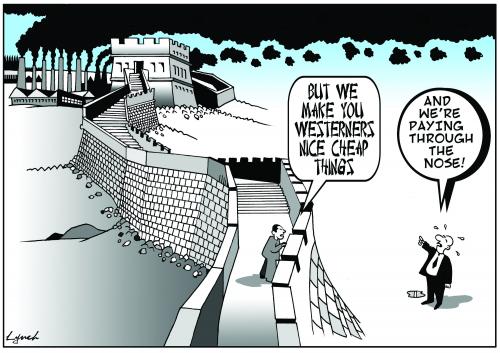
This is exactly the attitude that needs tackling: the whole idea that the North has the most progressive environmental policies is misleading. Sure, such statement holds when we are talking about quality standards of rivers and the like. But what about international trade? "Now what has trade got to do with it", you ask? Economic policy is not isolated from environmental concerns, just like the world economy is not isolated from the global ecosystem. The North consumes a majority of the natural resources that are extracted from this planet, yet most degradation that accompanies this extraction is experienced in the South. Rich countries use their purchasing power to shift the burden to the South. We cut down African rain forests in stead of American temperate woods. Now isn't it strange that third world countries suffer from deforestation while we don't see that many IKEA-closets in Kinshasa?

We can maintain both our welfare and natural richness by externalizing the environmental costs associated with production processes. We are still exploiting the South when enjoying our Starbucks coffee or blogging from our HP laptop. Not that we should be surprised at such a conclusion. Exploitation is the very mechanism that makes money go round. From its very start, the capitalist mode of production was grounded in keeping certain costs external to the one who was producing for the market. The market value in other words should not reflect the full cost of production upon society. An example: Starbucks doesn't make you pay for the biodiversity that got lost while clearing tropical forest for a coffee plantation.

"But doesn't the market tend to evolve toward some kind of balance, a correct price?" If only economists would use a little more of their time researching why the optimum is so hard to achieve, you wouldn't need to ask that question. (Economists tend to chatter along about an optimum hardly ever achieved...). If prices where to reflect the real social and environmental costs inflicted, there wouldn't be any surplus gain. The notion that under perfect competition no surplus profits are made is central to economic theory. Yet a lot of free market champions don't seem to understand that you can't get anything for free.
This is why a fair and sustainable society can never be achieved under capitalism. In a system based on the exploitation of both labor and nature, wealth can only be generated for a few at the expense of the many. If we would force our firms to internalize the full cost, the system would start to sputter. Our mode of production is one of production for sale; market value prevails over use value. Change needs to occur at the most fundamental level. Capitalism, with its insatiable hunger for more, functions as a treadmill of destruction. It must be stopped before it collapses under the gravity of its own consequences.

januari 28, 2012

Underdog contributions to humanitarian aid

One of the courses I really enjoyed last semester is International Development Aid. 'How on Earth can you make a course out of that' you may ask? Well, admittedly it diverges from the more common formulas. In our IDA-lessons we were stormed at with figure and fact; a veritable crossfire of statistics. The goal is not to cultivate a fetish for numbers, but to visualize some underlying trends in development aid. Various mechanisms in financing and applying aid can remain hidden by manipulating the way in which various concepts are defined.

The design of our lessons was quite successful. Even to such an extent that I wish to try the formula in this post. We will be fighting the idea that humanitarian aid is a matter of the North paying to the South. Following is an armory of dates, amounts, and percentages that are to drive the enemy claim toward surrender. Enjoy!
  • In 2009, the efforts of the BRICS countries - Brazil, Russia, India, China and South Africa - totaled to an amount of 3,7 billion US dollar. That same year the joint humanitarian aid expenses of Saudi Arabia, the United Arab Emirates and Kuwait was 4,2 billion. It should be added that these are conservative estimates as certain aid flows are under-measured.
  • In 2010, the top two contributors to the Emergency Relief Fund for the Haiti earthquake were Saudi Arabia and Brazil. They respectively donated 50 and 8 million US dollar. Amongst the top ten contributers were a lot of African nations too: Nigeria gave 2,5 million while Equatorial Guinea made an effort of 2 million. Gabon, Tunisia and the Congo DR each added 1 million US dollar.
Ever heard that 'we can not help all of them'? Believe me, we aren't. Most refugees are located in the Third World!
  • Really unexpected humanitarian aid numbers for the year 2008 are: Thailand (27,4 million), Kazakhstan (9,7 million) and Iraq (8 million). A similar exercise for 2010 brings about Turkey (60,9 million), again Thailand (11,7 million) and Mexico (10,7 million).
  • Bangladesh received 70% of its 2007 humanitarian aid from non-traditional donors. In 2008 Pakistan can say the same for 85% of the aid and the Maldives even got as much as 90% of their humanitarian aid of 2009 from non-Western countries.
All numbers were lifted from reports by the independent research institute Global Humanitarian Assistance. Hopefully this post was useful to you in some way. As with a lot of figures these numbers are only a first step towards a more thorough understanding. If you are interested in North-South development cooperation, check out my earlier post on how aid really functions.

december 04, 2011

A dragon and its cave: China's environmental policy

Before I start, an important notice to my more regular readers: you might notice a drop in activity the next two months or so. This due to the holidays, examination period and preparation for my paper. The past two weeks I have been writing some scraps that can be turned into articles with ease. Just to make sure that, even without much time, I never run out of interesting material to post.

Now, after monetary and economic policy, this final post in the 'dragon nation' series will focus on China's environmental policies. China is often portrayed as a big polluter who doesn't want to see its economic growth constrained. The People's Republic is indeed the biggest carbon emitter in absolute numbers. When emissions are however expressed in terms relative to say population or wealth, the West still does a lot worse. Additionally, the United States and Western Europe pollute a lot more than their own ecology can cope with. Thus an 'ecological debt' is created to countries who's environment is polluted by the excess of the West.
The per capita carbon emissions from various countries. Just compare India and China (left) to Belgium or the States.
The ecological debt surely puts things in perspective; industrialized and industrializing countries suffer the same ailments. The question now is whether China undertakes efforts to mitigate its impact. In its most recent five-year plan, the Chinese Communist Party emphasized energy efficiency and laid out a strategy for cleaning the air. A lot of uncertainty remains, but the Chinese government is working on market-based mechanisms to combat climate change. An emissions-trading system and green taxes are among the favored techniques. The national strategy in the making draws upon regional experiments with carbon-trading and petroleum taxes.

China profits from betting on sustainability. It already is
the leading producer of solar panels and CF light bulbs.
Now why does China seek to implement this shift? One thing most debaters agree upon is that economic motives are driving the process. China is the leading manufacturer of compact-fluorescent light bulbs and solar panels already. Its industries profit from energy-efficiency goals. Yet the so-called green technologies might cause ecological stress in their production and disposal processes, a factor too often ignored. Another motive for China is that it needs to crick up its credibility if it wants to keep enjoying cash inflows from the Clean Development Mechanism. This tool, created under the Kyoto Protocol, allows industrialized countries to invest in carbon-reducing initiatives abroad. The emission reduction then goes on account of the investor. China received a lot of such funding in the past but its biggest investor, the European Union, wants to revise its policy before 2013.

As always, the picture looks more complex upon careful examination. China isn't the environmental boogieman we often blame it too be. Though its efforts are economically motived, I for one expect China to do a lot in the future.

november 26, 2011

A dragon and its younglings: State-owned enterprises

Today I finally present the second article in my 'dragon nation' series. As explained in the previous installment, the aim is to tackle some misconceptions surrounding the oft-mystified Chinese policy. This time I investigated the claim that reforms in China have made it a capitalist economy. Hereto I focused on the state-owned enterprises and their role in the Chinese economy. Well-aware that a complete image requires much more, I would still like to draw some conclusions.

Under impulse of Deng Xiaoping, China moved beyond Maoist recipes and reformed its way out of Third World status. I will not discuss the Chinese economic reform into detail. Much more interesting is to see how much 'Chinese characteristics' there really are in Deng's socialist market economy. After all, once reform was initiated, liberal theorists expect(ed) the People's Republic to move ever-closer to the western model of capitalism. The attachment to ideological references they dismissed as futile shadow-discourse; a canalization of Chinese nationalism at most. How solid is this view?

The Chinese government protects the state-owned enterprises. Favored
companies are effectively shielded from competition by perverse policy.
In 2001, China joined the World Trade Organization (WTO). In this the Chinese establishment subjected itself to the liberalization of its international trade relationships. While this surely is a big move, the power of state-owned enterprises within China's domestic market is still overwhelming. Indeed, ten years after the country's admission to the WTO, state-owned enterprises are stronger than ever. The Chinese government ensures a dominant position for its partners; favored companies abide and in return their share in the market is protected. The authorities realize this by applying rules with a double standard and by obstructing the take-over of domestic companies by foreign ones.

For a detailed analysis of how the state shamelessly obstructs market forces I can recommend this article from The Economist. Now our focus shifts again to the WTO: while domestic suppliers have a guaranteed playing field, they have it easier to export their services/products. The WTO strives toward free trade between its member states and, while it is true a foreign company can access the Chinese market, it is shielded from actual demand. Meanwhile Chinese firms, enjoying subsidized/enforced demand at home, can well-compete for the demand in Europe and the United States. China is thus far from a capitalist country. Much more it resembles a covert form of state-capitalism or even modern mercantilism. Regardless of the label, the state and indeed politics are a most determining factor in China's enterprise environment.

november 14, 2011

A dragon and its treasure: The Chinese yuan

The title of this post refers to the Chinese People's Republic as a dragon. Chinese economic policy is almost as mythical as the creature often used to portray the nation. Incredible growth, enormous exports, vast amounts of financial reserves and yet lead by a party that calls itself 'communist'. In a series of three posts I would like to examine some of the myths that surround Chinese economic policy. First up is the supposedly undervalued currency and its perverse effects on global trade.

The Chinese leadership is often accused of keeping the yuan, the currency of the China, artificially low. An undervalued currency holds a significant advantage: it suppresses domestic prices of raw materials and labor. In essence you make domestic production artificially cheap, compared to foreign production. This causes  Chinese rubbish to be priced too low and thus to sell better than American, Japanese or European rubbish. The Chinese government rejoices when it checks its export numbers. Other industrialized countries are less happy for they see their trade balance - the worth of export minus import - become less balanced.

The trade balance of countries around the world, based on IMF statistics for 1980-2008. Notice the high deficit for the United States, which is largely benefited Japan in the eighties and China since WTO-admission in 2001.
The question that keeps us busy is twofold: is China keeping its coin artificially cheap and, if so, then how do we deal with it? The grievances of China's trading partners are without a doubt legitimate. It needs however to be said that, ever since 2007, the Chinese government has taken measures to adjust its underpriced coin. Indeed since June 2011 the yuan has appreciated over 7% against the dollar. And considering the spread between China's inflation rate and the much lower one of its trading partners, relative costs in China have risen even more. All this show us that the yuan is not as much undervalued as it used to be.

Myth 1: "The Chinese yuan is kept artificially low
and thus the Chinese policy distorts global trade"
Yet China-bashing is more popular than ever, especially in the United States. On October 11, the US Senate approved a bill that allows its government to take measures against what it deems undervalued currencies. This strategy might be politically successful as it might get one votes from people who lost their manufacturing jobs allegedly due to cheap Chinese imports. Yet from an economic point of view the results would be devastating. A trade war between two economic behemoths, who are also each other's principal foreign debtor/creditor, will disrupt today's fragile economy even further. To ward cheap Chinese products from your market would by the way mostly harm the consumer. And China only needs to challenge such a policy before the WTO to enforce free trade. After all the international economic regime regards undervalued currencies to be a prerogative of the IMF.

Then should we stay inert and leave the matter be? There is something to say for abstaining from action. Though the yuan is far from flee-floating, it is steadily gaining in value. A more 'flexible' yuan offer chances for China to hasten the reorientation of its economy from exports to domestic consumption. This is something the Chinese authorities recognize and seek to achieve, even more so when a global recession might be just around the corner.

oktober 30, 2011

Catching Kony: altruism or geopolitics?

Some days ago I learned that president Obama is going to send military reinforcements to Uganda. This is announced in a time when the US military presence in Iraq is almost completely reduced. The goal of the military venture is to make an end to the activities of Joseph Kony and his Lord's Resistance Army (LRA). The LRA is a renegade rebel army that seeks to overthrow the Ugandan government. It is hard to convey an image of the LRA in brief, but I'll try it nonetheless: it combines a mix(ed)-up ideology rooted in Christianity, traditional African mysticism and Acholi nationalism. The LRA recruits children in its ranks by raiding villages, accompanied by the many cruelties commonly associate with child soldiers (think rape, murder and drugs).

Entire Mid-Eastern Africa is politically troubled:
(1) Somalia as a 'failed state' and the many refugees in Kenya
(2) South Sudan, only just independent, is extremely poor
(3) The Great Lakes with the LRA and refugee camps in Goma
(4) The unstable Central African Republic with lots of violence
Would it be wise to add more military to the equation?
You can imagine how relieved I was to learn that the United States would 'finally' do something worthwhile with its military capacity. An emotional reaction and, as it turned out, a biased one. Without any doubt a monster like Kony has to be stopped. But several aspects have been left out of the picture when Uncle Sam presented its great humanitarian deed to the world. First of all, LRA activities in the region have been on a low pitch since 2007. The rebellion against the government is not what it once was and this might open the way for non-military conflict resolution. It is however the corrupted Ugandan regime that seems to put on its brake when being asked for more democracy, pluralism and liberties.

A second noteworthy fact is that the United States are already involved in hunting down Kony and other LRA leaders. So far their tactics didn't prove very successful. It is very doubtful that stronger military pressure would be a road to result. Some would even dare to say that it might undermine regional stability even further, actually endangering the common people more than was the case since 2007. But American-Ugandan ties have strengthened during the War on Terror in Somalia. Another major strategic importance of good ties with the Ugandan authorities are the oil reserves in the nearby region. Especially now that South Sudan, with considerable reserves, became independent.

What first seemed an altruist deed to protect people now looks a lot grimmer. And it is easy to buy the 'peacekeeper' story, even when being sold by a country that has a pretty nasty record of military interventions. The reason that we are tempted to do so is that we are under-informed on the Ugandan situation, and African politics in general. The lesson I learned: stay informed or stay sceptic.

oktober 15, 2011

Thesis: Wallerstein 2.0

I only just proposed my thesis subject to my promotor. Hopefully, it gets approved because it is what I really want to do. My thesis subject can be situated at the crossroad of all my major interests: economic systems, development in the global South and ecology. What I hope to be preoccupied with for the two years to come is the ecologically unequal exchange. 'Unequal exchange' is a marxist idea signifying a trade in which the price of the traded good does not reflect the actual costs and benefits for both parties. Of course it's a very contested concept.

The Third World Studies Center of Ghent University
Probably the best known application of the concept is its usage in Immanuel Wallerstein's World-systems Analysis. In this theory, Wallerstein argues that a set of core nations (the industrialized North) develops by exploiting the periphery (the global South) trough unequal trade relations. Such ideas were very popular in the 70's but with the rise of neoliberalism it got more and more contested. My thesis will focus on a chance of revival for World-systems Analysis; a chance embodied by the ecologically unequal exchange or EUE.

An EUE is just like the marxist concept, only it focuses specifically on the negative effects of an economic activity on the environment. EUE-theorists claim that often such ecological costs are not included in the pricing mechanism. The result is a product with an artificially low price, the excess value being transfered to the buyer. Can you see where this is going? Indeed, the industrialized North buys not-so-eco-fiendly goods produced in the global South thus extracting the excess value. My goal is to find out whether this effect plays in the real world, outside the field of theory, and in what way it contributes to problematic development in the South.

You all burn a candle for that the promotor may set the light to green and this exciting matter comes my way!

oktober 10, 2011

How aid really functions

Ever since the Second World War, several aid programs for the Third World have been called into existence. Most of these initiatives can hardly be called a success. This failure of development aid is partially due to the creative exploits made by the industrialized North. Indeed a lot of misuses exist and today's objective is to expose them.

DEFINING AID
Most important is to give a proper definition of what development aid is. The accepted standard is the 'Official Development Assistance' (ODA) as put forth by the OECD countries. A lot of spending included in ODA is highly controversial. For instance, up till 1990 it was allowed to book military aid as development assistance. Just think of all the 'developing' the United States have done in the Vietnam War... Less striking examples of such misfits include the administrative costs a country makes to deliver aid and the costs attached to the first year of shelter for refugees and asylum seekers. All these positive reductions contribute to a higher number of delivered aid while the benefits for development remain a mystery.

Military assistance is NOT development aid (or is it?)
Another curiosity is the inclusion of humanitarian aid; the kind of emergency aid raised to combat the results of a natural disaster or a food crisis. This is not development aid in a strict sense, yet it was good for almost one tenth of all ODA donated in 2008. My personal favorite amongst the ODA misfits is however debt remission. In 2008, debt remissions made up a staggering 28% of all ODA. While it is true that debt remission lightens the burden that lays on a country it remains an exploit due to the way it is used. The instrument of debt remission is addressed only to avoid default and to keep countries borrowing.

A NOBLE GESTURE
So far for cheating trough accountancy. Up to another sore now: the motives for aid. Why is it that developed countries allocate part of their wealth to the not-so-wealthy? It will not surprise you that 'contributing to a better world' is not the main incentive. A most effective way to make motives for aid visible is to take a look at who is receiving it. If development really was the goal one could expect ODA to flow mainly to the Least Developed Countries (LDC's). Yet a lot of financial means are dedicated to middle-income countries. Between the lines you may read that donor countries subsidize the local purchasing power to the benefit of their own export.

Is world-wide development even possible?
A more explicit manifestation of economic motives is the so-called 'tied aid'. This is to be understood as ODA given under the condition that the money is spent on purchases in the donor country. Old-fashioned and vulgar subsidizing. It is sound to assume that this type of aid will be applied least in the LDC's as their purchasing power is lowest. Figures show that in 2005 almost half of the ODA destined for LDC's was tied aid.

Next to economic motives, geopolitics are an important factor too. At the end of the Cold War, in 1991, Egypt and Israel had a joint share of 41% in the development assistance provided by the United States. Inescapable in this light is the war on terror which provided a new boost for geopolitically motived aid. In the period 1999-2003, means donated by OECD countries to Pakistan increased tenfold. In 2009 Afghanistan and Iraq were the biggest receivers of US paychecks.

CONCLUSION
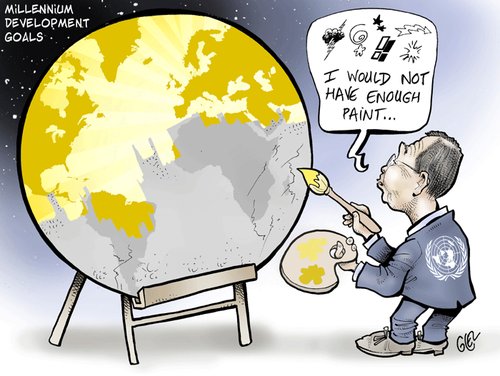
The facts and figures displayed in this post show a grim image of development aid. Numerous multilateral efforts have been made to correct the highlighted mistakes, but to no avail. My prediction is that until 2015 - the end date for the fulfillment of the Millennium Development Goals - governments will continue as they are. In little over three years time they will come to the conclusion that it didn't work out quite as they planned. But we ought to be confident that civil organizations will remind them; that they will point out their mistakes. And just maybe 2015 can be the start of a new practice of actual development.