Posts tonen met het label Development Aid. Alle posts tonen

januari 28, 2012

Underdog contributions to humanitarian aid

One of the courses I really enjoyed last semester is International Development Aid. 'How on Earth can you make a course out of that' you may ask? Well, admittedly it diverges from the more common formulas. In our IDA-lessons we were stormed at with figure and fact; a veritable crossfire of statistics. The goal is not to cultivate a fetish for numbers, but to visualize some underlying trends in development aid. Various mechanisms in financing and applying aid can remain hidden by manipulating the way in which various concepts are defined.

The design of our lessons was quite successful. Even to such an extent that I wish to try the formula in this post. We will be fighting the idea that humanitarian aid is a matter of the North paying to the South. Following is an armory of dates, amounts, and percentages that are to drive the enemy claim toward surrender. Enjoy!
  • In 2009, the efforts of the BRICS countries - Brazil, Russia, India, China and South Africa - totaled to an amount of 3,7 billion US dollar. That same year the joint humanitarian aid expenses of Saudi Arabia, the United Arab Emirates and Kuwait was 4,2 billion. It should be added that these are conservative estimates as certain aid flows are under-measured.
  • In 2010, the top two contributors to the Emergency Relief Fund for the Haiti earthquake were Saudi Arabia and Brazil. They respectively donated 50 and 8 million US dollar. Amongst the top ten contributers were a lot of African nations too: Nigeria gave 2,5 million while Equatorial Guinea made an effort of 2 million. Gabon, Tunisia and the Congo DR each added 1 million US dollar.
Ever heard that 'we can not help all of them'? Believe me, we aren't. Most refugees are located in the Third World!
  • Really unexpected humanitarian aid numbers for the year 2008 are: Thailand (27,4 million), Kazakhstan (9,7 million) and Iraq (8 million). A similar exercise for 2010 brings about Turkey (60,9 million), again Thailand (11,7 million) and Mexico (10,7 million).
  • Bangladesh received 70% of its 2007 humanitarian aid from non-traditional donors. In 2008 Pakistan can say the same for 85% of the aid and the Maldives even got as much as 90% of their humanitarian aid of 2009 from non-Western countries.
All numbers were lifted from reports by the independent research institute Global Humanitarian Assistance. Hopefully this post was useful to you in some way. As with a lot of figures these numbers are only a first step towards a more thorough understanding. If you are interested in North-South development cooperation, check out my earlier post on how aid really functions.

november 20, 2011

Silly intermezzo (cartoon)

So much that needs to be done and so little time to do it in. It is a real pity I can't write a real post for now, but to give you something I have this fun comic starring Jesus. The clever cartoon is about how sometimes well-intended help can actually worsen the conditions of those who are supposed to benefit. I lifted the cartoon from this website, I do not own the rights to it. So please don't try to make a profit or whatever without permission from the author/artist. I totally suck at intellectual property rights, but you got the point. Enjoy!

oktober 10, 2011

How aid really functions

Ever since the Second World War, several aid programs for the Third World have been called into existence. Most of these initiatives can hardly be called a success. This failure of development aid is partially due to the creative exploits made by the industrialized North. Indeed a lot of misuses exist and today's objective is to expose them.

DEFINING AID
Most important is to give a proper definition of what development aid is. The accepted standard is the 'Official Development Assistance' (ODA) as put forth by the OECD countries. A lot of spending included in ODA is highly controversial. For instance, up till 1990 it was allowed to book military aid as development assistance. Just think of all the 'developing' the United States have done in the Vietnam War... Less striking examples of such misfits include the administrative costs a country makes to deliver aid and the costs attached to the first year of shelter for refugees and asylum seekers. All these positive reductions contribute to a higher number of delivered aid while the benefits for development remain a mystery.

Military assistance is NOT development aid (or is it?)
Another curiosity is the inclusion of humanitarian aid; the kind of emergency aid raised to combat the results of a natural disaster or a food crisis. This is not development aid in a strict sense, yet it was good for almost one tenth of all ODA donated in 2008. My personal favorite amongst the ODA misfits is however debt remission. In 2008, debt remissions made up a staggering 28% of all ODA. While it is true that debt remission lightens the burden that lays on a country it remains an exploit due to the way it is used. The instrument of debt remission is addressed only to avoid default and to keep countries borrowing.

A NOBLE GESTURE
So far for cheating trough accountancy. Up to another sore now: the motives for aid. Why is it that developed countries allocate part of their wealth to the not-so-wealthy? It will not surprise you that 'contributing to a better world' is not the main incentive. A most effective way to make motives for aid visible is to take a look at who is receiving it. If development really was the goal one could expect ODA to flow mainly to the Least Developed Countries (LDC's). Yet a lot of financial means are dedicated to middle-income countries. Between the lines you may read that donor countries subsidize the local purchasing power to the benefit of their own export.

Is world-wide development even possible?
A more explicit manifestation of economic motives is the so-called 'tied aid'. This is to be understood as ODA given under the condition that the money is spent on purchases in the donor country. Old-fashioned and vulgar subsidizing. It is sound to assume that this type of aid will be applied least in the LDC's as their purchasing power is lowest. Figures show that in 2005 almost half of the ODA destined for LDC's was tied aid.

Next to economic motives, geopolitics are an important factor too. At the end of the Cold War, in 1991, Egypt and Israel had a joint share of 41% in the development assistance provided by the United States. Inescapable in this light is the war on terror which provided a new boost for geopolitically motived aid. In the period 1999-2003, means donated by OECD countries to Pakistan increased tenfold. In 2009 Afghanistan and Iraq were the biggest receivers of US paychecks.

CONCLUSION
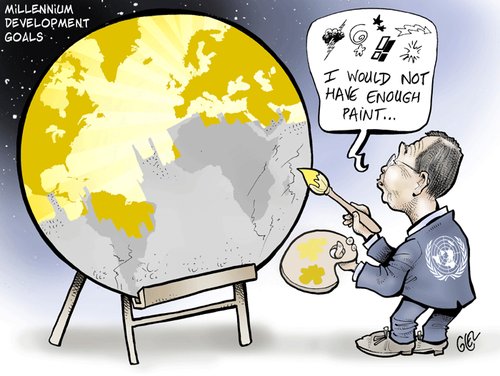
The facts and figures displayed in this post show a grim image of development aid. Numerous multilateral efforts have been made to correct the highlighted mistakes, but to no avail. My prediction is that until 2015 - the end date for the fulfillment of the Millennium Development Goals - governments will continue as they are. In little over three years time they will come to the conclusion that it didn't work out quite as they planned. But we ought to be confident that civil organizations will remind them; that they will point out their mistakes. And just maybe 2015 can be the start of a new practice of actual development.