Posts tonen met het label United States. Alle posts tonen

oktober 02, 2012

Four Years of Obama: An Evaluation

Incumbent president Barack Obama. I am rooting for the
guy even though this article doesn't avoid criticism.
Republican criticism of U.S. president Barack Obama has been harsh. At the Republican convention in Tampa, vice presidential nominee Paul Ryan characterized life under the Obama administration as planned out by the government. 'A country where everything is free but we are not', he stated. Clearly the Republicans are not amused by what the past legislation brought forth. Sure, the differences between the two parties seem wider than ever; polarization seems to grasp the sphere rather well. Yet a lot of progressive Democrats too are dissatisfied with their president. Voters on the left who supported Obama in 2008 have grown disillusioned. It is to this part of the electorate that the Democrat directed himself when he argued that 'when you give up now, nothing will change'.

Does Obama follow a centrist line? Is he the Republicans' little bitch? Or a socialist crook, as Tea Party types claim? In spite of all 'election speech' I do believe in the good intentions of Obama. And when reflecting upon his realizations (or the lack thereof) we must always keep in mind that a president can only do so much. In making policy, Obama has been winged by a Republican-dominated Congress. As a result, the output of four years Obama is always the output of a four year game between all relevant actors.

THE PROGRESSIVE CANDIDATE
Whether the past legislature can be dubbed 'left' or 'right' depends on which policy branch is under consideration. One field in which Obama made a difference is the emancipation of the gay community. He repealed the DADT policy which barred homosexuals from the army. As a major influence on the public opinion he also openly approved of gay couples. I consider this a big step forward in what I consider to be a backward country regarding such issues. (If this judgement seems harsh, please consider that I live in Belgium. Same-sex marriage is totally legal here and even our PM is homosexual!). Sure, Republicans aren't all united on this issue. But I do believe that a Republican president would have made a difference, if only in his silence.

On a side note: Obama is black. Perhaps it is lame to see this as a positive quality, but I can't help thinking it makes a difference. It is something like a first female head of state: not necessarily an indication of real emancipation but a strong token of progress nonetheless.

Obama might well be the 'greenest' president the States
ever have seen. A tendency his party can capitalize on, as
a lot of moderate voters have environmental concerns too.
The branch in which Obama made the biggest difference is, I belief, the environmental policy. His administration protected the Grand Canyon from uranium mining, supported green industry, enacted stronger protections against poisonous substances, etc. Again Democrats and Republicans come in various flavors when the environment is concerned. Yet the duo Romney-Ryan campaigns with dismantling such protections as the Clean Air Act and Clean Water Act. Their approach completely denies climate change, as does a frightening large portion of their party's officials. Climate change is a debate in its own, but massive amounts of toxins and greenhouse gases can't be very wholesome. To claim that such pollution has no effect - you tell me who believes in fairy tales?

The following might be striking, but with that I have covered Obama's biggest achievements. What about the social policy, you may ask? What about saving the economy? There is no denying that the president did a decent job governing in difficult circumstances. I am however not convinced that a Republican candidate would have made a significant difference. Of course this is counterfactual, and thus not solid. But allow me to make a case.

SOCIO-ECONOMIC CENTRIST
The economy got stimulated with a 800 billion plan in 2009. One third of this amount was however implemented as tax cuts. Cuts are less stimulating than outright public investment since people will have the incentive to save up for the hardship to come. Especially the left was not too happy with this design, but then again it were the Republicans in Congress that needed to be courted. Perhaps McCain (or another generic Republican candidate) would have added a bigger portion of tax cuts. Perhaps the benefits would go to a higher income group than the middle class Obama favoured. But these measures would only be less effective in stimulating the real economy as a whole. And after all, there are only so many ways to revive an economy in a limited scope of time.

With the tax cuts mentioned, I would like to take the time to tackle one of the biggest myths created by the American right. The tax burden didn’t massively increase under the Obama administration. True, the president set out to revoke Bush’s tax cuts for the rich. But this never came about. Too bad I say. And his more leftist supporters would surely agree, a failure. On the other hand taxes were reduced for the middle classes, mainly with the stimulus program. Neutral economic institutes set the current U.S. tax rate at the lowest in decades!
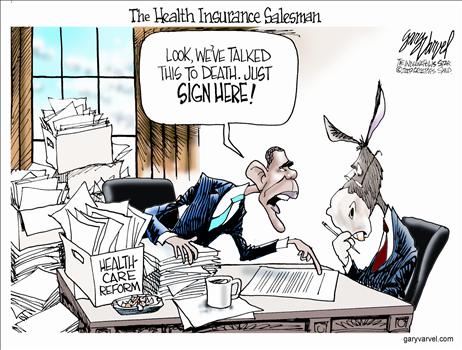
The health care reform, often dubbed 'Obamacare', is
subject to much debate. A look at recent history puts
much of the consternation in perspective, though.
On to that other eyesore for conservatives: Obamacare. Republicans are angered, yet it concerns a reform they thought about for years themselves. Its very blueprint - as is by now well known - was implemented by no less than Mitt Romney as governor of Massachusetts! The so-called Heritage model, created by one of the biggest conservative think-thanks, obligates Americans to buy an insurance with a private company. Those who can’t afford one are entitled to subsidies. As a counterweight, insurance companies can’t turn anyone down. But why would they if the state just bought them 30 million of new customers?! Republicans can't be too mad as their ultimate nightmare was avoided: a public insurance option after European fashion. Such an option was present in a failed plan once presented by Nixon. And why did Nixon fail? The Democrats wanted more. Now they themselves presented less, and short-sighted Republicans call it socialism.

If Obama is a communist he knows damn well how to hide it. Sure, he nationalized the car industry. But only for a while. And while Romney suggested to drop GM and Chrysler, I heavily doubt any president would have the guts. It sure wouldn’t do him any good in the polls. As for Wall Street, saving behemoth financial institutions with tax payer money can hardly be called called socialist either. For one there weren't any real options here. And second, the government asked nothing in return. No accountability, no caps on bonuses or management wages. The families who lost their homes due to malpractices outside their control could count on far less support...

A MIXED RECORD
Other hot topics Obama-supporters bring up are migration and foreign policy. The DREAM act was a nice gesture. Most Republicans wouldn't dream of coming up with such a proposal. And indeed they complain it will only encourage illegal immigration. This may be, but the Obama administration is also responsible for doubling border patrols. Obama seeks to reduce the influx while dealing with the illegal community already present. Not too shabby, I must concur. The war in Iraq ended. For Afghanistan the end is in sight. No real victory is achieved in my eyes, yet there is nothing any president could do to help. Obama is however not the softy hawkish Republicans think him to be: under his administration more drone strikes were ordered. Also, Guantanamo remains in use and the Patriot Act still stands.

I conclude by pointing out that there is a growing number of disillusioned voters since Clinton. People who care deeply for strong environmental and social policies. They supported Obama before, and he needs them again now. I am not sure if he deserves them though, since on crucial matters - economic and social - there has been no significant difference.

september 09, 2012

The Decline of US Power: An Eagle Crash Landing?

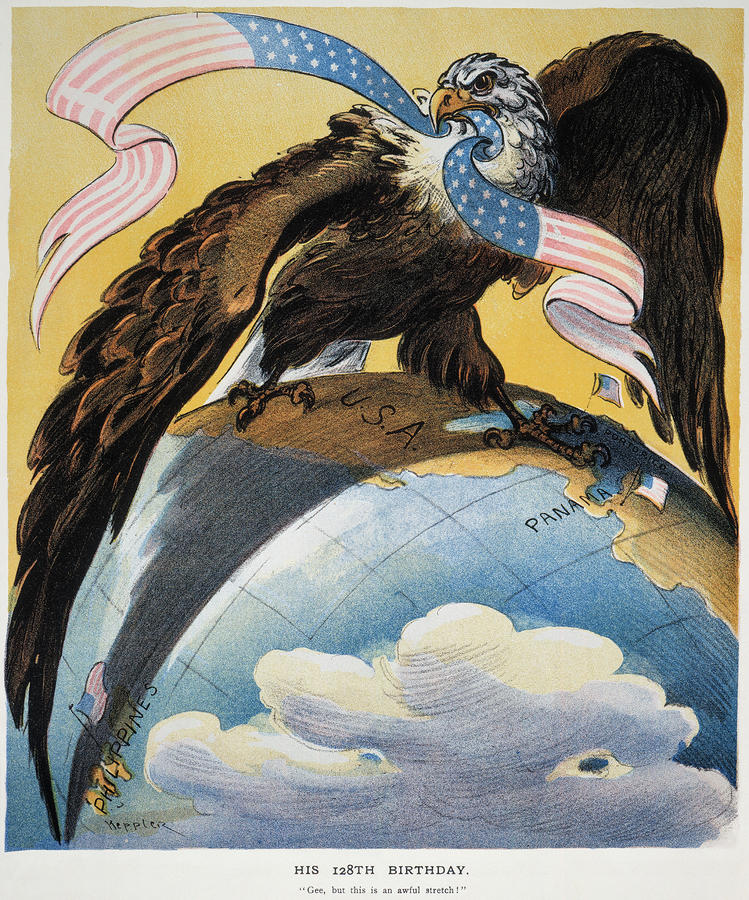
Columbia, as personification of the United States, carries
civilization westward. This image represents the 'manifest
destiny' of America as well as its expansionist tendency.
The 09/11 attacks were an eye-opener, a moment of revelation. Not so much as a defining moment, but rather as part of a lengthy historic trajectory which entails the decline of US hegemony. The majority of American policy makers, however, responded with denial and anger. They remain attached to the idea of American exceptionalism. To them the American dream is a guiding light for individuals around the world, Americans have a manifest destiny. While these underlying values present useful insights, they are not an exact representation of reality. To understand the world we need to look beyond our dreams; we need to look at the history of the United States and its place in the world. This post seeks to do just that. What do we see when we trace this superpower? How is it that the terrorist attacks and the American response, a 'War on Terror', fit in this pattern?

The truth is that by the turn of the millennium the States already lost their shine. A lone superpower that lacks true might. A leader everybody stopped following. Drifting dangerously amidst a chaos it cannot control.

In the nineties the US economy seemed to do well. Productivity was high, the stock market boomed, both unemployment and inflation were low. The resulting surplus made possible the liquidation of government debt. Many Americans believed this to be an affirmation of the vision and the economic policy of their leaders. What at first seemed to be success turned out to be a bubble. But even bubbles and downturns are deceiving: the world-economy has been in relative stagnation ever since the seventies!1 For three consecutive decades, the powerful economic loci have tried to shift the losses to each other. Western Europe did well in the seventies, then Japan had its decade, and the States had their share in the nineties. Globally, however, success was dim. The global economic slowdown parallels the decline of American hegemony. Indeed this is no coincidence. And it is all but certain that the US will outshine its competitors in a resolution. An under-the-surface fear is already today shaping American policy.

Central, though not crucial, in both economic and political decline was the Vietnam War. This costly conflict exhausted the American gold reserves at a moment when both Western Europe and Japan experienced an economic upswing. With the abandonment of fixed exchange rates, US pre-eminence in the global economy came to an end. Vietnam was perhaps even more devastating in another way: it was a rejection of the status quo as established by the winning powers of WWII at Yalta. A rejection by Third World nations which wanted to pursue their own way. The social upheaval of 1968 drew upon this. Just like the people of Vietnam, protesting youth contested the collusion of the two superpowers. While the direct political consequences of this 'revolution' were minimal, its intellectual and geopolitical implications were irrevocable. Centrist liberalism, binding conservatives and radicals alike since 1848, fell of its throne. Ideological choices presented themselves as conservatives became again conservative and radicals, radical.

Cartoon depicting US imperialism in the Pacific and the
Americas. Military-driven maintenance of 'empire' denies
the waning hegemony and in fact strengthens this trend.
Conservative tendencies took the steering wheel under the flag of neoliberalism. With the onset of economic stagnation in the seventies, ‘developmentalist’ policies were abandoned. As a political complement violence and rejection became more widespread in the Global South. The US had to rely increasingly on brute force, in itself a sign of growing weakness. Military failures came about in Lebanon (1983) and Somalia (1992), where American troops were effectively pushed out. Success existed mainly against countries without troops, like Grenada and Panama. While the US wasn’t  paying attention, the Soviet Union collapsed. A cause of the liquidation of the Yalta agreements and internal liberalisation. In spite of all Western victory and end of ideology, the collapse of Communism meant in effect a collapse of liberalism. The Soviet threat was the only justification of American leadership over ‘the free world’. Of course the illusion of supremacy persisted, as it does in many ways up till today. As an arbiter in the Middle East the US kicked Iraq’s but in the Gulf War. Yet all the superpower could demand from a medium strength regional player was status quo. An intervention stopped the worst atrocities in Yugoslavia. But the ethnification went on and was indeed legitimized.

09/11 too proved the waning American power. It is not so much that a band of rogue fanatics with relatively little resources managed to scar the number one military power. It is the response that speaks: invading Iraq, a country that had nothing to do with the attacks, without much international consultation. This only spread anti-American sentiments, even among allies. Different voices are heard in how to deal with this reality. On the one hand there is the isolationist tendency, preaching a withdrawal into Fortress America. On the other hand there is the ‘hawkish’ macho-militarism. Both expressions of American nationalism, they share the same attitude toward others: one of fear and disdain, a belief in the superiority of the own way of life. Involvement in the quarrels of others is only permitted if we can impose our ways. Without a real possibility to bend the downward trajectory, however, the United States have chosen to ignore the trend. A policy prevailing from Vietnam till today that only hastens the decline.

1 World-economy is a term borrowed from world-systems analysis. For our usage here it can be equated to the global economy. When we say this global economy is in relative stagnation we mean that it is not expanding at as fast a rate as before, hence the 'relative'. For a general introduction to the underlying mechanism and the supposed consequences, see World-Systems Analysis: An Introduction.

maart 18, 2012

The American Voter: US Political Culture Explored

I worked really hard on this post and wondered if I would finish it by the US presidential elections of 2012. Luckily for me it is done well before. So here it is: some reflections on the American voter, backed with numbers and fancy sources. This post is not so much on ordeal, rather it functions as a set of ideas that frame the upcoming elections. Feel free to feel inspired and please share any thoughts! :p

Political culture is hard to define, yet it offers an attractive explanation for national differences concerning political behavior such as voting. 'The French are such', 'Americans do not think that way', etc. I am confident you have heard some like those before. There are indeed a lot of differences, but they are in my opinion not given. First of all political culture is dynamic: it can change over time (see the graph below). This is evident from the declining trust in political institutions with Americans. Second, the creation of and changes in political culture are the result of historical development. The trust is influenced by education levels, economic climate and central figures with their vigor or scandal.
Now how unique is the American political culture? Ronald Inglehart, famous amongst political scientists, was a driving force behind thinking about post-materialism: a value pattern focussing on self-realization relative to self-preservation. By adding traditionalism/secularism as a second dimension, Inglehart identified different cultures. He found an Anglo-Saxon value pattern which scores very high on self-realization and moderate on the second dimension. This is expressed in various features of American political culture: the perceived exceptionalism, the belief in popular judgement and the typical conception of freedom. All these elements are rooted in the history of the American state and society: fleeing religious or political persecution, resistance against the English crown, the autonomy of the states, etc.

(It needs to be said that the dominant political culture in the United States is perhaps more of an imposed value pattern rooted in the Anglo-Saxon and Protestant inheritance. Values differ along various lines, of which ethnicity might well be one. In how far the political culture is shared by say Afro-Americans or Latinos is hard to say. Even more difficult is it to draw conclusions as to how 'American' American political culture is.)

'American' political culture: a combination of influences or
the dominance of white Anglo-Saxon Protestant values?
The above should enable us to situate the American political culture and place it in its historical context. On to the voter now, as the upcoming election is the essence of this article. United States politics is largely spared from the increasing fragmentation that has Europe in its grip. Even in the UK they need to form coalitions now, despite the majoritarian mode of voting. This does however not mean that voting behavior didn't change in the States. Like everywhere in the West, identification of the voters with a single party has been diminishing. The electorate is increasingly motivated by what is called 'retrospective voting': casting your ballot based on specific issues, the image of parties/leaders and the economic climate.

Studies from the sixties up till now show that only up to a fifth of the American population is motivated by ideological reasons when casting the vote; about 40% defines politics in terms of group interests (classes, ethnicity, etc.) and 25% rewards or punishes the establishment based on the general tendency of the economy and society as a whole. The others are, sadly, apathetic: they don't give a ----. Furthermore, an overwhelming eight out of ten voters show no temporal stability in their ideological preferences. However in times of crisis and change the electorate becomes more ideological in its thought than its leaders, pushing for extremes. If these results don't seem to tell you anything, read this paragraph over once again whilst thinking about Obama's success in 2008. Now repeat that exercise with the possible Republican nominees for this year in mind.

Sources:
Converse, P.E. (1964). The nature of belief systems in mass publics. In D.E. Apter (Ed.), Ideology and discontent (pp. 206-261). New York: Free Press.
Hague, R. & Harrop, M. (2010). Elections and voters. In Comparative government and politics: An introduction (pp. 179-202). Basingstoke: Palgrave.
Hague, R. & Harrop, M. (2010). Political culture. In Comparative government and politics: An introduction (pp. 121-137). Basingstoke: Palgrave.
Inglehart, R. (1997). Modernization and postmodernization: Cultural, economic and social change in 43 countries. Princeton: Princeton University Press.
Inglehart, R. (1999). Postmodernization erodes respect for authority, but increases support for democracy. In P. Norris (Ed.), Critical citizens: Global support for democratic governance (pp. 359-392). Oxford: Oxford University Press.
Putnam, R. (2002). Democracies in flux: The evolution of social capital in contemporary society. Oxford: Oxford University Press.
Sears, D.O. & Funk, C.L. (1990). The role of self-interest in social and political attitudes, Advances in experimental social psychology, 24, pp. 1-91.

januari 24, 2012

The Iranian bomb: cause or solution to unrest?

In a previous post I explained how the conflict between Iran on the one hand and the United States on the other is in fact a security dilemma. Both sides are 'securing' their interests at the expense of creating more danger to the interests of the other. A quick recap of the facts: Iran is accused of working on nuclear weaponry by the United States and regional ally Israel. This assumption has been confirmed by IAEA reports on this case. The Iranian authorities however remain vigorously that their nuclear enrichment program is for civil ends only. My personal feel is that Iran has probably restarted its military branch of the nuclear program. A pity if you oppose nuclear proliferation like I do.

WHAT'S WRONG WITH IRANIAN NUKES?
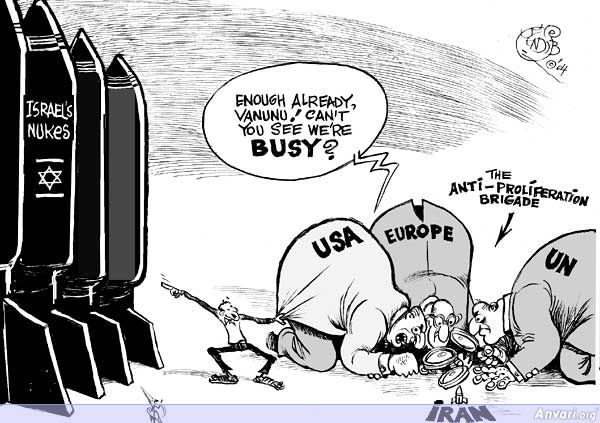
Iran is not the only country that is going rogue with
a nuclear program. No wonder it feels insecure when
Israel and Pakistan - both US allies -  posses an arsenal.
Isn't Iran entitled to a nuclear arsenal? I'm talking about the legal entitlement here, not about the moral or humanitarian sides of the question. For this I wish to refer to the opinion on the legality of the threat or use of nuclear weapons. This statement by the International Court of Justice was to answer whether a state may use a nuclear attack or threaten to do so. The advice stated that there is no prohibition on the use of nuclear arms as such, but it would be in conflict with humanitarian law. So did the Court really rule that nukes are out of the question? Not exactly as the advice left a loophole: the Court felt that it 'cannot conclude definitely whether the treat or use of nuclear weapons would be lawful or unlawful in an extreme circumstance of self-defence'. So if a the existence of a state were at stake, the use of nuclear arms might be permitted.

In its finality this opinion is inconclusive on the use of nuclear force. In it the Court also recognized that there is no evidence for or against the legal possession of nuclear arms, thus actually allowing the continuous possession of nuclear devices. Iran is however a signatory member of the Non-Proliferation Treaty and thus committed itself to a prohibition on developing its own nuclear arsenal. This is probably the main reason Iran keeps denying that its nuclear program has a military branch; heavily sanctions might follow if Iran openly admitted any violations. It is often remarked that other states - in question Israel, Pakistan and India - have nuclear arms. These are indeed contrary to the principles of non-proliferation. But then again these three nations have not signed the above mentioned treaty. You may well consider them to be 'rogue nations' for this (I do) but fact is that they follow the rules.

HOW NOT DO DEAL WITH IRAN
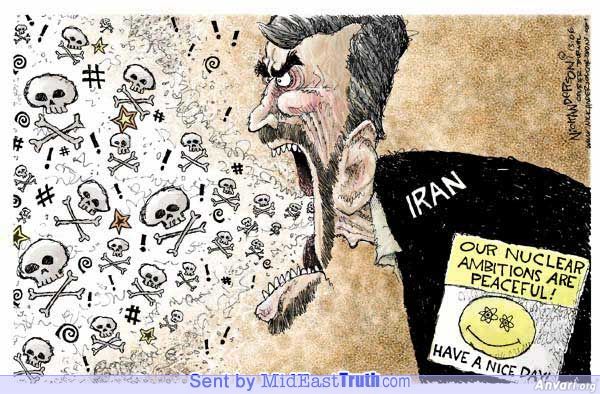
Iran remains that its nuclear program doesn't serve military
ends. That statement is likely untrue, though I do believe
that Iran is building nuclear arms for defensive reasons.
Up till today international reaction vis-a-vis the Iranian nuclear aspirations carried a certain degree of machismo. The United States, and even more fiercely Israel, have been talking about unilateral military measures. Such action is not bound to the realm of fiction: Israel acted against key facilities in the nuclear programs of Iraq (1981) and Syria (2007) before. The strategy applied against Iran is supplemented with assaults on nuclear scientists and economic pressure. The latter in the form of an embargo on Iranian oil, currently upheld by the United States and the European Union. It is my opinion that the path pursued is in its entirety a mistake. For starters the aggressive talk and action only endorse the radical voices in Iran, claiming that the West is pressuring the country toward regime change. A second setback is that the embargo will hit the people of Iran hard. If hardship for the masses is our idea of creating justice I pass for it. Not only is using this impoverishment-strategy interference with Iran's internal affairs, it is ethically most questionable too.

My feel is that Iran should not build a nuclear weapon or talk about closing of the Strait of Hormuz, the West needs to understand that aggression invokes aggression. That is the mechanism behind the security dilemma. Maybe Iran can send a message by collaborating with its fellow members at OPEC. Economic and political affirmation of the Middle East as a region in its own right would force us to rethink our strategy. And rethinking is needed. Iran certainly made some bad choices concerning its methods in the past, but its concerns are valid. As a regional power it is entitled to secure and manifest itself as long as it does not violate the rights of others.

januari 21, 2012

American elections, economic crisis and the future world

The upcoming United States presidential election promises to be most interesting. America is at a crossroads: it can continue down a road of careful progress or it can try to secure the system it currently leads. The latter might create some successes in the short run, but the ultimate demise of the current world-system is inevitable. Even more vulnerable is the dominant position of the United States within that system. As I shall continue to argue, American politics would do better by using their achievements to sustain progress in stead of holding it back. Now it would do violence to reality to state that these two policies are parallel to the Democrat-Republican divide. It can however not be denied that, in recent years, the two parties have polarized. This can be seen in the charts on the right. It is also evident from the heavy resistance of some against the approaches of incumbent president Barack Obama.

AN HISTORICAL PERSPECTIVE
This political polarization is a result of the waning position of the United States as hegemon within the world-system. The concept of hegemonic power is complex and much debated. For issues of space I shall refer to the related concept of superpower: the States have a significant more means to steer the direction in which the world goes. For a long time, and certainly since the demise of the Soviet Union, it policed international society on its own. Examples are the creation of the WTO and increased U.S. unilateralism. No-one can stay in power forever though; contenders are always on the rise. The unique American position has been under fire ever since the seventies. In that decade, the stabile Bretton Woods financial system was abolished, Europe acted more independently and the 'Third World' began to manifest itself as a unique set of nations. Also the loss of the Vietnam War caused heavy resentment to future foreign ventures of a military nature.

Between 1970 and 2010 the American GNP doubled
while middle income wages only rose by 20%
The end of the Cold War, and indeed the 'end of history' perceived by some, is an intermezzo of temporary nature. It only shows that the hegemon has overcome the systemic contradictions for the time being. How did the States overcome these? The answer was found in shifting the burden: the world was put on a diet of neoliberal recipes to safeguard the system of its own destruction. Working class people earned a smaller share of their productivity and Third World nations were trapped in a cycle of restructuring and loans. By cutting the prices of input - labor and raw materials - more profit could be generated to relaunch the system.

THE LOGIC BEHIND TODAY'S TAMPERING
In this light today's sputtering of the economic machine is nothing new. Another phase of contest for the system ánd the hegemon are announced. Indeed the cures prescribed are not very original: we nationalized the messy risks of the banks (they can keep the profits though) and the national governments are going to cut spending. Meanwhile environmental policies are under pressure because you don't have money to save the planet when you have to save the banks (depends on your priorities I guess). Another factor is in play here too: more sustainable production equals more costly production, read 'less profitable'.

A cartoon from The Huffington Post expressing the logic.
The benevolent hegemon, as the U.S. was portrayed in the nineties, is not so benevolent anymore. The establishment has launched an offensive: Obama is to concerned about the environment, healthcare is 'socialist', the Chinese need to increase the value of their currency, etc. It all comes down to the same thing: production must get cheaper, cheaper at the expense of equity and sustainability. They want to pass the bill to the people and the planet. The waning superpower is trying to safeguard its capital - the ultimate basis of its superiority - in various ways. Another most curious part of this wicked strategy is the uneven stress on the public debts of eurozone-countries. Washington and also London are kept strategically of the radar while their situations are fairly comparable. As a nice bonus to the euro taking part of the heat, the social achievements in continental Europe are pressured too.

EMANCIPATION FOR THE FUTURE
But there is reason to keep up hope. (About time that phrase showed up :p). Scoffing at Obama and his 'evil socialist scheme' together with the fuss about Occupy Wall Street are emancipating people across the States. If the Democrats continue down a more progressive road they might turn America from a conservative bastion to a leading reformer on the world stage. In Europe the struggle is going on as well, both within the institution of the Union as on the national level. What Europe do we want? What America do we want? These questions are being raised today. And by looking for an answer we are discovering what kind of world, what sort of society we want to be a part of...

NOTE: The graphs on polarization where retrieved from Polarized America? (Kenworthy, 2010). First hand sources are mentioned by the author.

november 14, 2011

A dragon and its treasure: The Chinese yuan

The title of this post refers to the Chinese People's Republic as a dragon. Chinese economic policy is almost as mythical as the creature often used to portray the nation. Incredible growth, enormous exports, vast amounts of financial reserves and yet lead by a party that calls itself 'communist'. In a series of three posts I would like to examine some of the myths that surround Chinese economic policy. First up is the supposedly undervalued currency and its perverse effects on global trade.

The Chinese leadership is often accused of keeping the yuan, the currency of the China, artificially low. An undervalued currency holds a significant advantage: it suppresses domestic prices of raw materials and labor. In essence you make domestic production artificially cheap, compared to foreign production. This causes  Chinese rubbish to be priced too low and thus to sell better than American, Japanese or European rubbish. The Chinese government rejoices when it checks its export numbers. Other industrialized countries are less happy for they see their trade balance - the worth of export minus import - become less balanced.

The trade balance of countries around the world, based on IMF statistics for 1980-2008. Notice the high deficit for the United States, which is largely benefited Japan in the eighties and China since WTO-admission in 2001.
The question that keeps us busy is twofold: is China keeping its coin artificially cheap and, if so, then how do we deal with it? The grievances of China's trading partners are without a doubt legitimate. It needs however to be said that, ever since 2007, the Chinese government has taken measures to adjust its underpriced coin. Indeed since June 2011 the yuan has appreciated over 7% against the dollar. And considering the spread between China's inflation rate and the much lower one of its trading partners, relative costs in China have risen even more. All this show us that the yuan is not as much undervalued as it used to be.

Myth 1: "The Chinese yuan is kept artificially low
and thus the Chinese policy distorts global trade"
Yet China-bashing is more popular than ever, especially in the United States. On October 11, the US Senate approved a bill that allows its government to take measures against what it deems undervalued currencies. This strategy might be politically successful as it might get one votes from people who lost their manufacturing jobs allegedly due to cheap Chinese imports. Yet from an economic point of view the results would be devastating. A trade war between two economic behemoths, who are also each other's principal foreign debtor/creditor, will disrupt today's fragile economy even further. To ward cheap Chinese products from your market would by the way mostly harm the consumer. And China only needs to challenge such a policy before the WTO to enforce free trade. After all the international economic regime regards undervalued currencies to be a prerogative of the IMF.

Then should we stay inert and leave the matter be? There is something to say for abstaining from action. Though the yuan is far from flee-floating, it is steadily gaining in value. A more 'flexible' yuan offer chances for China to hasten the reorientation of its economy from exports to domestic consumption. This is something the Chinese authorities recognize and seek to achieve, even more so when a global recession might be just around the corner.

oktober 30, 2011

Catching Kony: altruism or geopolitics?

Some days ago I learned that president Obama is going to send military reinforcements to Uganda. This is announced in a time when the US military presence in Iraq is almost completely reduced. The goal of the military venture is to make an end to the activities of Joseph Kony and his Lord's Resistance Army (LRA). The LRA is a renegade rebel army that seeks to overthrow the Ugandan government. It is hard to convey an image of the LRA in brief, but I'll try it nonetheless: it combines a mix(ed)-up ideology rooted in Christianity, traditional African mysticism and Acholi nationalism. The LRA recruits children in its ranks by raiding villages, accompanied by the many cruelties commonly associate with child soldiers (think rape, murder and drugs).

Entire Mid-Eastern Africa is politically troubled:
(1) Somalia as a 'failed state' and the many refugees in Kenya
(2) South Sudan, only just independent, is extremely poor
(3) The Great Lakes with the LRA and refugee camps in Goma
(4) The unstable Central African Republic with lots of violence
Would it be wise to add more military to the equation?
You can imagine how relieved I was to learn that the United States would 'finally' do something worthwhile with its military capacity. An emotional reaction and, as it turned out, a biased one. Without any doubt a monster like Kony has to be stopped. But several aspects have been left out of the picture when Uncle Sam presented its great humanitarian deed to the world. First of all, LRA activities in the region have been on a low pitch since 2007. The rebellion against the government is not what it once was and this might open the way for non-military conflict resolution. It is however the corrupted Ugandan regime that seems to put on its brake when being asked for more democracy, pluralism and liberties.

A second noteworthy fact is that the United States are already involved in hunting down Kony and other LRA leaders. So far their tactics didn't prove very successful. It is very doubtful that stronger military pressure would be a road to result. Some would even dare to say that it might undermine regional stability even further, actually endangering the common people more than was the case since 2007. But American-Ugandan ties have strengthened during the War on Terror in Somalia. Another major strategic importance of good ties with the Ugandan authorities are the oil reserves in the nearby region. Especially now that South Sudan, with considerable reserves, became independent.

What first seemed an altruist deed to protect people now looks a lot grimmer. And it is easy to buy the 'peacekeeper' story, even when being sold by a country that has a pretty nasty record of military interventions. The reason that we are tempted to do so is that we are under-informed on the Ugandan situation, and African politics in general. The lesson I learned: stay informed or stay sceptic.

oktober 20, 2011

Security issue or security dilemma?

Recently, the United States claimed they had prevented an Iranian terrorist attack. The supposed violence-in-the-making would have been directed against the Israeli and Saudi-Arabian embassies in Washington. A faction of the Iranian Revolutionary Guards - the country's politically influential elite army - would have been behind the plotting. The Iranian government denies all accusations, which they percieve as a framing operation set up by the United States itself. I will stay clear of declaring any truth. In stead, this article will offer a framework to analyse the tensed US-Iran relation, based on the classic notion of the safety dilemma.

A safety dilemma occurs when one state raises its military capacity and, by doing so, becomes a treath to a second state. This other state will have to decide whether to respond proportionally or to remain idle. When responding with armement, the first state may interpret this as a hostile signal undoing its initial effort; an arms race is started. Persuing the second option however means that a (percieved) risk is left unattended. This phenomenon, which involves a great deal of subjectivity, proves to be most usefull in explaining US-Iranian frictions.

Uncle Sam and president Ahmadinejad in a 'staring contest'
Let's start with the States. The US has a Cold War-era ally in the Middle East which isn't too loved by the Arab nations. This ally Israel is believed to possess nuclear arms, though it never formally confirmed or denied this. In adittion, the States supported Irak in its war against Iran back in the eighties. American support was given to Saddam Hussein (yes, the very same) because the Iranian regime wasn't too favorable for the West. This war, which continued from 1980 to 1988, is a bit forgotten by most of us but the terrible attrocities inflicted upon the Iranian people are well-remembered over there. It  is a scar that never fully healed and here is where trouble kicks in. Iran is still traumatized by its history. It still thinks that the main objective of the West concerning Iran is to install a friendly regime it can influence. Just like the one of the Shah before the Islamic Revolution. With a nuclear treath in Israel and ongoing military presence in Iraq and Afghanistan, Iran feels enclosed. The only way it sees out of this 'brutal imperialism' is a nuclear weapon of its own. Iran's nuclear program, together with its violent language when condamning Israel or the US, are only the stepping stone to the next degree of the security dilemma. Now the Iranian bomb in turn is seen as a treat to regional stability by the Americans.

The perception of both states is in this all more important than the facts. Does the US seek to overthrow the Ayatollahs? Is Iran being agressive in its nuclear program? Was a terrorist attack prevented or is it a framing operations after all? These questions might be interesting, but they do not reach the heart of the conflict. What really matters is that the US and Iran are engaged in a logic of confrontation; there is a lack of mutual trust. We aren't looking at a security issue, but rather at a security dilemma.