Posts tonen met het label Emancipation. Alle posts tonen

september 21, 2012

Islam Spelled Backwards: A Lesson In History

The characterization of Islam as backward has a long
history. Yet such representation fails to grasp the
genesis of the backward cultural frame or the direction
of the profits generated by it. Islam is not as such
by definition, it always functions within a context .
Muslim agitation over 'insulting' imagery is nothing new. It is as present in the media as advertisement. I can't turn on my television or pick up a newspaper without bumping into the latest analysis, opinion, or tirade. Chances are that you experience the same. That is why I first decided not to contribute on this issue. Surely, the facts are by now well-known: a distasteful depiction of the Muslim prophet invoked outbreaks around the world. The violence stirred debate on the compatibility of Islam and 'modern' values like freedom of speech. All too often, the friction which exists between Islam and liberal democracy is reduced to a Clash of Civilizations. 'Islam is a backward belief incapable of allowing democracy to flourish', such is the stance. On the other side of the debate, religious extremists eagerly adhere to this logic of collision. They invert the Western insult to a threat. I dealt with this perspective before. Still, mainstream media fail to grasp the real forces at play. They either subscribe to populist name calling or conjure up an image of the 'backyard Muslim'. The latter to remind us that many Muslims are valuable members of the community. What lacks is a coherent framework to combat the superficial clash put forth.

Religion is often used - misused - as a guise for real social conflict. Indeed conflicting interests have been masked by ideological differences throughout history. Today Islam is coupled to backwardness, but during the 16th century this role was allotted to Catholicism. At the dawn of modern Europe, religious conflicts tore apart political units at most levels. The rise of Protestant movements challenged the old order. Protestantism came in many a form, from the rather modest Anglicanism to radical Dutch Remonstrants. After the dust of the Thirty Years War settled, Protestantism had triumphed in those regions that would do most well in economic terms: the Dutch Republic, England, Scotland, and to some extent France which had the Huguenot legacy. Catholicism strengthened its position in Spain, the Italian states and Poland. These more peripheral areas saw a refeudalization as opposed to the forward surge of (proto-)industry in the Protestant nations. My point? If today's rhetoric was to be applied on this historic case, the conclusion would be that Catholicism is backward while Protestantism is not. Such a view has indeed been suggested. Yet, I prefer a vision that takes into account the gameplay behind the curtain of theological discussion.
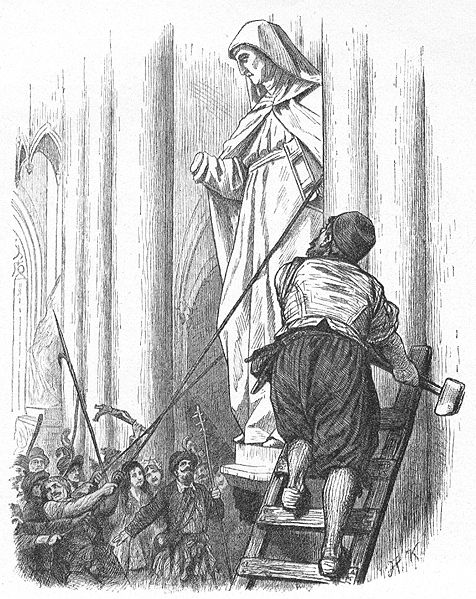
The 'Breaking of the Images' in the Low
Countries is quite comparable with Muslim
aggression toward idols. Yet one we call
progressive while the other is a sign of
anti-cultural sentiment?
Letting ideological dissent account for different social and economic realities is not a balanced view. On the other hand, one must be aware of deriving all cultural patterns from material conditions. Protestantism might more easily reach concord with progressive ideas than Catholicism, since the later has been a defining factor in a former order. But this only is a function of exactly that former constellation. It guaranteed that Protestantism could ally with socially progressive forces. Or better: that socially progressive forces could ally under the umbrella of Protestantism. New nobility, gentry, commercial entrepreneurs tried to secure their interests by assaulting Church property and the privileges of the old nobility. Another major factor was the buildup of a state machinery and the financial resources needed. The refeudalization, weaker state machineries and primacy of Catholicism in 'backward' Medieval Europe served the further rise of the 'strong states'. Baltic and Central Europe became a grain basket, producing much needed cereals of which the trade was monopolized by the Netherlands. Spain imported bullion from the New World to feed the growing economic activity in the northwest. Local aristocracies and the financial reserves of Italian city-states provided a market for Dutch and English cloth.

We have to view the position of the Islam in a similar logic. If the countries of the Middle East and Northern Africa are backward, it is not due to some primordial nature of Islam. Religion at best delivers an arsenal of symbols and values through which social and political forces act. Not so long ago the countries in those regions were ruled by an elite which promised modernity and progress. In reality people were oppressed, kept backward while a ruling few grew rich in serving foreign interests - the interests of the strong states. The Arab Spring was a reaction against this broken promise. And current uproar, all in the name of Islam, is in fact an internal struggle following regime collapse. Part of the old elite tries to reinvent itself, renew its promise. Islamist forces combat them by combatting their example, the Western liberal democracies. Does this make Political Islam a force of progress? I doubt it. Surely its current form is anti-Western, an enemy of the current installment of imperial privileges. The rise of Islamist regimes eats away at the hegemony of the West and brings the world further in touch with a growing multipolar reality. It will however not free the majority of the Muslim population, nor bring them material progress.

maart 01, 2012

What lies beneath: Implicit attitudes and emancipation

In the previous post I addressed the issue of traditional gender roles. Inspired by a publication of the Belgian Institute for the Equality of Woman and Man, I argued that gender roles are constraining to the personal freedom. Here I want to illustrate this point more thoroughly: Gender roles are a mostly social phenomenon, while it is often portrayed as a natural order. This makes that any deviant behavior is considered abnormal, even when superficially tolerated. There always exists implicit psychological pressure to adjust to the norm, regardless of whether explicit social pressure accompanies it. The psychological bias is deeply ingrained within our minds, as I will show. I can however not do this without first mentioning the illicit nature of this pressure and thus of the constraints. We are not sufficiently aware of how indoctrinated we truly are. And, as stated in the previous post, it is in this subtlety that lies the real danger.

On to the proof now, as big declarations about brainwashing make me sound more like a lunatic than I am comfortable with. A key notion in need of understanding is that the human brain is the ultimate instrument of deceit: we succeed to fool ourselves with the most powerful illusions time and time again. People can say that they oppose traditional gender roles, even believe that they do, while subconsciously they have a positive attitude toward them. As long is this conflict does not surface the person in question doesn't notice. A quick example: people can speak noble of tolerance toward homosexuality until their son 'needs to say something'. Same so with multiculturalism and the daughter introducing her new boyfriend Ali.

That people are not aware of implicit attitudes is widely accepted in social psychology. An instrument has been designed to measure such attitudes, the implicit association test (IAT). The test was created by Harvard psychologists in 1998 and caused a real revolt in methodology. I suggest not to find out how it works untill you have taken one yourself. It is a solid instrument though and some stunning results have been discovered using it:


The above image illustrates the preference of whites over blacks (left) and the attitude toward traditional gender roles (right). Both measured once by self-observation trough a list of questions (explicit) and once using IAT (implicit). Apparently women are not as emancipated as they themselves claim to be. Sure they are free, they have made their own choices, etc. Subconsciously they are still compelled to follow the gender roles though. Socialization at its best here. I included the example of blacks and whites in the United States because it shows that even blacks have a more positive attitude toward whites than toward their in-group. Seemingly the black community is based on a contrast with whites, a socially produced (!) contrast that places blacks at the bottom end of the comparison. A contrasts blacks too agree upon, albeit without being aware of it.

IAT research strengthens my view that there is a merit in stressing the harm done by the less visible or even invisible dynamics. We must acknowledge that the continuous portrayal of socially produced inequality as natural blocks the way to true emancipation. We must expose the triggers of mental oppression and fight them openly. To end this post I wish to thank J.J. Ekins for his comments on the previous post. They were a genuine stimulus for me to build upon. To all other readers: feel free to engage, to formulate your own thoughts, etc. A little polemic makes my blog more than an exercise in writing.

februari 26, 2012

Gender equality in Belgium: The IGVM report

A few days ago the Belgian Institute For the Equality of Woman and Man (IGVM) published its second report on gender statistics. The report is an instrument that lists numerous indicators of inequality between genders. The first gender statistics report was published in 2006. Since that time a lot of progress has been made in my little country. Especially at the indicators of education and academic careers the emancipation is really visible. A lot of problems still remain though. The hardest conclusion to digest - also the one the press covered most intensely - is that for every houseman there still are 32 housewives. Classic gender roles are indeed more firmly embedded in our open societies than you might imagine. The group of men who are participating in the household is growing, albeit at a slow rate. In the end the combination of a working job with tasks around the household still falls mainly on women. Housemen are a marginal group both within the population of men and the population of house cats. This is a trend that persists even in younger generations.

In Belgium we have a great system of time credit formulas: social security arrangements that allow working people to do less hours or even take a few months off to raise the children, care for an ill family member, etc. It is a sad reflection though that mainly women make use of these formulas. I understand that an instinct for caring might be more characteristic of woman, but not to such statistic extremes. There is no denying that a cultural pattern is at work here. And this is a real pity since the IGVM explicitly states in its report that "a more equal distribution of (caring) tasks within the household is a necessary condition for greater equality in other domains" (IGVM, 2012a).

To conclude I wish to point out that the inequality evident from the numbers has two main reasons. One is the ongoing enforcement of gender stereotypes onto children. Examples are all too evident: girls between 12 and 18 engage significantly more in household activities than boys of the same age, sports are still considered a boy's thing while we buy girls a doll for their birthday, etc. The IGVM report confirms the role of such practices which are to me no less than indoctrinating, limiting the free choice of children. I dare to say indoctrinating because how else would you call the natural representation of a constructed social order? The second problem links up to this in a direct fashion: most people see no problem. Most Belgian citizens do not recognize gender roles as a severe limitation to either freedom or emancipation. Gender roles may  not be as rigid as they once where, the danger lies exactly in their subtlety. What remains slumbering under the surface is hard to contest, but it can spread its poison nonetheless.

Sources:

IGVM (2012a). Press release 'Females and males in Belgium: Equal in 2012?' (Dutch). Consulted on February 22, 2012 (http://igvm-iefh.belgium.be/nl/binaries/Persbericht%2021feb2012_tcm336-163732.pdf).

IGVM (2012b). Females and males in Belgium. Gender statistics and indicators (Dutch). Consulted on February 22, 2012 (http://igvm-iefh.belgium.be/nl/binaries/GenderStat_N_Hfdst1-8_tcm336-161101.pdf).

februari 12, 2012

"We, The People"

My activity is on a downward slope, so it seems. My paper has me really occupied so all I can present you for now is this exciting piece of text on language and populism. It looks dull though, no links or color images involved. I promise more eye candy in the next one. Cross my heart and hope to write more soon.

See if you recognize the following reasoning: "Intellectuals look down on the common man and are estranged from reality as it is experienced by the people. They use a language infused with technobabble that conceals reality and thus gives a distorted view." Sounds familiar? It is called a populist discourse which aggressively downplays the role of theory and language. A defensive reflex against theory can be found anywhere in the political spectrum: populism is a matter of left and right, of progressive and conservative. Yet it is naive and above all it is dangerous too. By bashing intellectuals and glorifying everyday speech, populists endanger actual emancipation.

"Society is an amalgam of groups constructed along fluid identities."
First of all, the populist critique against class, gender, race, etc. can be turned against the catch-all categories like 'common man' or 'the people'. These are ideological constructs themselves and there is no reason to assume a priori that they more accurately describe reality! Indeed the populist discourse is dangerous because whoever claims 'the common man' claims a majority. This constructed majority is based on a patchwork of stereotypes: the common man is a caucasian male with limited schooling who works hard, pays his taxes, loves his family, watches popular media and thinks that all politicians are crooks. This cliché can be expanded in any direction at will to gain the favor of other identities. Quite a few things are ignored by populists which become obvious when we introduce a wider geographical area or certain historical developments into our analysis: we have high schooling degrees, deprivation is largest with immigrants/non-whites, gender is not a given thing, etc. Society is an amalgam of groups constructed along fluid identities. This fluidity should not be mistaken for a common identity or even common interests. The boundaries of classes are vague and sometimes they overlap, but the cores of classes still remain.

Populists reject any such analysis. For them the world is a simple place in which the struggle is one between elites - either misguided or malevolent - and the people. Populism therefore is in general a struggle about discourse; a struggle that encompasses more than just 'the people' versus 'classes'. That the attacks of populists are not justified can be seen in their selectiveness: they oppose theory, abstractions, terminology, etc. only when it concerns social and political phenomena. Never they oppose terms as inflation, appeal, cardiological or fusion-reactor. Why not? Because the associated fields of theory do not pose a threat to them. Nothing more dangerous to a populist than describing social reality. After all, you might get people emancipated...

Overcomplicating things is never a good thing. Explaining social phenomena in a understandable way is a must for the advantaged. The real evil lies however in the opposite of oversimplification. When you keep them stupid, you can keep them down. So do as Bob Marley sang and emancipate yourselves of mental slavery. Dare to deconstruct your language, but always with a constructive attitude.

januari 21, 2012

American elections, economic crisis and the future world

The upcoming United States presidential election promises to be most interesting. America is at a crossroads: it can continue down a road of careful progress or it can try to secure the system it currently leads. The latter might create some successes in the short run, but the ultimate demise of the current world-system is inevitable. Even more vulnerable is the dominant position of the United States within that system. As I shall continue to argue, American politics would do better by using their achievements to sustain progress in stead of holding it back. Now it would do violence to reality to state that these two policies are parallel to the Democrat-Republican divide. It can however not be denied that, in recent years, the two parties have polarized. This can be seen in the charts on the right. It is also evident from the heavy resistance of some against the approaches of incumbent president Barack Obama.

AN HISTORICAL PERSPECTIVE
This political polarization is a result of the waning position of the United States as hegemon within the world-system. The concept of hegemonic power is complex and much debated. For issues of space I shall refer to the related concept of superpower: the States have a significant more means to steer the direction in which the world goes. For a long time, and certainly since the demise of the Soviet Union, it policed international society on its own. Examples are the creation of the WTO and increased U.S. unilateralism. No-one can stay in power forever though; contenders are always on the rise. The unique American position has been under fire ever since the seventies. In that decade, the stabile Bretton Woods financial system was abolished, Europe acted more independently and the 'Third World' began to manifest itself as a unique set of nations. Also the loss of the Vietnam War caused heavy resentment to future foreign ventures of a military nature.

Between 1970 and 2010 the American GNP doubled
while middle income wages only rose by 20%
The end of the Cold War, and indeed the 'end of history' perceived by some, is an intermezzo of temporary nature. It only shows that the hegemon has overcome the systemic contradictions for the time being. How did the States overcome these? The answer was found in shifting the burden: the world was put on a diet of neoliberal recipes to safeguard the system of its own destruction. Working class people earned a smaller share of their productivity and Third World nations were trapped in a cycle of restructuring and loans. By cutting the prices of input - labor and raw materials - more profit could be generated to relaunch the system.

THE LOGIC BEHIND TODAY'S TAMPERING
In this light today's sputtering of the economic machine is nothing new. Another phase of contest for the system ánd the hegemon are announced. Indeed the cures prescribed are not very original: we nationalized the messy risks of the banks (they can keep the profits though) and the national governments are going to cut spending. Meanwhile environmental policies are under pressure because you don't have money to save the planet when you have to save the banks (depends on your priorities I guess). Another factor is in play here too: more sustainable production equals more costly production, read 'less profitable'.

A cartoon from The Huffington Post expressing the logic.
The benevolent hegemon, as the U.S. was portrayed in the nineties, is not so benevolent anymore. The establishment has launched an offensive: Obama is to concerned about the environment, healthcare is 'socialist', the Chinese need to increase the value of their currency, etc. It all comes down to the same thing: production must get cheaper, cheaper at the expense of equity and sustainability. They want to pass the bill to the people and the planet. The waning superpower is trying to safeguard its capital - the ultimate basis of its superiority - in various ways. Another most curious part of this wicked strategy is the uneven stress on the public debts of eurozone-countries. Washington and also London are kept strategically of the radar while their situations are fairly comparable. As a nice bonus to the euro taking part of the heat, the social achievements in continental Europe are pressured too.

EMANCIPATION FOR THE FUTURE
But there is reason to keep up hope. (About time that phrase showed up :p). Scoffing at Obama and his 'evil socialist scheme' together with the fuss about Occupy Wall Street are emancipating people across the States. If the Democrats continue down a more progressive road they might turn America from a conservative bastion to a leading reformer on the world stage. In Europe the struggle is going on as well, both within the institution of the Union as on the national level. What Europe do we want? What America do we want? These questions are being raised today. And by looking for an answer we are discovering what kind of world, what sort of society we want to be a part of...

NOTE: The graphs on polarization where retrieved from Polarized America? (Kenworthy, 2010). First hand sources are mentioned by the author.

januari 17, 2012

Rattle those chains!

Western democracies often label themselves as 'free'. But what does it mean to be free? How free are we really? With this post I do not seek to refute the liberties enjoyed by citizens in the West. I simply wish to reflect upon the nature of those liberties; I want to investigate if liberty is synonymous with freedom. In the tradition of some earlier posts I want to promote a view rooted in marxist thought - what follows thus is a marxist conception of freedom.

There are a few difficulties in grasping an abstract philosophical notion like 'freedom'. We need to overcome these before we can judge todays freedom, and point out future directions. The latter should be the ultimate goal of our reflections. Now how to deal with the problems we face? How to know freedom? As always, starting in the field of practice proves to be useful: in the West we are free in a relative fashion, relative to contemporary authoritarian societies and relative to our own past social order. This notion of relative freedom has its (theoretic) opposite in an absolute freedom. I added theoretic between brackets because freedom can never be absolute. Absolute freedom only exists in the realm of fiction, where it is often attributed to divine beings. Mortals however will always be subject to boundaries; as material substance human beings have to abide the rules of physics. Next to the laws of nature, other limitations exist: geographic conditions, material capacities, social structures, etc. Even the expectations themselves can impose boundaries as expectations are formed within a social context - our scope of possibilities can be limited by dominant cultural values.

Mankind is however no passive slave of his conditions; throughout history we gained knowledge over nature and applied tools to overcome our limitations. Agriculture lead to increased carrying capacity of the land, language allowed for better coordination, etc. Sometimes our instruments of liberation imposed new boundaries, as was the case with economic modes of production (feudality, capitalism) or the creation of unity (culture, religion, nationalism). Karl Marx' famous example is the organization of society under the state - a strong mechanism for overcoming our natural condition but a strong boundary on further development as well. In fact, Marx thought it was such a big roadblock that he saw revolutionary overthrow of the state as only possible way forward. A bit radical, but considering the circumstances at his time not a strange conclusion at all.

Our liberal freedom is built upon the unfreedom of others.
Historic ánd continued exploitation make up pour welfare;
Speaking of evolution, we can discern an evolutionary pattern away from the initial 'anarchic' freedom. This natural condition was described by Hobbes as the fight of all against all; Darwin called it the struggle for survival. It is a natural freedom of social boundaries that we luckily left behind us. Ever since civilization came about, history has unfold as a history of emancipation from our boundaries. The modern day western society is quantitatively more free than say China's or Iran's. Qualitatively they are all the same: they are communities build upon tools to lift us out of natural anarchy but impose new limitations. They are filled with tools of oppression (political correctness, gender constructs) and tools of exploitation (a capitalist market economy).

One might argue that western democracies do not pose the same physical obstacles as raised by 'unfree' societies. True, but our liberal freedom - manifested in welfare and security - is based upon the exploitation and unfreedom of others: the bottom billion in the third world, the cheap Chinese workers, etc. Our freedom is stolen freedom and simply shifts the burden. The goal should be to take the next qualitative jump from liberal freedom to actual freedom. We ought to build a fair society in which the explicit goal is true maximum freedom for all, not just limited freedom reserved for some.