Posts tonen met het label Middle East. Alle posts tonen

september 21, 2012

Islam Spelled Backwards: A Lesson In History

The characterization of Islam as backward has a long
history. Yet such representation fails to grasp the
genesis of the backward cultural frame or the direction
of the profits generated by it. Islam is not as such
by definition, it always functions within a context .
Muslim agitation over 'insulting' imagery is nothing new. It is as present in the media as advertisement. I can't turn on my television or pick up a newspaper without bumping into the latest analysis, opinion, or tirade. Chances are that you experience the same. That is why I first decided not to contribute on this issue. Surely, the facts are by now well-known: a distasteful depiction of the Muslim prophet invoked outbreaks around the world. The violence stirred debate on the compatibility of Islam and 'modern' values like freedom of speech. All too often, the friction which exists between Islam and liberal democracy is reduced to a Clash of Civilizations. 'Islam is a backward belief incapable of allowing democracy to flourish', such is the stance. On the other side of the debate, religious extremists eagerly adhere to this logic of collision. They invert the Western insult to a threat. I dealt with this perspective before. Still, mainstream media fail to grasp the real forces at play. They either subscribe to populist name calling or conjure up an image of the 'backyard Muslim'. The latter to remind us that many Muslims are valuable members of the community. What lacks is a coherent framework to combat the superficial clash put forth.

Religion is often used - misused - as a guise for real social conflict. Indeed conflicting interests have been masked by ideological differences throughout history. Today Islam is coupled to backwardness, but during the 16th century this role was allotted to Catholicism. At the dawn of modern Europe, religious conflicts tore apart political units at most levels. The rise of Protestant movements challenged the old order. Protestantism came in many a form, from the rather modest Anglicanism to radical Dutch Remonstrants. After the dust of the Thirty Years War settled, Protestantism had triumphed in those regions that would do most well in economic terms: the Dutch Republic, England, Scotland, and to some extent France which had the Huguenot legacy. Catholicism strengthened its position in Spain, the Italian states and Poland. These more peripheral areas saw a refeudalization as opposed to the forward surge of (proto-)industry in the Protestant nations. My point? If today's rhetoric was to be applied on this historic case, the conclusion would be that Catholicism is backward while Protestantism is not. Such a view has indeed been suggested. Yet, I prefer a vision that takes into account the gameplay behind the curtain of theological discussion.
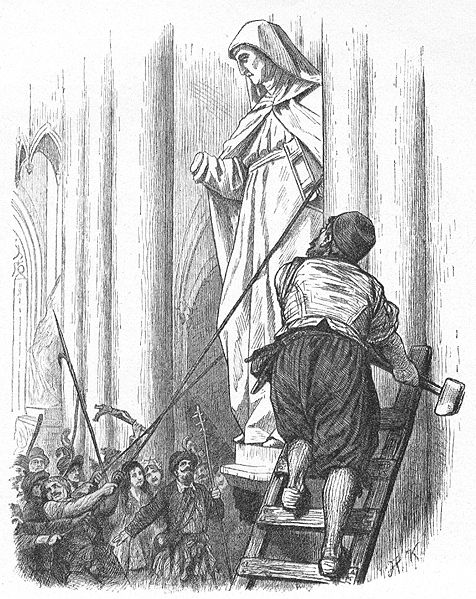
The 'Breaking of the Images' in the Low
Countries is quite comparable with Muslim
aggression toward idols. Yet one we call
progressive while the other is a sign of
anti-cultural sentiment?
Letting ideological dissent account for different social and economic realities is not a balanced view. On the other hand, one must be aware of deriving all cultural patterns from material conditions. Protestantism might more easily reach concord with progressive ideas than Catholicism, since the later has been a defining factor in a former order. But this only is a function of exactly that former constellation. It guaranteed that Protestantism could ally with socially progressive forces. Or better: that socially progressive forces could ally under the umbrella of Protestantism. New nobility, gentry, commercial entrepreneurs tried to secure their interests by assaulting Church property and the privileges of the old nobility. Another major factor was the buildup of a state machinery and the financial resources needed. The refeudalization, weaker state machineries and primacy of Catholicism in 'backward' Medieval Europe served the further rise of the 'strong states'. Baltic and Central Europe became a grain basket, producing much needed cereals of which the trade was monopolized by the Netherlands. Spain imported bullion from the New World to feed the growing economic activity in the northwest. Local aristocracies and the financial reserves of Italian city-states provided a market for Dutch and English cloth.

We have to view the position of the Islam in a similar logic. If the countries of the Middle East and Northern Africa are backward, it is not due to some primordial nature of Islam. Religion at best delivers an arsenal of symbols and values through which social and political forces act. Not so long ago the countries in those regions were ruled by an elite which promised modernity and progress. In reality people were oppressed, kept backward while a ruling few grew rich in serving foreign interests - the interests of the strong states. The Arab Spring was a reaction against this broken promise. And current uproar, all in the name of Islam, is in fact an internal struggle following regime collapse. Part of the old elite tries to reinvent itself, renew its promise. Islamist forces combat them by combatting their example, the Western liberal democracies. Does this make Political Islam a force of progress? I doubt it. Surely its current form is anti-Western, an enemy of the current installment of imperial privileges. The rise of Islamist regimes eats away at the hegemony of the West and brings the world further in touch with a growing multipolar reality. It will however not free the majority of the Muslim population, nor bring them material progress.

september 09, 2012

Ten Years of 9/11: Rethinking The Middle East

So by now it has been eleven years, not ten. I wrote this as a guest blog for a good friend of mine. In fact that has been my first post ever to appear on Blogger. Its message is significant enough to be stressed once again. A repost is also interesting since my next contribution, due for 09/11, will place the same Middle East policy in a long term perspective. (Damn, I said no deadlines). Enjoy!

Day to day it has been ten years since Al-Qaeda struck the United States in its heart. 9/11 was certainly one of the most dramatic events of the past two decades. I do however disagree with the common view that it was one of the most significant ones. Without wanting to palliate the cruelty of the terrorist attack, I do feel its impact on world politics is not as direct as generally accepted. The effect of 9/11 was, I argue, mostly indirect and of a subjective nature. In the course of events taking place after the towers of the World Trade Center came down, America reacted with drastic measures. Washington increased its efforts in securing the safety of its citizens, sometimes by harassing those very citizens, and started a costly war on terror. It is exactly the road taken right after the attacks that would shape world politics for the next ten years. When it comes to significance for policy makers, the heavy costs of war and often problematic progress in rebuilding ‘freed’ nations like Afghanistan outweigh the September sting.

My opinion is not that 9/11 was completely irrelevant, but I do feel its impact is one constructed in the minds of both policy makers and the public at large. The terrorist act itself was sanctified as a symbol of fundamentalist hatred towards the innocent West while it was only a minority’s brutal response to America’s actions in the Middle East. This emotional misinterpretation fed and strengthened an image of  ‘us against them’. The public opinion shifted. A vision was created in which the Middle East was believed to be full of backward terrorists plotting to bring about the end of western democracy. Of course the number of oppressing regimes we supported far surpassed Islamist states, another fact gently neglected. In turn this mistaken paradigm contributed to the American answer to the attacks: war abroad and security at home. When the American people were confronted with persisting Taliban sympathies in Afghanistan and parts of Pakistan they saw their idea that the average Muslim is a warmongering fundamentalist confirmed.

Both the American answer to Muslim extremism and the distorted public opinion it partially draws upon are flawed for at least two reasons:

(1) First of all the actual causes for religious fanaticism in the Middle East are not recognized. The belief that Islam and indeed the Middle East itself is a monolith does not correspond with reality. Not  all –  not even most – Muslims agree to violence or the oppression of women. We don’t need to support militarist dictators in order to avert the rise of Islamist terrorists. An example is the young middle class that lives in Karachi, the biggest and most liberal city in Pakistan. The youth there likes to party and engage in performing arts. They proof that there exists something like a modern and self-conscious Muslim living in the Middle East. What most of us fail to see is that religious fundamentalists, such as the Taliban, gain their support by exploiting poverty. The real causes are indeed socio-economic in nature: hunger, corruption, lack of proper education, etc. Which is exactly why their support for the fundamentalists is all the bigger in underdeveloped mountainous regions.

Failing to endorse the role of socio-economic causes can have disastrous results. Take for instance the 2010 floods in Pakistan. An enlightened take on the Middle East would stress the importance of economic certainty and food supply. Because of the distorted public opinion in the West, however, the influx of financial support was substandard, worsening our credibility with a needy population. After all who wants to aid a terrorist? Another even more painful example of how counterproductive this mistake might be, has to do with the 9/11 attacks themselves: no-one dared to inquire what the motives for the attacks were. Not even the official report of the 9/11 Commission mentioned the only rational question ‘why’. Why not? Because they didn’t want to acknowledge that Al-Qaeda itself defined its terrorism as a response against US foreign policy. We don’t want people to question our policy, now do we? And so by bringing more war and destruction to the Middle East, NATO became an instrument for spreading hatred towards the West. Think of it as Newton’s third law of motion: For every action there is always an equal and opposite reaction.

(2) A second major issue is that the policy toward the Middle East has since long been dominated by a certain degree of hypocrisy. When colonization in Northern Africa and the Near East came to an end, the new nations were either ‘westernized’ or ‘Sovietized’. Experiments along the line of non-alignment were not appreciated by either Cold War camp. The resulting polarization cast its shadow over the Arab World. The US-Soviet dualism dominated conflicts such as the Arab-Israeli conflict or the internal politics of countries like Syria or Turkey. The ground shaking Iranian Islamic Revolution of 1979 breached this ideological dualism and marked the rise of political Islam. Military powers in the West however remained caught in their two-party paradigm. The US in particular failed to recognize the demise of the bipolar world order and the erosion of its own status as a superpower. (As a side note I’d like to add that the Soviet regime didn’t recognize these evolutions either, but they had quite an effective eye-opener about ten years later.) Because the US government failed to look beyond the two-party structure, it trained and funded Islamists to combat the Soviets in Afghanistan. Those very same freedom fighters used their CIA training to erase numerous innocent lives on September 11, 2001.

Ever since World War II ended, the democratic West has been supporting not so democratic regimes around the globe, first to combat ‘Communism’ and now to hold off the Islamist threat. I hope my argumentation above provided insight in how seemingly isolated events are actually part of more encompassing structures. The time is right for a new paradigm in dealing with the Middle East, one that corresponds with reality. As shown in the example concerning ‘liberal’ Karachi, Islam and modernity are compatible. In the revolutions of the Arab Spring people called for social justice, free elections and an end to corruption. These protests are directed against regimes our governments supported and thus they are directed against how we treated the Middle East in the past. It is my deepest wish that news coverage of the protests in Egypt, Libya and Syria can guide the public opinion in another direction. With a public belief in the people of the Middle East our leaders might tune foreign policy accordingly, upholding fair economic relations and stressing social advancement.

februari 05, 2012

A Marxist analysis of Political Islam

After the Arab Spring revolts, elections in Tunisia, Egypt and Morocco all point toward a victory for Islamist parties. This tendency worries Western observers, who perceive Political Islam as a major uncertainty at best. These recent events, together with insights I received after talking with Muslim friends here Belgium, compelled me to blog on the matter. Is Political Islam a threat or a treat? To whom is it so and why? These are the questions that concern us. Also bear in mind the difference between Islam as such and Political Islam; the latter being an ideological current that seeks to shape society by participating in the political process.

Is Political Islam opposed to imperialism or capitalism?
Can it, as a set of ideas, formulate an answer to them?
Before anything else, Islam is a religion. And as such based on dogma - an absolute and undeniable truth that is given and exists outside of humanity. It also is a mechanism of socialization, replicating cultural patterns (values and attitudes) over generations. Cultural patterns always are historical entities, they are a product of their time. From a Marxist point of view, archaic patterns limit the scope by which people can realize their potential. Traditional Islam thus is a boundary on further emancipation. From this follows that Political Islam as it exists today is fundamentally anti-Western. Speaking in a cultural sense, that is. 'Western values' linked to modernity (freedom of religion, emancipation of women, etc.) are in conflict with the current traditional interpretations given by Political Islam.

The anti-Western attitude is however not a characteristic of Political Islam by definition. Islam can be united with modernity. So in no way am I making the case for Islamophobia or a clash of civilizations. The contradiction is one in the field of ideas, and ideas change along with the circumstances that allows them to exist. The traditional interpretation of Islam that thrives today reflects underlying material realities: Islam can be used as a means of mobilization and propagation in support of or against ruling elites, whether they'd be domestic (Ben Ali, Mubarak) or foreign (Israel, United States). Given the current circumstances, a traditional anti-Western and anti-modern interpretation is most lucrative; it is also the way of the least resistance.

Is there really a clash of civilizations à la Huntington?
Or is it actually just a clash of state/class interests?
Political Islam is thus a tool to real interests; as an ideology in itself it does not seek to alter material conditions. That Political Islam is conceptually poor can be seen in what it articulates: serving in a community and taking part in rituals is paramount. Charity toward the poor is encouraged, but the recognition of struggle against one's material conditions as legitimate is missing. Political Islam is an empty box and indeed not 'political' at all. Because Islam offers no adequate framework to criticize material conditions or structures, it is not even anti-imperialist or anti-capitalist. Sure, Islam isn't too keen on rents (making money with money) but this is a mere aspect of financial economics. In no way can Islam be used to address capitalism as a mode of production. The same it goes for the international political organization.

Does this mean that a Muslim can not be against imperialism or capitalism? Of course not, it only means he can not be so on grounds of his religious beliefs. Islam can well be mixed with other views from conservatism, liberalism, etc. But the political aspects of his reasoning would lie outside Islam. The only questions that thus remain are: (1) To what extend can Islam be consistently unified with other (modern) ideologies? (2) Supposed that a modern formulation of Islam would not be meaningless, would it be useful? From my Marxist perspective on religion, the answer is quite clear-cut. I do nonetheless look kindly to efforts linking Islam with modernity.

Any thoughts, questions, or other relevancies? Please do share in the comments section! :p

januari 24, 2012

The Iranian bomb: cause or solution to unrest?

In a previous post I explained how the conflict between Iran on the one hand and the United States on the other is in fact a security dilemma. Both sides are 'securing' their interests at the expense of creating more danger to the interests of the other. A quick recap of the facts: Iran is accused of working on nuclear weaponry by the United States and regional ally Israel. This assumption has been confirmed by IAEA reports on this case. The Iranian authorities however remain vigorously that their nuclear enrichment program is for civil ends only. My personal feel is that Iran has probably restarted its military branch of the nuclear program. A pity if you oppose nuclear proliferation like I do.

WHAT'S WRONG WITH IRANIAN NUKES?
Iran is not the only country that is going rogue with
a nuclear program. No wonder it feels insecure when
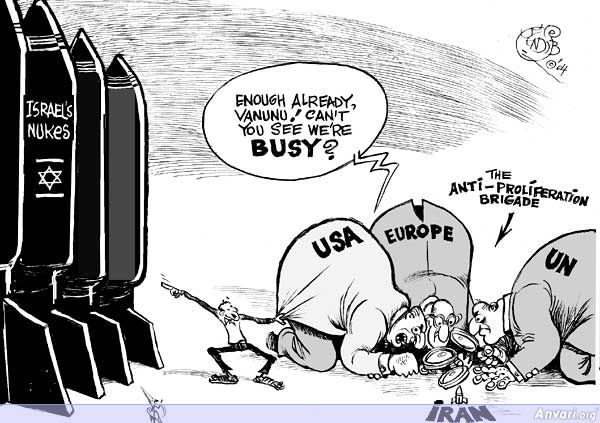
Israel and Pakistan - both US allies -  posses an arsenal.
Isn't Iran entitled to a nuclear arsenal? I'm talking about the legal entitlement here, not about the moral or humanitarian sides of the question. For this I wish to refer to the opinion on the legality of the threat or use of nuclear weapons. This statement by the International Court of Justice was to answer whether a state may use a nuclear attack or threaten to do so. The advice stated that there is no prohibition on the use of nuclear arms as such, but it would be in conflict with humanitarian law. So did the Court really rule that nukes are out of the question? Not exactly as the advice left a loophole: the Court felt that it 'cannot conclude definitely whether the treat or use of nuclear weapons would be lawful or unlawful in an extreme circumstance of self-defence'. So if a the existence of a state were at stake, the use of nuclear arms might be permitted.

In its finality this opinion is inconclusive on the use of nuclear force. In it the Court also recognized that there is no evidence for or against the legal possession of nuclear arms, thus actually allowing the continuous possession of nuclear devices. Iran is however a signatory member of the Non-Proliferation Treaty and thus committed itself to a prohibition on developing its own nuclear arsenal. This is probably the main reason Iran keeps denying that its nuclear program has a military branch; heavily sanctions might follow if Iran openly admitted any violations. It is often remarked that other states - in question Israel, Pakistan and India - have nuclear arms. These are indeed contrary to the principles of non-proliferation. But then again these three nations have not signed the above mentioned treaty. You may well consider them to be 'rogue nations' for this (I do) but fact is that they follow the rules.

HOW NOT DO DEAL WITH IRAN
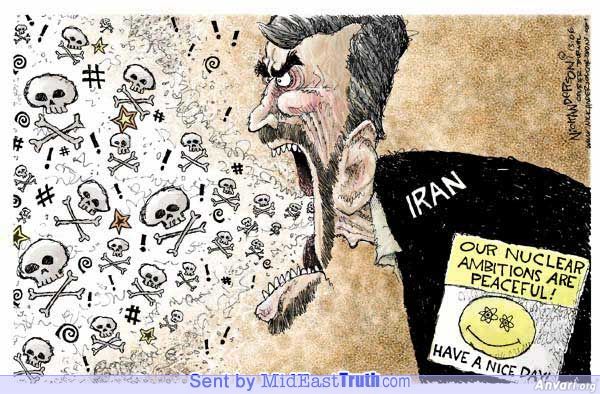
Iran remains that its nuclear program doesn't serve military
ends. That statement is likely untrue, though I do believe
that Iran is building nuclear arms for defensive reasons.
Up till today international reaction vis-a-vis the Iranian nuclear aspirations carried a certain degree of machismo. The United States, and even more fiercely Israel, have been talking about unilateral military measures. Such action is not bound to the realm of fiction: Israel acted against key facilities in the nuclear programs of Iraq (1981) and Syria (2007) before. The strategy applied against Iran is supplemented with assaults on nuclear scientists and economic pressure. The latter in the form of an embargo on Iranian oil, currently upheld by the United States and the European Union. It is my opinion that the path pursued is in its entirety a mistake. For starters the aggressive talk and action only endorse the radical voices in Iran, claiming that the West is pressuring the country toward regime change. A second setback is that the embargo will hit the people of Iran hard. If hardship for the masses is our idea of creating justice I pass for it. Not only is using this impoverishment-strategy interference with Iran's internal affairs, it is ethically most questionable too.

My feel is that Iran should not build a nuclear weapon or talk about closing of the Strait of Hormuz, the West needs to understand that aggression invokes aggression. That is the mechanism behind the security dilemma. Maybe Iran can send a message by collaborating with its fellow members at OPEC. Economic and political affirmation of the Middle East as a region in its own right would force us to rethink our strategy. And rethinking is needed. Iran certainly made some bad choices concerning its methods in the past, but its concerns are valid. As a regional power it is entitled to secure and manifest itself as long as it does not violate the rights of others.

oktober 24, 2011

Turkish accession: some obstacles

Turkey has been a recurring topic in the past week's media. First there were attacks by the Kurdistan Working Party (PKK), then there was the retaliation of the Turkish army. Few days later there was an earthquake in the East of the country, a region were a lot of Kurds live. I first considered writing something on the Kurdish question, but that would require some research. Because I don't exactly have a lot of time right now, I will stick to more familiar terrain: what are the biggest obstacles for Turkish accession to the EU?

(1) The first issue to pop up in my mind would be the Turkish recognition of North Cyprus. In 1974 a coup d'état on Cyprus would have lead to annexation by Greece, so the Turks made a military intervention. The island has been divided ever since. The northern part declared itself independent in 1983; Turkey is the only country to have recognized it. Since Cyprus is a member of the European Union, this issue needs to be settled one way or another.

(2) Another obstacle on the road to accession is the Kurdish question I already mentioned. The EU already has talks with Turkey about accession since 2005. In the light of these talks, Turkey already expanded the rights of the Kurdish minority. At least on paper, Kurds have gained various right such as education in their own language, etc. However, relations between the Turkish authorities and Kurds remain difficult. And the EU doesn't think lightly of human right...

Do you think Turkey would make a great addition?
(3) The third, and perhaps most difficult problem to solve is one that lies with the EU itself. The public opinion in countries with notable Turkish minorities is not in favor of Turkish accession. I think of Belgium, France, Germany, etc. The governments of these countries are most sensitive to this. Strange enough, a lot of Turkish immigrants and their children aren't big fans of Turkish accession either. Promises have been made so if Turkey insists it will become a member state. But all the stalling might make that Turkey changes its mind.

I myself am a most fanatic supporter of Turkish accession. Turkey has a young and dynamic population, a growing economy and a (relatively) big army. Also, as a predominantly muslim country and gateway to the Middle East, it holds diplomatic and strategic importance. I honestly hope we can welcome Turkey in the EU within a matter of years!

oktober 20, 2011

Security issue or security dilemma?

Recently, the United States claimed they had prevented an Iranian terrorist attack. The supposed violence-in-the-making would have been directed against the Israeli and Saudi-Arabian embassies in Washington. A faction of the Iranian Revolutionary Guards - the country's politically influential elite army - would have been behind the plotting. The Iranian government denies all accusations, which they percieve as a framing operation set up by the United States itself. I will stay clear of declaring any truth. In stead, this article will offer a framework to analyse the tensed US-Iran relation, based on the classic notion of the safety dilemma.

A safety dilemma occurs when one state raises its military capacity and, by doing so, becomes a treath to a second state. This other state will have to decide whether to respond proportionally or to remain idle. When responding with armement, the first state may interpret this as a hostile signal undoing its initial effort; an arms race is started. Persuing the second option however means that a (percieved) risk is left unattended. This phenomenon, which involves a great deal of subjectivity, proves to be most usefull in explaining US-Iranian frictions.

Uncle Sam and president Ahmadinejad in a 'staring contest'
Let's start with the States. The US has a Cold War-era ally in the Middle East which isn't too loved by the Arab nations. This ally Israel is believed to possess nuclear arms, though it never formally confirmed or denied this. In adittion, the States supported Irak in its war against Iran back in the eighties. American support was given to Saddam Hussein (yes, the very same) because the Iranian regime wasn't too favorable for the West. This war, which continued from 1980 to 1988, is a bit forgotten by most of us but the terrible attrocities inflicted upon the Iranian people are well-remembered over there. It  is a scar that never fully healed and here is where trouble kicks in. Iran is still traumatized by its history. It still thinks that the main objective of the West concerning Iran is to install a friendly regime it can influence. Just like the one of the Shah before the Islamic Revolution. With a nuclear treath in Israel and ongoing military presence in Iraq and Afghanistan, Iran feels enclosed. The only way it sees out of this 'brutal imperialism' is a nuclear weapon of its own. Iran's nuclear program, together with its violent language when condamning Israel or the US, are only the stepping stone to the next degree of the security dilemma. Now the Iranian bomb in turn is seen as a treat to regional stability by the Americans.

The perception of both states is in this all more important than the facts. Does the US seek to overthrow the Ayatollahs? Is Iran being agressive in its nuclear program? Was a terrorist attack prevented or is it a framing operations after all? These questions might be interesting, but they do not reach the heart of the conflict. What really matters is that the US and Iran are engaged in a logic of confrontation; there is a lack of mutual trust. We aren't looking at a security issue, but rather at a security dilemma.