Posts tonen met het label Ideology. Alle posts tonen

september 21, 2012

Islam Spelled Backwards: A Lesson In History

The characterization of Islam as backward has a long
history. Yet such representation fails to grasp the
genesis of the backward cultural frame or the direction
of the profits generated by it. Islam is not as such
by definition, it always functions within a context .
Muslim agitation over 'insulting' imagery is nothing new. It is as present in the media as advertisement. I can't turn on my television or pick up a newspaper without bumping into the latest analysis, opinion, or tirade. Chances are that you experience the same. That is why I first decided not to contribute on this issue. Surely, the facts are by now well-known: a distasteful depiction of the Muslim prophet invoked outbreaks around the world. The violence stirred debate on the compatibility of Islam and 'modern' values like freedom of speech. All too often, the friction which exists between Islam and liberal democracy is reduced to a Clash of Civilizations. 'Islam is a backward belief incapable of allowing democracy to flourish', such is the stance. On the other side of the debate, religious extremists eagerly adhere to this logic of collision. They invert the Western insult to a threat. I dealt with this perspective before. Still, mainstream media fail to grasp the real forces at play. They either subscribe to populist name calling or conjure up an image of the 'backyard Muslim'. The latter to remind us that many Muslims are valuable members of the community. What lacks is a coherent framework to combat the superficial clash put forth.

Religion is often used - misused - as a guise for real social conflict. Indeed conflicting interests have been masked by ideological differences throughout history. Today Islam is coupled to backwardness, but during the 16th century this role was allotted to Catholicism. At the dawn of modern Europe, religious conflicts tore apart political units at most levels. The rise of Protestant movements challenged the old order. Protestantism came in many a form, from the rather modest Anglicanism to radical Dutch Remonstrants. After the dust of the Thirty Years War settled, Protestantism had triumphed in those regions that would do most well in economic terms: the Dutch Republic, England, Scotland, and to some extent France which had the Huguenot legacy. Catholicism strengthened its position in Spain, the Italian states and Poland. These more peripheral areas saw a refeudalization as opposed to the forward surge of (proto-)industry in the Protestant nations. My point? If today's rhetoric was to be applied on this historic case, the conclusion would be that Catholicism is backward while Protestantism is not. Such a view has indeed been suggested. Yet, I prefer a vision that takes into account the gameplay behind the curtain of theological discussion.
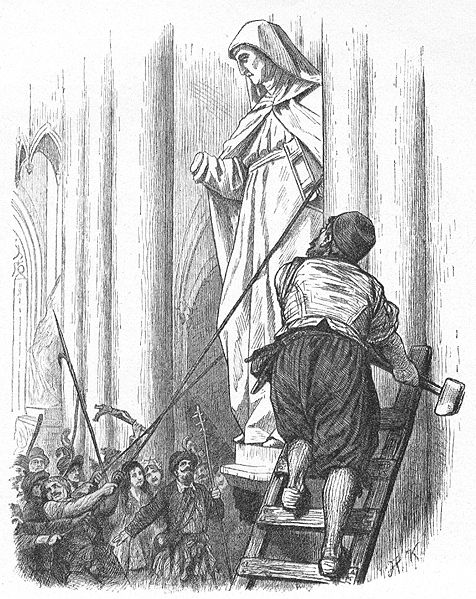
The 'Breaking of the Images' in the Low
Countries is quite comparable with Muslim
aggression toward idols. Yet one we call
progressive while the other is a sign of
anti-cultural sentiment?
Letting ideological dissent account for different social and economic realities is not a balanced view. On the other hand, one must be aware of deriving all cultural patterns from material conditions. Protestantism might more easily reach concord with progressive ideas than Catholicism, since the later has been a defining factor in a former order. But this only is a function of exactly that former constellation. It guaranteed that Protestantism could ally with socially progressive forces. Or better: that socially progressive forces could ally under the umbrella of Protestantism. New nobility, gentry, commercial entrepreneurs tried to secure their interests by assaulting Church property and the privileges of the old nobility. Another major factor was the buildup of a state machinery and the financial resources needed. The refeudalization, weaker state machineries and primacy of Catholicism in 'backward' Medieval Europe served the further rise of the 'strong states'. Baltic and Central Europe became a grain basket, producing much needed cereals of which the trade was monopolized by the Netherlands. Spain imported bullion from the New World to feed the growing economic activity in the northwest. Local aristocracies and the financial reserves of Italian city-states provided a market for Dutch and English cloth.

We have to view the position of the Islam in a similar logic. If the countries of the Middle East and Northern Africa are backward, it is not due to some primordial nature of Islam. Religion at best delivers an arsenal of symbols and values through which social and political forces act. Not so long ago the countries in those regions were ruled by an elite which promised modernity and progress. In reality people were oppressed, kept backward while a ruling few grew rich in serving foreign interests - the interests of the strong states. The Arab Spring was a reaction against this broken promise. And current uproar, all in the name of Islam, is in fact an internal struggle following regime collapse. Part of the old elite tries to reinvent itself, renew its promise. Islamist forces combat them by combatting their example, the Western liberal democracies. Does this make Political Islam a force of progress? I doubt it. Surely its current form is anti-Western, an enemy of the current installment of imperial privileges. The rise of Islamist regimes eats away at the hegemony of the West and brings the world further in touch with a growing multipolar reality. It will however not free the majority of the Muslim population, nor bring them material progress.

maart 18, 2012

The American Voter: US Political Culture Explored

I worked really hard on this post and wondered if I would finish it by the US presidential elections of 2012. Luckily for me it is done well before. So here it is: some reflections on the American voter, backed with numbers and fancy sources. This post is not so much on ordeal, rather it functions as a set of ideas that frame the upcoming elections. Feel free to feel inspired and please share any thoughts! :p

Political culture is hard to define, yet it offers an attractive explanation for national differences concerning political behavior such as voting. 'The French are such', 'Americans do not think that way', etc. I am confident you have heard some like those before. There are indeed a lot of differences, but they are in my opinion not given. First of all political culture is dynamic: it can change over time (see the graph below). This is evident from the declining trust in political institutions with Americans. Second, the creation of and changes in political culture are the result of historical development. The trust is influenced by education levels, economic climate and central figures with their vigor or scandal.
Now how unique is the American political culture? Ronald Inglehart, famous amongst political scientists, was a driving force behind thinking about post-materialism: a value pattern focussing on self-realization relative to self-preservation. By adding traditionalism/secularism as a second dimension, Inglehart identified different cultures. He found an Anglo-Saxon value pattern which scores very high on self-realization and moderate on the second dimension. This is expressed in various features of American political culture: the perceived exceptionalism, the belief in popular judgement and the typical conception of freedom. All these elements are rooted in the history of the American state and society: fleeing religious or political persecution, resistance against the English crown, the autonomy of the states, etc.

(It needs to be said that the dominant political culture in the United States is perhaps more of an imposed value pattern rooted in the Anglo-Saxon and Protestant inheritance. Values differ along various lines, of which ethnicity might well be one. In how far the political culture is shared by say Afro-Americans or Latinos is hard to say. Even more difficult is it to draw conclusions as to how 'American' American political culture is.)

'American' political culture: a combination of influences or
the dominance of white Anglo-Saxon Protestant values?
The above should enable us to situate the American political culture and place it in its historical context. On to the voter now, as the upcoming election is the essence of this article. United States politics is largely spared from the increasing fragmentation that has Europe in its grip. Even in the UK they need to form coalitions now, despite the majoritarian mode of voting. This does however not mean that voting behavior didn't change in the States. Like everywhere in the West, identification of the voters with a single party has been diminishing. The electorate is increasingly motivated by what is called 'retrospective voting': casting your ballot based on specific issues, the image of parties/leaders and the economic climate.

Studies from the sixties up till now show that only up to a fifth of the American population is motivated by ideological reasons when casting the vote; about 40% defines politics in terms of group interests (classes, ethnicity, etc.) and 25% rewards or punishes the establishment based on the general tendency of the economy and society as a whole. The others are, sadly, apathetic: they don't give a ----. Furthermore, an overwhelming eight out of ten voters show no temporal stability in their ideological preferences. However in times of crisis and change the electorate becomes more ideological in its thought than its leaders, pushing for extremes. If these results don't seem to tell you anything, read this paragraph over once again whilst thinking about Obama's success in 2008. Now repeat that exercise with the possible Republican nominees for this year in mind.

Sources:
Converse, P.E. (1964). The nature of belief systems in mass publics. In D.E. Apter (Ed.), Ideology and discontent (pp. 206-261). New York: Free Press.
Hague, R. & Harrop, M. (2010). Elections and voters. In Comparative government and politics: An introduction (pp. 179-202). Basingstoke: Palgrave.
Hague, R. & Harrop, M. (2010). Political culture. In Comparative government and politics: An introduction (pp. 121-137). Basingstoke: Palgrave.
Inglehart, R. (1997). Modernization and postmodernization: Cultural, economic and social change in 43 countries. Princeton: Princeton University Press.
Inglehart, R. (1999). Postmodernization erodes respect for authority, but increases support for democracy. In P. Norris (Ed.), Critical citizens: Global support for democratic governance (pp. 359-392). Oxford: Oxford University Press.
Putnam, R. (2002). Democracies in flux: The evolution of social capital in contemporary society. Oxford: Oxford University Press.
Sears, D.O. & Funk, C.L. (1990). The role of self-interest in social and political attitudes, Advances in experimental social psychology, 24, pp. 1-91.

februari 12, 2012

"We, The People"

My activity is on a downward slope, so it seems. My paper has me really occupied so all I can present you for now is this exciting piece of text on language and populism. It looks dull though, no links or color images involved. I promise more eye candy in the next one. Cross my heart and hope to write more soon.

See if you recognize the following reasoning: "Intellectuals look down on the common man and are estranged from reality as it is experienced by the people. They use a language infused with technobabble that conceals reality and thus gives a distorted view." Sounds familiar? It is called a populist discourse which aggressively downplays the role of theory and language. A defensive reflex against theory can be found anywhere in the political spectrum: populism is a matter of left and right, of progressive and conservative. Yet it is naive and above all it is dangerous too. By bashing intellectuals and glorifying everyday speech, populists endanger actual emancipation.

"Society is an amalgam of groups constructed along fluid identities."
First of all, the populist critique against class, gender, race, etc. can be turned against the catch-all categories like 'common man' or 'the people'. These are ideological constructs themselves and there is no reason to assume a priori that they more accurately describe reality! Indeed the populist discourse is dangerous because whoever claims 'the common man' claims a majority. This constructed majority is based on a patchwork of stereotypes: the common man is a caucasian male with limited schooling who works hard, pays his taxes, loves his family, watches popular media and thinks that all politicians are crooks. This cliché can be expanded in any direction at will to gain the favor of other identities. Quite a few things are ignored by populists which become obvious when we introduce a wider geographical area or certain historical developments into our analysis: we have high schooling degrees, deprivation is largest with immigrants/non-whites, gender is not a given thing, etc. Society is an amalgam of groups constructed along fluid identities. This fluidity should not be mistaken for a common identity or even common interests. The boundaries of classes are vague and sometimes they overlap, but the cores of classes still remain.

Populists reject any such analysis. For them the world is a simple place in which the struggle is one between elites - either misguided or malevolent - and the people. Populism therefore is in general a struggle about discourse; a struggle that encompasses more than just 'the people' versus 'classes'. That the attacks of populists are not justified can be seen in their selectiveness: they oppose theory, abstractions, terminology, etc. only when it concerns social and political phenomena. Never they oppose terms as inflation, appeal, cardiological or fusion-reactor. Why not? Because the associated fields of theory do not pose a threat to them. Nothing more dangerous to a populist than describing social reality. After all, you might get people emancipated...

Overcomplicating things is never a good thing. Explaining social phenomena in a understandable way is a must for the advantaged. The real evil lies however in the opposite of oversimplification. When you keep them stupid, you can keep them down. So do as Bob Marley sang and emancipate yourselves of mental slavery. Dare to deconstruct your language, but always with a constructive attitude.

februari 05, 2012

A Marxist analysis of Political Islam

After the Arab Spring revolts, elections in Tunisia, Egypt and Morocco all point toward a victory for Islamist parties. This tendency worries Western observers, who perceive Political Islam as a major uncertainty at best. These recent events, together with insights I received after talking with Muslim friends here Belgium, compelled me to blog on the matter. Is Political Islam a threat or a treat? To whom is it so and why? These are the questions that concern us. Also bear in mind the difference between Islam as such and Political Islam; the latter being an ideological current that seeks to shape society by participating in the political process.

Is Political Islam opposed to imperialism or capitalism?
Can it, as a set of ideas, formulate an answer to them?
Before anything else, Islam is a religion. And as such based on dogma - an absolute and undeniable truth that is given and exists outside of humanity. It also is a mechanism of socialization, replicating cultural patterns (values and attitudes) over generations. Cultural patterns always are historical entities, they are a product of their time. From a Marxist point of view, archaic patterns limit the scope by which people can realize their potential. Traditional Islam thus is a boundary on further emancipation. From this follows that Political Islam as it exists today is fundamentally anti-Western. Speaking in a cultural sense, that is. 'Western values' linked to modernity (freedom of religion, emancipation of women, etc.) are in conflict with the current traditional interpretations given by Political Islam.

The anti-Western attitude is however not a characteristic of Political Islam by definition. Islam can be united with modernity. So in no way am I making the case for Islamophobia or a clash of civilizations. The contradiction is one in the field of ideas, and ideas change along with the circumstances that allows them to exist. The traditional interpretation of Islam that thrives today reflects underlying material realities: Islam can be used as a means of mobilization and propagation in support of or against ruling elites, whether they'd be domestic (Ben Ali, Mubarak) or foreign (Israel, United States). Given the current circumstances, a traditional anti-Western and anti-modern interpretation is most lucrative; it is also the way of the least resistance.

Is there really a clash of civilizations à la Huntington?
Or is it actually just a clash of state/class interests?
Political Islam is thus a tool to real interests; as an ideology in itself it does not seek to alter material conditions. That Political Islam is conceptually poor can be seen in what it articulates: serving in a community and taking part in rituals is paramount. Charity toward the poor is encouraged, but the recognition of struggle against one's material conditions as legitimate is missing. Political Islam is an empty box and indeed not 'political' at all. Because Islam offers no adequate framework to criticize material conditions or structures, it is not even anti-imperialist or anti-capitalist. Sure, Islam isn't too keen on rents (making money with money) but this is a mere aspect of financial economics. In no way can Islam be used to address capitalism as a mode of production. The same it goes for the international political organization.

Does this mean that a Muslim can not be against imperialism or capitalism? Of course not, it only means he can not be so on grounds of his religious beliefs. Islam can well be mixed with other views from conservatism, liberalism, etc. But the political aspects of his reasoning would lie outside Islam. The only questions that thus remain are: (1) To what extend can Islam be consistently unified with other (modern) ideologies? (2) Supposed that a modern formulation of Islam would not be meaningless, would it be useful? From my Marxist perspective on religion, the answer is quite clear-cut. I do nonetheless look kindly to efforts linking Islam with modernity.

Any thoughts, questions, or other relevancies? Please do share in the comments section! :p

januari 05, 2012

Nationalism as an empty box: the Flemish case

Recently, my good friend and blogger Dimitri asked me how he could define ideology. He was tasked with a review of Breytenbach and his literary opposition to the South African Apartheid regime. This compelled me to re-investigate some material I came across last year whilst writing a paper myself. In this post I want to share some insights on nationalist ideologies.

I resent the tendency among nationalists to defend their ideas as a coherent national ideology. There, I said it.

When assessing whether nationalism can be an ideology, one must keep in mind the distinction between two contrasting views on the concept: the scientific and the ideological. Any ideology will claim that it offers a coherent world view rooted in a real basis. All other ideologies are rooted in something else, something 'not real', and thus are false. For nationalists the ultimate foundation is the national character, the 'soul' of a people. To allow this nationalists have to presume a primordial 'nature'. Traditional nationalism considers the qualities that make up this nature to be given and invariable. More sophisticated versions circulate today, but I feel that the discourse of cultural patterns is more of a rhetorical means to block criticism. For it sure is not a genuine element of the theory.

"Rectilinear Flanders - Turn the page in a
pull to the right and you will see the
center color black" - cartoonist GAL
criticizes the impact of the ideology behind
Flemish nationalism. Depicted is De Wever
chairman of the New-Flemish Alliance.
From a sociological point of view, presuming a people with a single nature is too much of an abstraction. Bart De Wever, leader of the Flemish nationalist party N-VA, often recognizes this in debates. What he fails to explain is how nationalism can escape the devastating impact of this conclusion. (It can't). This pattern is typical for modern nationalism: Romantic views of national liberation lack the mobilization potential it had back in the 19th century. And indeed nationalism in itself has become hollow, an empty demand for autonomy that floats in an ideological vacuum. The empty box of nationalism requires to be filled with the conceptual framework of a proper ideology.

In the Flemish case we see that the N-VA draws upon neoconservative ideas on society and mankind. For its economic program it takes on board neoliberal recipes. This makes that the party program - save from the demand of independence in itself - has nothing to do with nationalism. The other Flemish nationalist party, Vlaams Belang, adopts an ideology situated at the far-right. Politicians of these two parties argue that Flemish nationalism provides a case for analyzing practically anything, from the budget to migration policy. But they are wrong, nationalism is not an ideology! Always try to trace the underlying ideology and unmask nationalism for the poor view it is - if it can be called a view at all.