Posts tonen met het label Economics. Alle posts tonen

september 09, 2012

The Decline of US Power: An Eagle Crash Landing?

Columbia, as personification of the United States, carries
civilization westward. This image represents the 'manifest
destiny' of America as well as its expansionist tendency.
The 09/11 attacks were an eye-opener, a moment of revelation. Not so much as a defining moment, but rather as part of a lengthy historic trajectory which entails the decline of US hegemony. The majority of American policy makers, however, responded with denial and anger. They remain attached to the idea of American exceptionalism. To them the American dream is a guiding light for individuals around the world, Americans have a manifest destiny. While these underlying values present useful insights, they are not an exact representation of reality. To understand the world we need to look beyond our dreams; we need to look at the history of the United States and its place in the world. This post seeks to do just that. What do we see when we trace this superpower? How is it that the terrorist attacks and the American response, a 'War on Terror', fit in this pattern?

The truth is that by the turn of the millennium the States already lost their shine. A lone superpower that lacks true might. A leader everybody stopped following. Drifting dangerously amidst a chaos it cannot control.

In the nineties the US economy seemed to do well. Productivity was high, the stock market boomed, both unemployment and inflation were low. The resulting surplus made possible the liquidation of government debt. Many Americans believed this to be an affirmation of the vision and the economic policy of their leaders. What at first seemed to be success turned out to be a bubble. But even bubbles and downturns are deceiving: the world-economy has been in relative stagnation ever since the seventies!1 For three consecutive decades, the powerful economic loci have tried to shift the losses to each other. Western Europe did well in the seventies, then Japan had its decade, and the States had their share in the nineties. Globally, however, success was dim. The global economic slowdown parallels the decline of American hegemony. Indeed this is no coincidence. And it is all but certain that the US will outshine its competitors in a resolution. An under-the-surface fear is already today shaping American policy.

Central, though not crucial, in both economic and political decline was the Vietnam War. This costly conflict exhausted the American gold reserves at a moment when both Western Europe and Japan experienced an economic upswing. With the abandonment of fixed exchange rates, US pre-eminence in the global economy came to an end. Vietnam was perhaps even more devastating in another way: it was a rejection of the status quo as established by the winning powers of WWII at Yalta. A rejection by Third World nations which wanted to pursue their own way. The social upheaval of 1968 drew upon this. Just like the people of Vietnam, protesting youth contested the collusion of the two superpowers. While the direct political consequences of this 'revolution' were minimal, its intellectual and geopolitical implications were irrevocable. Centrist liberalism, binding conservatives and radicals alike since 1848, fell of its throne. Ideological choices presented themselves as conservatives became again conservative and radicals, radical.
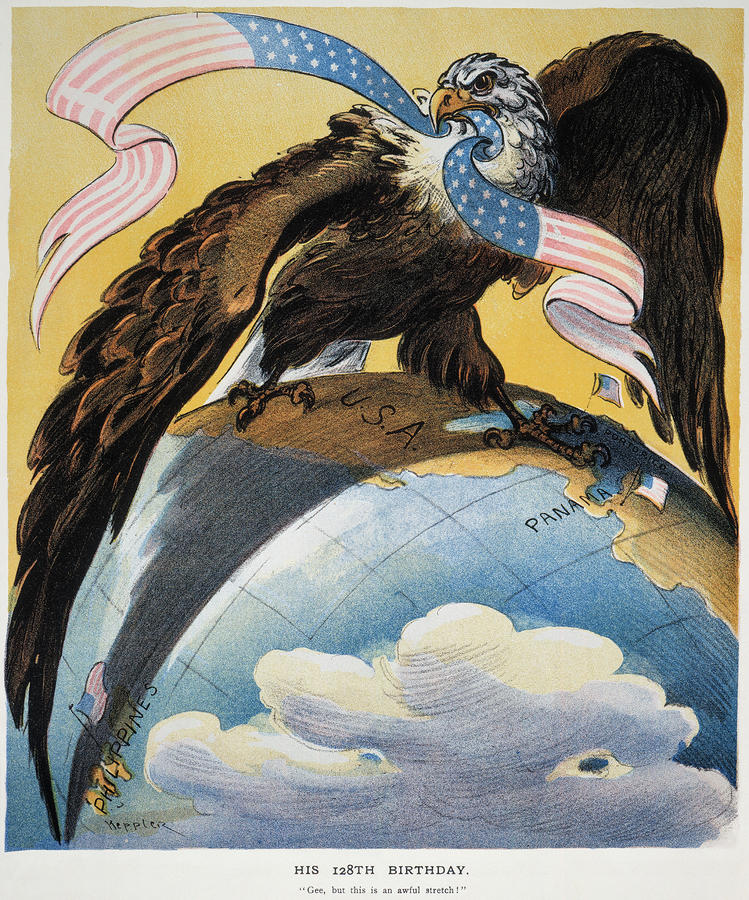
Cartoon depicting US imperialism in the Pacific and the
Americas. Military-driven maintenance of 'empire' denies
the waning hegemony and in fact strengthens this trend.
Conservative tendencies took the steering wheel under the flag of neoliberalism. With the onset of economic stagnation in the seventies, ‘developmentalist’ policies were abandoned. As a political complement violence and rejection became more widespread in the Global South. The US had to rely increasingly on brute force, in itself a sign of growing weakness. Military failures came about in Lebanon (1983) and Somalia (1992), where American troops were effectively pushed out. Success existed mainly against countries without troops, like Grenada and Panama. While the US wasn’t  paying attention, the Soviet Union collapsed. A cause of the liquidation of the Yalta agreements and internal liberalisation. In spite of all Western victory and end of ideology, the collapse of Communism meant in effect a collapse of liberalism. The Soviet threat was the only justification of American leadership over ‘the free world’. Of course the illusion of supremacy persisted, as it does in many ways up till today. As an arbiter in the Middle East the US kicked Iraq’s but in the Gulf War. Yet all the superpower could demand from a medium strength regional player was status quo. An intervention stopped the worst atrocities in Yugoslavia. But the ethnification went on and was indeed legitimized.

09/11 too proved the waning American power. It is not so much that a band of rogue fanatics with relatively little resources managed to scar the number one military power. It is the response that speaks: invading Iraq, a country that had nothing to do with the attacks, without much international consultation. This only spread anti-American sentiments, even among allies. Different voices are heard in how to deal with this reality. On the one hand there is the isolationist tendency, preaching a withdrawal into Fortress America. On the other hand there is the ‘hawkish’ macho-militarism. Both expressions of American nationalism, they share the same attitude toward others: one of fear and disdain, a belief in the superiority of the own way of life. Involvement in the quarrels of others is only permitted if we can impose our ways. Without a real possibility to bend the downward trajectory, however, the United States have chosen to ignore the trend. A policy prevailing from Vietnam till today that only hastens the decline.

1 World-economy is a term borrowed from world-systems analysis. For our usage here it can be equated to the global economy. When we say this global economy is in relative stagnation we mean that it is not expanding at as fast a rate as before, hence the 'relative'. For a general introduction to the underlying mechanism and the supposed consequences, see World-Systems Analysis: An Introduction.

februari 15, 2012

Capitalism and the global environment

As I explained at the beginning of my previous post I am spending all my free time on doing research for my paper. It came to me that if I wrote something on that, I would be able to maintain focus and keep you readers well-supplied for the next couple of days. What follows is a slimmed down summary of what I've been reading the past few months. It accounts of the exploitation of the South, its environment and the evil ways of capitalism. Enjoy!

In the West we still are under the impression that we ought to learn people in the South how to live in a sustainable way. This is evident from our leader's attitudes at international conferences and the various 'plant a three in the South'-like campaigns that are put forth as a solution to ecological crisis. As if environmental degradation in the South is the result of ignorance rather than poverty. As if we are setting a good example...

This is exactly the attitude that needs tackling: the whole idea that the North has the most progressive environmental policies is misleading. Sure, such statement holds when we are talking about quality standards of rivers and the like. But what about international trade? "Now what has trade got to do with it", you ask? Economic policy is not isolated from environmental concerns, just like the world economy is not isolated from the global ecosystem. The North consumes a majority of the natural resources that are extracted from this planet, yet most degradation that accompanies this extraction is experienced in the South. Rich countries use their purchasing power to shift the burden to the South. We cut down African rain forests in stead of American temperate woods. Now isn't it strange that third world countries suffer from deforestation while we don't see that many IKEA-closets in Kinshasa?

We can maintain both our welfare and natural richness by externalizing the environmental costs associated with production processes. We are still exploiting the South when enjoying our Starbucks coffee or blogging from our HP laptop. Not that we should be surprised at such a conclusion. Exploitation is the very mechanism that makes money go round. From its very start, the capitalist mode of production was grounded in keeping certain costs external to the one who was producing for the market. The market value in other words should not reflect the full cost of production upon society. An example: Starbucks doesn't make you pay for the biodiversity that got lost while clearing tropical forest for a coffee plantation.

"But doesn't the market tend to evolve toward some kind of balance, a correct price?" If only economists would use a little more of their time researching why the optimum is so hard to achieve, you wouldn't need to ask that question. (Economists tend to chatter along about an optimum hardly ever achieved...). If prices where to reflect the real social and environmental costs inflicted, there wouldn't be any surplus gain. The notion that under perfect competition no surplus profits are made is central to economic theory. Yet a lot of free market champions don't seem to understand that you can't get anything for free.
This is why a fair and sustainable society can never be achieved under capitalism. In a system based on the exploitation of both labor and nature, wealth can only be generated for a few at the expense of the many. If we would force our firms to internalize the full cost, the system would start to sputter. Our mode of production is one of production for sale; market value prevails over use value. Change needs to occur at the most fundamental level. Capitalism, with its insatiable hunger for more, functions as a treadmill of destruction. It must be stopped before it collapses under the gravity of its own consequences.

januari 29, 2012

How the EU combats the crisis

I found this marvelous chart on the website of the Institute of International and European Affairs (IIAA). The IIAA is an Irish think tank with a main focus on topics related to the European Union. It describes itself as 'an independent, not-for-profit organisation with charitable status'. The chart gives an oversight of the different components of Europe's anti-crisis strategy. It may look puzzling at first, especially if you are not that into economic terminology. Still, it is one of the most comprehensive and understandable explanations I have seen. Next time when you hear a journalist or politician rambling about eurobonds or the financial stability pact, just take a look at this chart.


As is evident from the image a lot is going on and it should be sufficient to stabilize the situation. Still, in the long run there is a lot of work to be done. I'm happy that the chart hints toward greater integration in social and economic areas such as employment. I'm also a big supporter of the fiscal union with 'more cash transfers between rich and poor regions'. A lack of unity and over-emphasizing one side of the integration process is what brought us this mess. More Europe - and a more balanced Europe! - thus is the way forward.

januari 21, 2012

American elections, economic crisis and the future world

The upcoming United States presidential election promises to be most interesting. America is at a crossroads: it can continue down a road of careful progress or it can try to secure the system it currently leads. The latter might create some successes in the short run, but the ultimate demise of the current world-system is inevitable. Even more vulnerable is the dominant position of the United States within that system. As I shall continue to argue, American politics would do better by using their achievements to sustain progress in stead of holding it back. Now it would do violence to reality to state that these two policies are parallel to the Democrat-Republican divide. It can however not be denied that, in recent years, the two parties have polarized. This can be seen in the charts on the right. It is also evident from the heavy resistance of some against the approaches of incumbent president Barack Obama.

AN HISTORICAL PERSPECTIVE
This political polarization is a result of the waning position of the United States as hegemon within the world-system. The concept of hegemonic power is complex and much debated. For issues of space I shall refer to the related concept of superpower: the States have a significant more means to steer the direction in which the world goes. For a long time, and certainly since the demise of the Soviet Union, it policed international society on its own. Examples are the creation of the WTO and increased U.S. unilateralism. No-one can stay in power forever though; contenders are always on the rise. The unique American position has been under fire ever since the seventies. In that decade, the stabile Bretton Woods financial system was abolished, Europe acted more independently and the 'Third World' began to manifest itself as a unique set of nations. Also the loss of the Vietnam War caused heavy resentment to future foreign ventures of a military nature.

Between 1970 and 2010 the American GNP doubled
while middle income wages only rose by 20%
The end of the Cold War, and indeed the 'end of history' perceived by some, is an intermezzo of temporary nature. It only shows that the hegemon has overcome the systemic contradictions for the time being. How did the States overcome these? The answer was found in shifting the burden: the world was put on a diet of neoliberal recipes to safeguard the system of its own destruction. Working class people earned a smaller share of their productivity and Third World nations were trapped in a cycle of restructuring and loans. By cutting the prices of input - labor and raw materials - more profit could be generated to relaunch the system.

THE LOGIC BEHIND TODAY'S TAMPERING
In this light today's sputtering of the economic machine is nothing new. Another phase of contest for the system ánd the hegemon are announced. Indeed the cures prescribed are not very original: we nationalized the messy risks of the banks (they can keep the profits though) and the national governments are going to cut spending. Meanwhile environmental policies are under pressure because you don't have money to save the planet when you have to save the banks (depends on your priorities I guess). Another factor is in play here too: more sustainable production equals more costly production, read 'less profitable'.

A cartoon from The Huffington Post expressing the logic.
The benevolent hegemon, as the U.S. was portrayed in the nineties, is not so benevolent anymore. The establishment has launched an offensive: Obama is to concerned about the environment, healthcare is 'socialist', the Chinese need to increase the value of their currency, etc. It all comes down to the same thing: production must get cheaper, cheaper at the expense of equity and sustainability. They want to pass the bill to the people and the planet. The waning superpower is trying to safeguard its capital - the ultimate basis of its superiority - in various ways. Another most curious part of this wicked strategy is the uneven stress on the public debts of eurozone-countries. Washington and also London are kept strategically of the radar while their situations are fairly comparable. As a nice bonus to the euro taking part of the heat, the social achievements in continental Europe are pressured too.

EMANCIPATION FOR THE FUTURE
But there is reason to keep up hope. (About time that phrase showed up :p). Scoffing at Obama and his 'evil socialist scheme' together with the fuss about Occupy Wall Street are emancipating people across the States. If the Democrats continue down a more progressive road they might turn America from a conservative bastion to a leading reformer on the world stage. In Europe the struggle is going on as well, both within the institution of the Union as on the national level. What Europe do we want? What America do we want? These questions are being raised today. And by looking for an answer we are discovering what kind of world, what sort of society we want to be a part of...

NOTE: The graphs on polarization where retrieved from Polarized America? (Kenworthy, 2010). First hand sources are mentioned by the author.

december 19, 2011

Les blues de Bruxelles

The recent update included the possibility where I would blog on 'urgent matters' in spite of me lacking time. This post already exploits that built-in glitch in my otherwise quite firm schedule. The topic once again is the protest against Kabila's re-election as president of Congo. This connects to former posts in which I made a brief sketch of the candidates and commented on Europe's waning commitment to promote democratic values.

Congolese in Matonge with a sign praising the Belgian
anti-establishment party N-VA, of which Bart (de) Wever
is the chairman. They are blatantly missing the point...
This post is a result of my indignation toward anti-Kabila protests in Belgium. Ever since the results of the Congolese presidential elections have been announced, people have been protesting in the Congolese Matonge neighborhood of Brussels. People of Congolese origin are unhappy that Belgium tolerates Kabila's alleged election fraud. They wave Flemish nationalist flags (?!) and they accuse the Belgian establishment. They are totally missing the point! The Congolese in Belgium are fitting themselves an identity that does not exist. As they see it, the West supports Kabila's oppression out of economic self-interest. This view of course can not account for the lack of unity within Congo. I do not deny that economic patterns play a defining role. Complex reality can however not be reduced to a one-on-one relationship of Western exploitation and Congolese dictatorship.

Congolese waving a Flemish flag during the protests.
This can well be considered a strange sight in Brussels.
Colonial inheritance, Cold War dynamics and modern day globalization trough interplay shaped the Congolese economy to what it is today: an inconsistent amalgam of Western-dominated resource extraction, feudal farming methods and an informal petty market in urbanized regions. The Congolese economy is directed at meeting external demand and as such can not realize domestic development. The people of Congo are forced to fall back on the local community to satisfy their basic needs. This causes commitment to a regional identity created along ethnic and cultural divides. Since an economic base is lacking, no civil community or indeed 'nation' can develop.

Without nationhood the central government lacks the legitimacy it needs to be effective. In addition local patterns of clientelism and ethnic tensions are projected into the government institutions. Different groups became engage in a struggle for power over the state, an instrument of which each community wants to avoid that it gets used against its own security concerns. Where the state fails to provide public good, local communities struggle for power. This is the case in Congo - there is no Congolese nation, no Congolese citizenship, no Congolese identity.

The protesters in Brussels are trapped by the modernity paradigm. They blame Western egotism but remain trapped in a liberal discourse of progress and citizenship. I encourage them to tackle the real economic causes which lie underneath. Even if this means recognizing that part of the fault lies with local Congolese interests and the understandable but backward reliance on a closed identity.

december 16, 2011

On sustainable growth

Conclusions at COP-17 in Durban, South Africa were meager. True, the Kyoto Protocol to combat greenhouse emissions is prolonged. And surely commitments have been made to get a binding environmental treaty operational by 2020. Even if this outlook becomes reality, it can be classified under the label of 'too little too late'. Besides, emerging economies like China and India remain averse to far-going and legally binding measures. The other champion of environmental pollution, the United States, would have to ratify any such agreement in Congress. I seriously doubt that with its economic power waning, the States will make ecological commitments.

Bridging leftist ideas on the capitalist economic system with
ecological approaches that take into consideration the well-
being of the planet, provide useful insights for our future.
Up till today politicians have handled a strange logic in dealing with the climate crisis: the economic environment is taken as given, and from thereon we see what green measures we might take. That's bullocks, you can't negotiate with the climate! We must take into consideration the boundaries of our planet's ecosystem - without compromise. And from thát point on we should investigate what economic model is suitable. This radical shift has to take place in our minds and the minds of our political leadership.

We need to put an end to the parasitic way in which our economy relates to the environment. On a global scale, the political level must interfere in the sphere of economics. The pattern of consumption among prosperous citizens needs to shift drastically; away from unnecessary waste and luxury and toward investment in a green revolution. Parallel to the sustainable switch a big push is needed to close the ever-widening gap between rich and poor. The reason for this is twofold:

(1) Poor strata in a world dominated by market forces are confronted with unequal access possibilities. They are cut of from land, food and water even though such vital resources are abundant. Indeed it can be proven that such shortages are caused by unequal access rather than objective scarcity. As a result poor people will resort to clearing forests, burning cheap coal, etc. - this further exploiting the planet.
(2) Rich strata will make brainless consumption choices. They waste money to unneeded stuff simply because to them the marginal gain of a single euro/dollar is low. If the money thrown away had been invested in alleviating poverty, it would have contributed to a socially and environmentally sustainable world.

The essence: welfare should on a global scale be invested in the shift toward an ecologically sustainable society, which includes closing the gap between rich and poor. More growth at expense of the planet (and the poor) is in the long run devastating. Growth shall be sustainable or it shall not be at all.

december 09, 2011

Eurocrisis: An evaluation

That the euro might disappear is a thought that keeps on circulating. Today I heard that even some Irish banks are working along that scenario. A poor decision if you ask me. Political will to carry on with the euro-project is big and no economic law dictates that the eurozone should break up any time soon. Let's not forget that the euro is still a strong currency; in the end there is more room for a devaluation than for abandoning the euro altogether. The problem with the eurozone is that we have one currency that covers 27 different budgets, 27 different debts, 27 different wage policies, etc. Without getting too technical this makes the eurozone, and indeed the euro itself, vulnerable to asymmetric shocks. These are caused when one of the covered countries spends beyond its own economic payment capacity in the spirit that it is protected by the European umbrella. If one country starts to slip down the slope toward financial disaster, others soon follow. Just do not put the blame entirely with Greece and other 'small big spenders'. It were German and France banks who kept on financing in the search for profit. After all their risk was covered by government and taxpayer.

ECB president Mario Draghi, who brought the main rent
down to 1%, the lowest figure ever in the ECB history.
Now how get out of the difficult situation we're in? No two economists can seem to agree so what I will say next is certainly up for criticism. It is an opinion, but an informed opinion too. Something most EU politicians seem to agree upon is that Europe should get more grip on national budgets. Last night, 23 countries agreed to a (new) stability pact. They will implement the common rules: only 3% deficit, a public debt under 60% of BNP, etc. This formula exists since long, but this time the Commission and the European Court play a major role. In the past countries had to monitor themselves which obviously wasn't a big success. Less agreement can be found when it comes to the role of the European Central Bank. The ECB has announced yesterday that it would not keep on buying government bonds. For you who are not at home in the world of finances: Europe won't keep supporting indebted countries without limit. ECB president Mario Draghi stressed that the ECB does not have the proper mandate to do so. Yet, there is something the ECB could do instead: release the inflation genie! Inflation is the diminishing value of money over time, which manifests itself in rising prices. Generally, inflation is caused by wages going up faster than productivity or by a huge amount of new money being printed.

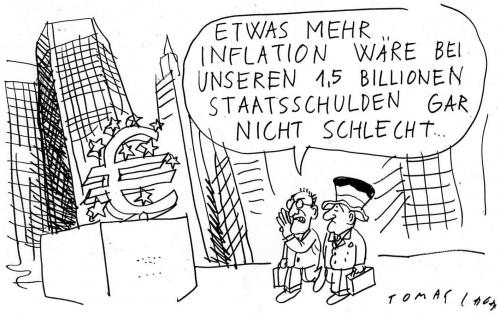
"Some more inflation would not be so bad
concerning our 1,5 billion of public debt"
Now why would the ECB want to print money? First of all, higher inflation means that the public debt of states would shrink. A quick example: I owe you hundred bucks and the rent is two percent, I have to pay you a 102. However, if in between inflation has risen from zero to three percent, those 102 are now worth 99 in real terms. I thus payed back less than I owed you. This isn't magic, but just a logical consequence of the inflation rate being higher than the rent. Additionally, high inflation allows the ECB to combat the speculators and strengthen Europe's concurrence position. Of course inflation is in the short run harmful to consumers and savers, common people already hit hardest by the economic crisis and budget austerity. Whilst not fair, it is paramount that we come clean. Inflation is in this a unique instrument. Sure, we need to handle it with care and no doubt that eventually we will need to get control back. But for now I can no longer agree with the neoliberal view that inflation is an ultimate evil. No wonder I was happy when the ECB reduced its most important rent from 1,25% to 1% yesterday - widening the inflation-rent gap with 25 percent points.

december 04, 2011

A dragon and its cave: China's environmental policy

Before I start, an important notice to my more regular readers: you might notice a drop in activity the next two months or so. This due to the holidays, examination period and preparation for my paper. The past two weeks I have been writing some scraps that can be turned into articles with ease. Just to make sure that, even without much time, I never run out of interesting material to post.

Now, after monetary and economic policy, this final post in the 'dragon nation' series will focus on China's environmental policies. China is often portrayed as a big polluter who doesn't want to see its economic growth constrained. The People's Republic is indeed the biggest carbon emitter in absolute numbers. When emissions are however expressed in terms relative to say population or wealth, the West still does a lot worse. Additionally, the United States and Western Europe pollute a lot more than their own ecology can cope with. Thus an 'ecological debt' is created to countries who's environment is polluted by the excess of the West.
The per capita carbon emissions from various countries. Just compare India and China (left) to Belgium or the States.
The ecological debt surely puts things in perspective; industrialized and industrializing countries suffer the same ailments. The question now is whether China undertakes efforts to mitigate its impact. In its most recent five-year plan, the Chinese Communist Party emphasized energy efficiency and laid out a strategy for cleaning the air. A lot of uncertainty remains, but the Chinese government is working on market-based mechanisms to combat climate change. An emissions-trading system and green taxes are among the favored techniques. The national strategy in the making draws upon regional experiments with carbon-trading and petroleum taxes.

China profits from betting on sustainability. It already is
the leading producer of solar panels and CF light bulbs.
Now why does China seek to implement this shift? One thing most debaters agree upon is that economic motives are driving the process. China is the leading manufacturer of compact-fluorescent light bulbs and solar panels already. Its industries profit from energy-efficiency goals. Yet the so-called green technologies might cause ecological stress in their production and disposal processes, a factor too often ignored. Another motive for China is that it needs to crick up its credibility if it wants to keep enjoying cash inflows from the Clean Development Mechanism. This tool, created under the Kyoto Protocol, allows industrialized countries to invest in carbon-reducing initiatives abroad. The emission reduction then goes on account of the investor. China received a lot of such funding in the past but its biggest investor, the European Union, wants to revise its policy before 2013.

As always, the picture looks more complex upon careful examination. China isn't the environmental boogieman we often blame it too be. Though its efforts are economically motived, I for one expect China to do a lot in the future.

november 26, 2011

A dragon and its younglings: State-owned enterprises

Today I finally present the second article in my 'dragon nation' series. As explained in the previous installment, the aim is to tackle some misconceptions surrounding the oft-mystified Chinese policy. This time I investigated the claim that reforms in China have made it a capitalist economy. Hereto I focused on the state-owned enterprises and their role in the Chinese economy. Well-aware that a complete image requires much more, I would still like to draw some conclusions.

Under impulse of Deng Xiaoping, China moved beyond Maoist recipes and reformed its way out of Third World status. I will not discuss the Chinese economic reform into detail. Much more interesting is to see how much 'Chinese characteristics' there really are in Deng's socialist market economy. After all, once reform was initiated, liberal theorists expect(ed) the People's Republic to move ever-closer to the western model of capitalism. The attachment to ideological references they dismissed as futile shadow-discourse; a canalization of Chinese nationalism at most. How solid is this view?

The Chinese government protects the state-owned enterprises. Favored
companies are effectively shielded from competition by perverse policy.
In 2001, China joined the World Trade Organization (WTO). In this the Chinese establishment subjected itself to the liberalization of its international trade relationships. While this surely is a big move, the power of state-owned enterprises within China's domestic market is still overwhelming. Indeed, ten years after the country's admission to the WTO, state-owned enterprises are stronger than ever. The Chinese government ensures a dominant position for its partners; favored companies abide and in return their share in the market is protected. The authorities realize this by applying rules with a double standard and by obstructing the take-over of domestic companies by foreign ones.

For a detailed analysis of how the state shamelessly obstructs market forces I can recommend this article from The Economist. Now our focus shifts again to the WTO: while domestic suppliers have a guaranteed playing field, they have it easier to export their services/products. The WTO strives toward free trade between its member states and, while it is true a foreign company can access the Chinese market, it is shielded from actual demand. Meanwhile Chinese firms, enjoying subsidized/enforced demand at home, can well-compete for the demand in Europe and the United States. China is thus far from a capitalist country. Much more it resembles a covert form of state-capitalism or even modern mercantilism. Regardless of the label, the state and indeed politics are a most determining factor in China's enterprise environment.

november 14, 2011

A dragon and its treasure: The Chinese yuan

The title of this post refers to the Chinese People's Republic as a dragon. Chinese economic policy is almost as mythical as the creature often used to portray the nation. Incredible growth, enormous exports, vast amounts of financial reserves and yet lead by a party that calls itself 'communist'. In a series of three posts I would like to examine some of the myths that surround Chinese economic policy. First up is the supposedly undervalued currency and its perverse effects on global trade.

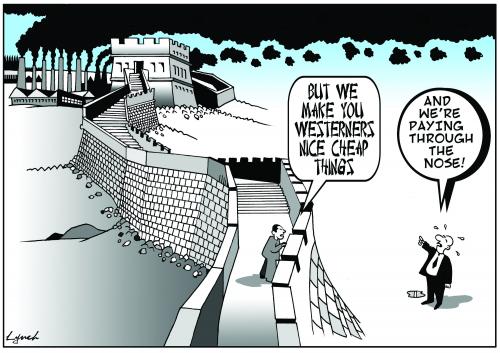
The Chinese leadership is often accused of keeping the yuan, the currency of the China, artificially low. An undervalued currency holds a significant advantage: it suppresses domestic prices of raw materials and labor. In essence you make domestic production artificially cheap, compared to foreign production. This causes  Chinese rubbish to be priced too low and thus to sell better than American, Japanese or European rubbish. The Chinese government rejoices when it checks its export numbers. Other industrialized countries are less happy for they see their trade balance - the worth of export minus import - become less balanced.

The trade balance of countries around the world, based on IMF statistics for 1980-2008. Notice the high deficit for the United States, which is largely benefited Japan in the eighties and China since WTO-admission in 2001.
The question that keeps us busy is twofold: is China keeping its coin artificially cheap and, if so, then how do we deal with it? The grievances of China's trading partners are without a doubt legitimate. It needs however to be said that, ever since 2007, the Chinese government has taken measures to adjust its underpriced coin. Indeed since June 2011 the yuan has appreciated over 7% against the dollar. And considering the spread between China's inflation rate and the much lower one of its trading partners, relative costs in China have risen even more. All this show us that the yuan is not as much undervalued as it used to be.

Myth 1: "The Chinese yuan is kept artificially low
and thus the Chinese policy distorts global trade"
Yet China-bashing is more popular than ever, especially in the United States. On October 11, the US Senate approved a bill that allows its government to take measures against what it deems undervalued currencies. This strategy might be politically successful as it might get one votes from people who lost their manufacturing jobs allegedly due to cheap Chinese imports. Yet from an economic point of view the results would be devastating. A trade war between two economic behemoths, who are also each other's principal foreign debtor/creditor, will disrupt today's fragile economy even further. To ward cheap Chinese products from your market would by the way mostly harm the consumer. And China only needs to challenge such a policy before the WTO to enforce free trade. After all the international economic regime regards undervalued currencies to be a prerogative of the IMF.

Then should we stay inert and leave the matter be? There is something to say for abstaining from action. Though the yuan is far from flee-floating, it is steadily gaining in value. A more 'flexible' yuan offer chances for China to hasten the reorientation of its economy from exports to domestic consumption. This is something the Chinese authorities recognize and seek to achieve, even more so when a global recession might be just around the corner.

oktober 16, 2011

Join the Banana War

I have recently joined a fight of a global scale; a war that involves some of the world's major economic powers: the Banana War! To fully understand this trade conflict, it is necessary to take a look at its history first. The European common market may be internally open to competition, it has a firm tradition of protectionism. The common market was born in 1957 when the European Economic Community (EEC) was formally erected. France however feared it couldn't face the German competition. Therefore it demanded that the principle of the common market was applied to the agrarian production too. France after all is one of the most agricultural countries on the continent. To safeguard European domestic food supply, the EEC also decided to pull up barriers against food imports.

Just five companies control 80% of the world wide banana
trade. These are Dole, Del Monte, Chiquita, Fyffes and
Noboa. Don't support their exploitation-based monopoly,
Buy Fair Trade!
Now what could this possibly have to do with bananas? Believe it or not, but Europe is a producer. Spain has a small share in the EU's banana production, but the major source is again France. Easily overlooked are the French overseas territories and they practically live from banana cultivation. A lot of Europe's trading partners don't like the tariffs we handle since they give an unfair advantage to French bananas. Luckily for American multinationals, Europe has a demand for bananas which surpasses the own production capacity. The war only commenced once Europe altered its protectionist policies in favor of fair trade...

In 2001 the EU approved the "Everything But Arms"-ordinance. This nice piece of legislation granted a reduction in trade tariffs for the ACP-countries (former European colonies). For the Least-Developed Countries, trade tariffs were abolished altogether. Europe didn't demand any compensations in return, this action was inspired by ethics only! The Commission wanted to stimulate the position of fair trade products to aid the developing world. And indeed, the competitive advantage greatly reduced the price gap between fair trade bananas and the so-called 'dollar bananas'. The difference in your purse between buying Oxfam or buying Chiquita became marginal.

The big American concerns, who grow their bananas at big plantations in Latin America using cheap labour, were not amused. Like an adult whining over some candy given to children, they demanded tariff reductions for themselves too. The World Trade Organization already ruled that the EU falsifies competition and this doesn't sort with their neoliberal dogma. Only free competition between exploitation and fair trade can lead to a better world, say the big boys. Europe has to give up on its supportive measures for fair trade. In the future the price gap will certainly rise. I urge you all to join this war, you can all help make a difference. Corporate exploiters haven't won yet; please stop buying dollar bananas and give the South a chance! Buy fair trade!

oktober 15, 2011

Thesis: Wallerstein 2.0

I only just proposed my thesis subject to my promotor. Hopefully, it gets approved because it is what I really want to do. My thesis subject can be situated at the crossroad of all my major interests: economic systems, development in the global South and ecology. What I hope to be preoccupied with for the two years to come is the ecologically unequal exchange. 'Unequal exchange' is a marxist idea signifying a trade in which the price of the traded good does not reflect the actual costs and benefits for both parties. Of course it's a very contested concept.

The Third World Studies Center of Ghent University
Probably the best known application of the concept is its usage in Immanuel Wallerstein's World-systems Analysis. In this theory, Wallerstein argues that a set of core nations (the industrialized North) develops by exploiting the periphery (the global South) trough unequal trade relations. Such ideas were very popular in the 70's but with the rise of neoliberalism it got more and more contested. My thesis will focus on a chance of revival for World-systems Analysis; a chance embodied by the ecologically unequal exchange or EUE.

An EUE is just like the marxist concept, only it focuses specifically on the negative effects of an economic activity on the environment. EUE-theorists claim that often such ecological costs are not included in the pricing mechanism. The result is a product with an artificially low price, the excess value being transfered to the buyer. Can you see where this is going? Indeed, the industrialized North buys not-so-eco-fiendly goods produced in the global South thus extracting the excess value. My goal is to find out whether this effect plays in the real world, outside the field of theory, and in what way it contributes to problematic development in the South.

You all burn a candle for that the promotor may set the light to green and this exciting matter comes my way!