Posts tonen met het label Monetary policy. Alle posts tonen

januari 29, 2012

How the EU combats the crisis

I found this marvelous chart on the website of the Institute of International and European Affairs (IIAA). The IIAA is an Irish think tank with a main focus on topics related to the European Union. It describes itself as 'an independent, not-for-profit organisation with charitable status'. The chart gives an oversight of the different components of Europe's anti-crisis strategy. It may look puzzling at first, especially if you are not that into economic terminology. Still, it is one of the most comprehensive and understandable explanations I have seen. Next time when you hear a journalist or politician rambling about eurobonds or the financial stability pact, just take a look at this chart.


As is evident from the image a lot is going on and it should be sufficient to stabilize the situation. Still, in the long run there is a lot of work to be done. I'm happy that the chart hints toward greater integration in social and economic areas such as employment. I'm also a big supporter of the fiscal union with 'more cash transfers between rich and poor regions'. A lack of unity and over-emphasizing one side of the integration process is what brought us this mess. More Europe - and a more balanced Europe! - thus is the way forward.

december 09, 2011

Eurocrisis: An evaluation

That the euro might disappear is a thought that keeps on circulating. Today I heard that even some Irish banks are working along that scenario. A poor decision if you ask me. Political will to carry on with the euro-project is big and no economic law dictates that the eurozone should break up any time soon. Let's not forget that the euro is still a strong currency; in the end there is more room for a devaluation than for abandoning the euro altogether. The problem with the eurozone is that we have one currency that covers 27 different budgets, 27 different debts, 27 different wage policies, etc. Without getting too technical this makes the eurozone, and indeed the euro itself, vulnerable to asymmetric shocks. These are caused when one of the covered countries spends beyond its own economic payment capacity in the spirit that it is protected by the European umbrella. If one country starts to slip down the slope toward financial disaster, others soon follow. Just do not put the blame entirely with Greece and other 'small big spenders'. It were German and France banks who kept on financing in the search for profit. After all their risk was covered by government and taxpayer.

ECB president Mario Draghi, who brought the main rent
down to 1%, the lowest figure ever in the ECB history.
Now how get out of the difficult situation we're in? No two economists can seem to agree so what I will say next is certainly up for criticism. It is an opinion, but an informed opinion too. Something most EU politicians seem to agree upon is that Europe should get more grip on national budgets. Last night, 23 countries agreed to a (new) stability pact. They will implement the common rules: only 3% deficit, a public debt under 60% of BNP, etc. This formula exists since long, but this time the Commission and the European Court play a major role. In the past countries had to monitor themselves which obviously wasn't a big success. Less agreement can be found when it comes to the role of the European Central Bank. The ECB has announced yesterday that it would not keep on buying government bonds. For you who are not at home in the world of finances: Europe won't keep supporting indebted countries without limit. ECB president Mario Draghi stressed that the ECB does not have the proper mandate to do so. Yet, there is something the ECB could do instead: release the inflation genie! Inflation is the diminishing value of money over time, which manifests itself in rising prices. Generally, inflation is caused by wages going up faster than productivity or by a huge amount of new money being printed.
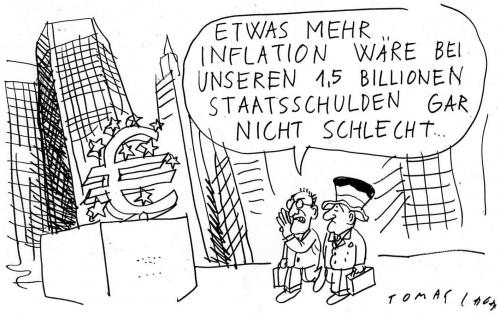
"Some more inflation would not be so bad
concerning our 1,5 billion of public debt"
Now why would the ECB want to print money? First of all, higher inflation means that the public debt of states would shrink. A quick example: I owe you hundred bucks and the rent is two percent, I have to pay you a 102. However, if in between inflation has risen from zero to three percent, those 102 are now worth 99 in real terms. I thus payed back less than I owed you. This isn't magic, but just a logical consequence of the inflation rate being higher than the rent. Additionally, high inflation allows the ECB to combat the speculators and strengthen Europe's concurrence position. Of course inflation is in the short run harmful to consumers and savers, common people already hit hardest by the economic crisis and budget austerity. Whilst not fair, it is paramount that we come clean. Inflation is in this a unique instrument. Sure, we need to handle it with care and no doubt that eventually we will need to get control back. But for now I can no longer agree with the neoliberal view that inflation is an ultimate evil. No wonder I was happy when the ECB reduced its most important rent from 1,25% to 1% yesterday - widening the inflation-rent gap with 25 percent points.

november 14, 2011

A dragon and its treasure: The Chinese yuan

The title of this post refers to the Chinese People's Republic as a dragon. Chinese economic policy is almost as mythical as the creature often used to portray the nation. Incredible growth, enormous exports, vast amounts of financial reserves and yet lead by a party that calls itself 'communist'. In a series of three posts I would like to examine some of the myths that surround Chinese economic policy. First up is the supposedly undervalued currency and its perverse effects on global trade.

The Chinese leadership is often accused of keeping the yuan, the currency of the China, artificially low. An undervalued currency holds a significant advantage: it suppresses domestic prices of raw materials and labor. In essence you make domestic production artificially cheap, compared to foreign production. This causes  Chinese rubbish to be priced too low and thus to sell better than American, Japanese or European rubbish. The Chinese government rejoices when it checks its export numbers. Other industrialized countries are less happy for they see their trade balance - the worth of export minus import - become less balanced.

The trade balance of countries around the world, based on IMF statistics for 1980-2008. Notice the high deficit for the United States, which is largely benefited Japan in the eighties and China since WTO-admission in 2001.
The question that keeps us busy is twofold: is China keeping its coin artificially cheap and, if so, then how do we deal with it? The grievances of China's trading partners are without a doubt legitimate. It needs however to be said that, ever since 2007, the Chinese government has taken measures to adjust its underpriced coin. Indeed since June 2011 the yuan has appreciated over 7% against the dollar. And considering the spread between China's inflation rate and the much lower one of its trading partners, relative costs in China have risen even more. All this show us that the yuan is not as much undervalued as it used to be.

Myth 1: "The Chinese yuan is kept artificially low
and thus the Chinese policy distorts global trade"
Yet China-bashing is more popular than ever, especially in the United States. On October 11, the US Senate approved a bill that allows its government to take measures against what it deems undervalued currencies. This strategy might be politically successful as it might get one votes from people who lost their manufacturing jobs allegedly due to cheap Chinese imports. Yet from an economic point of view the results would be devastating. A trade war between two economic behemoths, who are also each other's principal foreign debtor/creditor, will disrupt today's fragile economy even further. To ward cheap Chinese products from your market would by the way mostly harm the consumer. And China only needs to challenge such a policy before the WTO to enforce free trade. After all the international economic regime regards undervalued currencies to be a prerogative of the IMF.

Then should we stay inert and leave the matter be? There is something to say for abstaining from action. Though the yuan is far from flee-floating, it is steadily gaining in value. A more 'flexible' yuan offer chances for China to hasten the reorientation of its economy from exports to domestic consumption. This is something the Chinese authorities recognize and seek to achieve, even more so when a global recession might be just around the corner.