
 |
| The characterization of Islam as backward has a long history. Yet such representation fails to grasp the genesis of the backward cultural frame or the direction of the profits generated by it. Islam is not as such by definition, it always functions within a context . |
Muslim agitation over 'insulting' imagery is nothing new. It is as present in the media as advertisement. I can't turn on my television or pick up a newspaper without bumping into the latest analysis, opinion, or tirade. Chances are that you experience the same. That is why I first decided not to contribute on this issue. Surely, the facts are by now well-known: a distasteful depiction of the Muslim prophet invoked outbreaks around the world. The violence stirred debate on the compatibility of Islam and 'modern' values like freedom of speech. All too often, the friction which exists between Islam and liberal democracy is reduced to a Clash of Civilizations. 'Islam is a backward belief incapable of allowing democracy to flourish', such is the stance. On the other side of the debate, religious extremists eagerly adhere to this logic of collision. They invert the Western insult to a threat. I dealt with this perspective before. Still, mainstream media fail to grasp the real forces at play. They either subscribe to populist name calling or conjure up an image of the 'backyard Muslim'. The latter to remind us that many Muslims are valuable members of the community. What lacks is a coherent framework to combat the superficial clash put forth.
Religion is often used - misused - as a guise for real social conflict. Indeed conflicting interests have been masked by ideological differences throughout history. Today Islam is coupled to backwardness, but during the 16th century this role was allotted to Catholicism. At the dawn of modern Europe, religious conflicts tore apart political units at most levels. The rise of Protestant movements challenged the old order. Protestantism came in many a form, from the rather modest Anglicanism to radical Dutch Remonstrants. After the dust of the Thirty Years War settled, Protestantism had triumphed in those regions that would do most well in economic terms: the Dutch Republic, England, Scotland, and to some extent France which had the Huguenot legacy. Catholicism strengthened its position in Spain, the Italian states and Poland. These more peripheral areas saw a refeudalization as opposed to the forward surge of (proto-)industry in the Protestant nations. My point? If today's rhetoric was to be applied on this historic case, the conclusion would be that Catholicism is backward while Protestantism is not. Such a view has indeed been suggested. Yet, I prefer a vision that takes into account the gameplay behind the curtain of theological discussion.
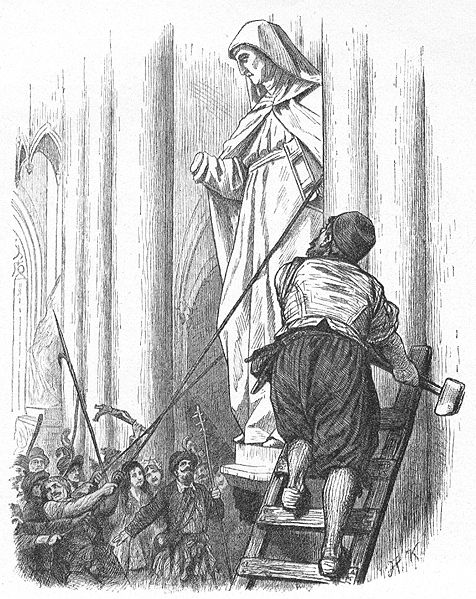 |
| The 'Breaking of the Images' in the Low Countries is quite comparable with Muslim aggression toward idols. Yet one we call progressive while the other is a sign of anti-cultural sentiment? |
Letting ideological dissent account for different social and economic realities is not a balanced view. On the other hand, one must be aware of deriving all cultural patterns from material conditions. Protestantism might more easily reach concord with progressive ideas than Catholicism, since the later has been a defining factor in a former order. But this only is a function of exactly that former constellation. It guaranteed that Protestantism could ally with socially progressive forces. Or better: that socially progressive forces could ally under the umbrella of Protestantism. New nobility, gentry, commercial entrepreneurs tried to secure their interests by assaulting Church property and the privileges of the old nobility. Another major factor was the buildup of a state machinery and the financial resources needed. The refeudalization, weaker state machineries and primacy of Catholicism in 'backward' Medieval Europe served the further rise of the 'strong states'. Baltic and Central Europe became a grain basket, producing much needed cereals of which the trade was monopolized by the Netherlands. Spain imported bullion from the New World to feed the growing economic activity in the northwest. Local aristocracies and the financial reserves of Italian city-states provided a market for Dutch and English cloth.
We have to view the position of the Islam in a similar logic. If the countries of the Middle East and Northern Africa are backward, it is not due to some primordial nature of Islam. Religion at best delivers an arsenal of symbols and values through which social and political forces act. Not so long ago the countries in those regions were ruled by an elite which promised modernity and progress. In reality people were oppressed, kept backward while a ruling few grew rich in serving foreign interests - the interests of the strong states. The Arab Spring was a reaction against this broken promise. And current uproar, all in the name of Islam, is in fact an internal struggle following regime collapse. Part of the old elite tries to reinvent itself, renew its promise. Islamist forces combat them by combatting their example, the Western liberal democracies. Does this make Political Islam a force of progress? I doubt it. Surely its current form is anti-Western, an enemy of the current installment of imperial privileges. The rise of Islamist regimes eats away at the hegemony of the West and brings the world further in touch with a growing multipolar reality. It will however not free the majority of the Muslim population, nor bring them material progress.

