Posts tonen met het label International Law. Alle posts tonen

maart 18, 2012

The WTO: A Brave New World?

Often mentioned in my posts is the World Trade Organization, WTO for short. Mostly it is in a complaint about the negative side-effects of its policies and actions. The WTO was established in 1995 as the successor to the GATT-negotiations. Its goal was to realize global free trade. I noticed however that more and more the organization is used as a battleground for the resolution of national interest conflicts. The big trading blocs - United States, European Union and China - are pursuing their economic self-interest, disguising it as concerns of free trade, ecology or fair trade.

One of the first big clashes was between Europe and the Cairns Group. The latter attacked the agricultural policy of the Union. Of course this was a genuine case of protectionism versus free trade. But when Europe masked its subsidies as support for environmental development, things got really nasty. The WTO was expected to decide on the legitimacy of environmental and other 'progressive' arguments, something it had no mandate for. Indeed the WTO assesses mostly in favor of free trade. Two clear-cut cases are the Banana War and the dispute about Europe's unilateral guarantee of free trade to its poorest trading partners. In both cases Europe had nothing to gain financially itself, but the WTO ruled that such practices are 'against the spirit of freeing up world trade'. I wonder what will become of the Union's aircraft carbon tax...

With its one-sided focus on free trade the WTO can
only serve capital. There is no attention for legitimate
concerns regarding the environment or free trade...
The WTO was created in a moment that everyone believed capitalism had triumphed. A brave new world dawned, a world in which free trade was good trade, best trade. In this spirit the rules of good practice were enshrined in legislation that could only be changed by unanimous vote of the WTO members. This gave rise to what political scientist Stephen Gill calls the new constitutionalism of disciplinary neoliberalism: governments across the world have to abide the rules regardless of their orientation, resisting or retreating equals economic suicide. Truly globalization at its best here, or should I perhaps say at its worst?

Nations sometimes win, sometimes they lose. The real winner in this game is capital: it enjoys the freedom to exploit without the hinderance of border, it is free to set up governments against each other. Who gives the biggest tax cut? Who provides the juiciest subsidies? Who doesn't care that the world dies tomorrow if we can feast today? The one-sided stress of free trade is the real tragedy of the WTO. When we have global exchange we need global regulation. Not the kind of night-watchman authority the WTO provides. Perhaps the resolution lies in the blockage the organization is currently in: being stuck halfway between painful fines and equally painful import taxes can only cause irritation with the WTO's members.

januari 24, 2012

The Iranian bomb: cause or solution to unrest?

In a previous post I explained how the conflict between Iran on the one hand and the United States on the other is in fact a security dilemma. Both sides are 'securing' their interests at the expense of creating more danger to the interests of the other. A quick recap of the facts: Iran is accused of working on nuclear weaponry by the United States and regional ally Israel. This assumption has been confirmed by IAEA reports on this case. The Iranian authorities however remain vigorously that their nuclear enrichment program is for civil ends only. My personal feel is that Iran has probably restarted its military branch of the nuclear program. A pity if you oppose nuclear proliferation like I do.

WHAT'S WRONG WITH IRANIAN NUKES?
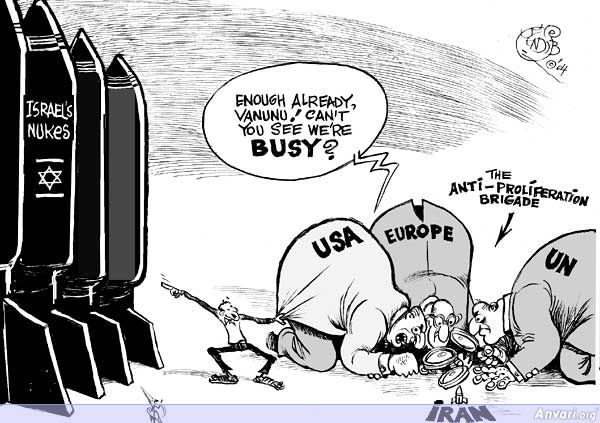
Iran is not the only country that is going rogue with
a nuclear program. No wonder it feels insecure when
Israel and Pakistan - both US allies -  posses an arsenal.
Isn't Iran entitled to a nuclear arsenal? I'm talking about the legal entitlement here, not about the moral or humanitarian sides of the question. For this I wish to refer to the opinion on the legality of the threat or use of nuclear weapons. This statement by the International Court of Justice was to answer whether a state may use a nuclear attack or threaten to do so. The advice stated that there is no prohibition on the use of nuclear arms as such, but it would be in conflict with humanitarian law. So did the Court really rule that nukes are out of the question? Not exactly as the advice left a loophole: the Court felt that it 'cannot conclude definitely whether the treat or use of nuclear weapons would be lawful or unlawful in an extreme circumstance of self-defence'. So if a the existence of a state were at stake, the use of nuclear arms might be permitted.

In its finality this opinion is inconclusive on the use of nuclear force. In it the Court also recognized that there is no evidence for or against the legal possession of nuclear arms, thus actually allowing the continuous possession of nuclear devices. Iran is however a signatory member of the Non-Proliferation Treaty and thus committed itself to a prohibition on developing its own nuclear arsenal. This is probably the main reason Iran keeps denying that its nuclear program has a military branch; heavily sanctions might follow if Iran openly admitted any violations. It is often remarked that other states - in question Israel, Pakistan and India - have nuclear arms. These are indeed contrary to the principles of non-proliferation. But then again these three nations have not signed the above mentioned treaty. You may well consider them to be 'rogue nations' for this (I do) but fact is that they follow the rules.

HOW NOT DO DEAL WITH IRAN
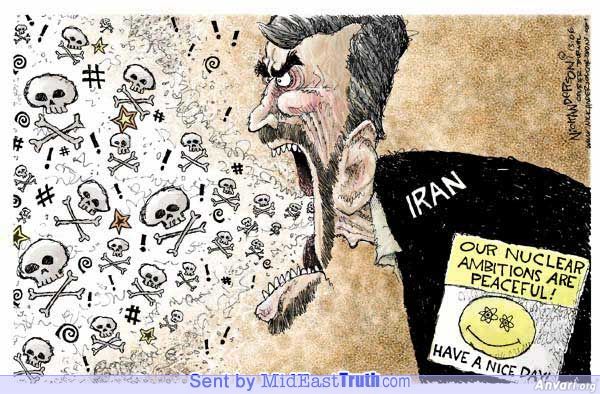
Iran remains that its nuclear program doesn't serve military
ends. That statement is likely untrue, though I do believe
that Iran is building nuclear arms for defensive reasons.
Up till today international reaction vis-a-vis the Iranian nuclear aspirations carried a certain degree of machismo. The United States, and even more fiercely Israel, have been talking about unilateral military measures. Such action is not bound to the realm of fiction: Israel acted against key facilities in the nuclear programs of Iraq (1981) and Syria (2007) before. The strategy applied against Iran is supplemented with assaults on nuclear scientists and economic pressure. The latter in the form of an embargo on Iranian oil, currently upheld by the United States and the European Union. It is my opinion that the path pursued is in its entirety a mistake. For starters the aggressive talk and action only endorse the radical voices in Iran, claiming that the West is pressuring the country toward regime change. A second setback is that the embargo will hit the people of Iran hard. If hardship for the masses is our idea of creating justice I pass for it. Not only is using this impoverishment-strategy interference with Iran's internal affairs, it is ethically most questionable too.

My feel is that Iran should not build a nuclear weapon or talk about closing of the Strait of Hormuz, the West needs to understand that aggression invokes aggression. That is the mechanism behind the security dilemma. Maybe Iran can send a message by collaborating with its fellow members at OPEC. Economic and political affirmation of the Middle East as a region in its own right would force us to rethink our strategy. And rethinking is needed. Iran certainly made some bad choices concerning its methods in the past, but its concerns are valid. As a regional power it is entitled to secure and manifest itself as long as it does not violate the rights of others.

oktober 14, 2011

Bush behind bars?

I try to avoid America-bashing since it has become really ordinary; a whole whiny discourse of its own. With an interest in international politics it is however hard to ignore the facts. Reality is that superpowers like the States aren't amongst the most honorable actors on the world stage. Todays newspaper offered me a topic I can't allow to pass by without mentioning: the accountability of former US-president George W. Bush for the violation of human rights.

National hero, war criminal or both?
In the light of the War on Terror, pronounced by president Bush after the September 11 attacks, a lot of policy shifts were made. The one that concerns us here is his decision to allow 'reinforced interrogation techniques' to be used against suspected terrorists. By now Guantanamo and Abu Ghraib have become concepts in itself. In military-penitentiary complexes like these, human rights may be violated to safeguard national security. In the case of Abu Ghraib sheer fun of the occupying forces also was a valid reason for mistreatment. Keep in mind that in a lot of cases the objects of torture were only <u>suspected</u> terrorists. Last time I checked guilt was determined trough a fair trial. Nonetheless president Bush allowed practices such as waterboarding to be used against people that ever got past being accused.

One of the leading NGO's in protecting human rights is Amnesty International (AI). This organization has send a thousand-page report to the Canadian authorities, requesting the apprehension of George W. Bush if he would visit the country as planned for October 20th. The Canadian responded negatively to what they called 'a stunt', but worldwide pressure is big. Bush already had to cancel a trip to Switzerland and if he would visit my country - Belgium - he would be extradited to the International Criminal Court for sure. Now, I do think Bush is responsible for some nasty stuff, but that is not the point of extradition at all. What really matters is that the United States government, and most US citizens for that matter, refuses to accept that its (former) leaders are accountable for their acts. Even, or particularly, when such acts violate the rights of individuals who can not appeal to the US judicial institutions.

The Obama administration has no intention of handing Bush over to international justice, nor does Canada so it seems. The entire topic is highly controversial in the States since the protection of national security seems to be very important to a lot of people. More important than the human rights and dignity of some Muslim guy who probably hates America anyway. All I can say is 'keep the pressure on'. Americans need to learn that they can not intervene outside their own judicial territory without being accountable to anyone.

For those interested in this particular case and its details; you can always take a look at Bugliosi's The Prosecution of George W. Bush For Murder. I haven't read it myself, but it was suggested to me by a good friend. He called it 'comprehensive', for whatever that is worth.