Posts tonen met het label Development. Alle posts tonen

maart 18, 2012

The WTO: A Brave New World?

Often mentioned in my posts is the World Trade Organization, WTO for short. Mostly it is in a complaint about the negative side-effects of its policies and actions. The WTO was established in 1995 as the successor to the GATT-negotiations. Its goal was to realize global free trade. I noticed however that more and more the organization is used as a battleground for the resolution of national interest conflicts. The big trading blocs - United States, European Union and China - are pursuing their economic self-interest, disguising it as concerns of free trade, ecology or fair trade.

One of the first big clashes was between Europe and the Cairns Group. The latter attacked the agricultural policy of the Union. Of course this was a genuine case of protectionism versus free trade. But when Europe masked its subsidies as support for environmental development, things got really nasty. The WTO was expected to decide on the legitimacy of environmental and other 'progressive' arguments, something it had no mandate for. Indeed the WTO assesses mostly in favor of free trade. Two clear-cut cases are the Banana War and the dispute about Europe's unilateral guarantee of free trade to its poorest trading partners. In both cases Europe had nothing to gain financially itself, but the WTO ruled that such practices are 'against the spirit of freeing up world trade'. I wonder what will become of the Union's aircraft carbon tax...

With its one-sided focus on free trade the WTO can
only serve capital. There is no attention for legitimate
concerns regarding the environment or free trade...
The WTO was created in a moment that everyone believed capitalism had triumphed. A brave new world dawned, a world in which free trade was good trade, best trade. In this spirit the rules of good practice were enshrined in legislation that could only be changed by unanimous vote of the WTO members. This gave rise to what political scientist Stephen Gill calls the new constitutionalism of disciplinary neoliberalism: governments across the world have to abide the rules regardless of their orientation, resisting or retreating equals economic suicide. Truly globalization at its best here, or should I perhaps say at its worst?

Nations sometimes win, sometimes they lose. The real winner in this game is capital: it enjoys the freedom to exploit without the hinderance of border, it is free to set up governments against each other. Who gives the biggest tax cut? Who provides the juiciest subsidies? Who doesn't care that the world dies tomorrow if we can feast today? The one-sided stress of free trade is the real tragedy of the WTO. When we have global exchange we need global regulation. Not the kind of night-watchman authority the WTO provides. Perhaps the resolution lies in the blockage the organization is currently in: being stuck halfway between painful fines and equally painful import taxes can only cause irritation with the WTO's members.

februari 15, 2012

Capitalism and the global environment

As I explained at the beginning of my previous post I am spending all my free time on doing research for my paper. It came to me that if I wrote something on that, I would be able to maintain focus and keep you readers well-supplied for the next couple of days. What follows is a slimmed down summary of what I've been reading the past few months. It accounts of the exploitation of the South, its environment and the evil ways of capitalism. Enjoy!

In the West we still are under the impression that we ought to learn people in the South how to live in a sustainable way. This is evident from our leader's attitudes at international conferences and the various 'plant a three in the South'-like campaigns that are put forth as a solution to ecological crisis. As if environmental degradation in the South is the result of ignorance rather than poverty. As if we are setting a good example...

This is exactly the attitude that needs tackling: the whole idea that the North has the most progressive environmental policies is misleading. Sure, such statement holds when we are talking about quality standards of rivers and the like. But what about international trade? "Now what has trade got to do with it", you ask? Economic policy is not isolated from environmental concerns, just like the world economy is not isolated from the global ecosystem. The North consumes a majority of the natural resources that are extracted from this planet, yet most degradation that accompanies this extraction is experienced in the South. Rich countries use their purchasing power to shift the burden to the South. We cut down African rain forests in stead of American temperate woods. Now isn't it strange that third world countries suffer from deforestation while we don't see that many IKEA-closets in Kinshasa?

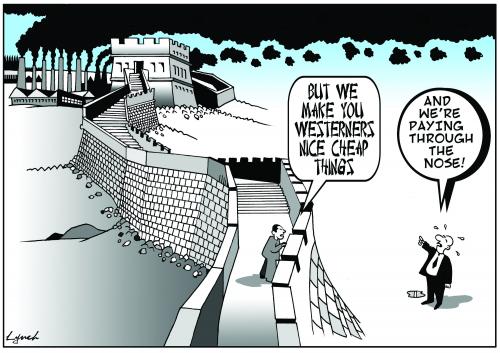
We can maintain both our welfare and natural richness by externalizing the environmental costs associated with production processes. We are still exploiting the South when enjoying our Starbucks coffee or blogging from our HP laptop. Not that we should be surprised at such a conclusion. Exploitation is the very mechanism that makes money go round. From its very start, the capitalist mode of production was grounded in keeping certain costs external to the one who was producing for the market. The market value in other words should not reflect the full cost of production upon society. An example: Starbucks doesn't make you pay for the biodiversity that got lost while clearing tropical forest for a coffee plantation.

"But doesn't the market tend to evolve toward some kind of balance, a correct price?" If only economists would use a little more of their time researching why the optimum is so hard to achieve, you wouldn't need to ask that question. (Economists tend to chatter along about an optimum hardly ever achieved...). If prices where to reflect the real social and environmental costs inflicted, there wouldn't be any surplus gain. The notion that under perfect competition no surplus profits are made is central to economic theory. Yet a lot of free market champions don't seem to understand that you can't get anything for free.
This is why a fair and sustainable society can never be achieved under capitalism. In a system based on the exploitation of both labor and nature, wealth can only be generated for a few at the expense of the many. If we would force our firms to internalize the full cost, the system would start to sputter. Our mode of production is one of production for sale; market value prevails over use value. Change needs to occur at the most fundamental level. Capitalism, with its insatiable hunger for more, functions as a treadmill of destruction. It must be stopped before it collapses under the gravity of its own consequences.

december 19, 2011

Les blues de Bruxelles

The recent update included the possibility where I would blog on 'urgent matters' in spite of me lacking time. This post already exploits that built-in glitch in my otherwise quite firm schedule. The topic once again is the protest against Kabila's re-election as president of Congo. This connects to former posts in which I made a brief sketch of the candidates and commented on Europe's waning commitment to promote democratic values.

Congolese in Matonge with a sign praising the Belgian
anti-establishment party N-VA, of which Bart (de) Wever
is the chairman. They are blatantly missing the point...
This post is a result of my indignation toward anti-Kabila protests in Belgium. Ever since the results of the Congolese presidential elections have been announced, people have been protesting in the Congolese Matonge neighborhood of Brussels. People of Congolese origin are unhappy that Belgium tolerates Kabila's alleged election fraud. They wave Flemish nationalist flags (?!) and they accuse the Belgian establishment. They are totally missing the point! The Congolese in Belgium are fitting themselves an identity that does not exist. As they see it, the West supports Kabila's oppression out of economic self-interest. This view of course can not account for the lack of unity within Congo. I do not deny that economic patterns play a defining role. Complex reality can however not be reduced to a one-on-one relationship of Western exploitation and Congolese dictatorship.

Congolese waving a Flemish flag during the protests.
This can well be considered a strange sight in Brussels.
Colonial inheritance, Cold War dynamics and modern day globalization trough interplay shaped the Congolese economy to what it is today: an inconsistent amalgam of Western-dominated resource extraction, feudal farming methods and an informal petty market in urbanized regions. The Congolese economy is directed at meeting external demand and as such can not realize domestic development. The people of Congo are forced to fall back on the local community to satisfy their basic needs. This causes commitment to a regional identity created along ethnic and cultural divides. Since an economic base is lacking, no civil community or indeed 'nation' can develop.

Without nationhood the central government lacks the legitimacy it needs to be effective. In addition local patterns of clientelism and ethnic tensions are projected into the government institutions. Different groups became engage in a struggle for power over the state, an instrument of which each community wants to avoid that it gets used against its own security concerns. Where the state fails to provide public good, local communities struggle for power. This is the case in Congo - there is no Congolese nation, no Congolese citizenship, no Congolese identity.

The protesters in Brussels are trapped by the modernity paradigm. They blame Western egotism but remain trapped in a liberal discourse of progress and citizenship. I encourage them to tackle the real economic causes which lie underneath. Even if this means recognizing that part of the fault lies with local Congolese interests and the understandable but backward reliance on a closed identity.

december 16, 2011

On sustainable growth

Conclusions at COP-17 in Durban, South Africa were meager. True, the Kyoto Protocol to combat greenhouse emissions is prolonged. And surely commitments have been made to get a binding environmental treaty operational by 2020. Even if this outlook becomes reality, it can be classified under the label of 'too little too late'. Besides, emerging economies like China and India remain averse to far-going and legally binding measures. The other champion of environmental pollution, the United States, would have to ratify any such agreement in Congress. I seriously doubt that with its economic power waning, the States will make ecological commitments.

Bridging leftist ideas on the capitalist economic system with
ecological approaches that take into consideration the well-
being of the planet, provide useful insights for our future.
Up till today politicians have handled a strange logic in dealing with the climate crisis: the economic environment is taken as given, and from thereon we see what green measures we might take. That's bullocks, you can't negotiate with the climate! We must take into consideration the boundaries of our planet's ecosystem - without compromise. And from thát point on we should investigate what economic model is suitable. This radical shift has to take place in our minds and the minds of our political leadership.

We need to put an end to the parasitic way in which our economy relates to the environment. On a global scale, the political level must interfere in the sphere of economics. The pattern of consumption among prosperous citizens needs to shift drastically; away from unnecessary waste and luxury and toward investment in a green revolution. Parallel to the sustainable switch a big push is needed to close the ever-widening gap between rich and poor. The reason for this is twofold:

(1) Poor strata in a world dominated by market forces are confronted with unequal access possibilities. They are cut of from land, food and water even though such vital resources are abundant. Indeed it can be proven that such shortages are caused by unequal access rather than objective scarcity. As a result poor people will resort to clearing forests, burning cheap coal, etc. - this further exploiting the planet.
(2) Rich strata will make brainless consumption choices. They waste money to unneeded stuff simply because to them the marginal gain of a single euro/dollar is low. If the money thrown away had been invested in alleviating poverty, it would have contributed to a socially and environmentally sustainable world.

The essence: welfare should on a global scale be invested in the shift toward an ecologically sustainable society, which includes closing the gap between rich and poor. More growth at expense of the planet (and the poor) is in the long run devastating. Growth shall be sustainable or it shall not be at all.

december 04, 2011

A dragon and its cave: China's environmental policy

Before I start, an important notice to my more regular readers: you might notice a drop in activity the next two months or so. This due to the holidays, examination period and preparation for my paper. The past two weeks I have been writing some scraps that can be turned into articles with ease. Just to make sure that, even without much time, I never run out of interesting material to post.

Now, after monetary and economic policy, this final post in the 'dragon nation' series will focus on China's environmental policies. China is often portrayed as a big polluter who doesn't want to see its economic growth constrained. The People's Republic is indeed the biggest carbon emitter in absolute numbers. When emissions are however expressed in terms relative to say population or wealth, the West still does a lot worse. Additionally, the United States and Western Europe pollute a lot more than their own ecology can cope with. Thus an 'ecological debt' is created to countries who's environment is polluted by the excess of the West.
The per capita carbon emissions from various countries. Just compare India and China (left) to Belgium or the States.
The ecological debt surely puts things in perspective; industrialized and industrializing countries suffer the same ailments. The question now is whether China undertakes efforts to mitigate its impact. In its most recent five-year plan, the Chinese Communist Party emphasized energy efficiency and laid out a strategy for cleaning the air. A lot of uncertainty remains, but the Chinese government is working on market-based mechanisms to combat climate change. An emissions-trading system and green taxes are among the favored techniques. The national strategy in the making draws upon regional experiments with carbon-trading and petroleum taxes.

China profits from betting on sustainability. It already is
the leading producer of solar panels and CF light bulbs.
Now why does China seek to implement this shift? One thing most debaters agree upon is that economic motives are driving the process. China is the leading manufacturer of compact-fluorescent light bulbs and solar panels already. Its industries profit from energy-efficiency goals. Yet the so-called green technologies might cause ecological stress in their production and disposal processes, a factor too often ignored. Another motive for China is that it needs to crick up its credibility if it wants to keep enjoying cash inflows from the Clean Development Mechanism. This tool, created under the Kyoto Protocol, allows industrialized countries to invest in carbon-reducing initiatives abroad. The emission reduction then goes on account of the investor. China received a lot of such funding in the past but its biggest investor, the European Union, wants to revise its policy before 2013.

As always, the picture looks more complex upon careful examination. China isn't the environmental boogieman we often blame it too be. Though its efforts are economically motived, I for one expect China to do a lot in the future.

oktober 15, 2011

Thesis: Wallerstein 2.0

I only just proposed my thesis subject to my promotor. Hopefully, it gets approved because it is what I really want to do. My thesis subject can be situated at the crossroad of all my major interests: economic systems, development in the global South and ecology. What I hope to be preoccupied with for the two years to come is the ecologically unequal exchange. 'Unequal exchange' is a marxist idea signifying a trade in which the price of the traded good does not reflect the actual costs and benefits for both parties. Of course it's a very contested concept.

The Third World Studies Center of Ghent University
Probably the best known application of the concept is its usage in Immanuel Wallerstein's World-systems Analysis. In this theory, Wallerstein argues that a set of core nations (the industrialized North) develops by exploiting the periphery (the global South) trough unequal trade relations. Such ideas were very popular in the 70's but with the rise of neoliberalism it got more and more contested. My thesis will focus on a chance of revival for World-systems Analysis; a chance embodied by the ecologically unequal exchange or EUE.

An EUE is just like the marxist concept, only it focuses specifically on the negative effects of an economic activity on the environment. EUE-theorists claim that often such ecological costs are not included in the pricing mechanism. The result is a product with an artificially low price, the excess value being transfered to the buyer. Can you see where this is going? Indeed, the industrialized North buys not-so-eco-fiendly goods produced in the global South thus extracting the excess value. My goal is to find out whether this effect plays in the real world, outside the field of theory, and in what way it contributes to problematic development in the South.

You all burn a candle for that the promotor may set the light to green and this exciting matter comes my way!