Posts tonen met het label European Union. Alle posts tonen

januari 29, 2012

How the EU combats the crisis

I found this marvelous chart on the website of the Institute of International and European Affairs (IIAA). The IIAA is an Irish think tank with a main focus on topics related to the European Union. It describes itself as 'an independent, not-for-profit organisation with charitable status'. The chart gives an oversight of the different components of Europe's anti-crisis strategy. It may look puzzling at first, especially if you are not that into economic terminology. Still, it is one of the most comprehensive and understandable explanations I have seen. Next time when you hear a journalist or politician rambling about eurobonds or the financial stability pact, just take a look at this chart.


As is evident from the image a lot is going on and it should be sufficient to stabilize the situation. Still, in the long run there is a lot of work to be done. I'm happy that the chart hints toward greater integration in social and economic areas such as employment. I'm also a big supporter of the fiscal union with 'more cash transfers between rich and poor regions'. A lack of unity and over-emphasizing one side of the integration process is what brought us this mess. More Europe - and a more balanced Europe! - thus is the way forward.

december 19, 2011

Congolese elections and European values

A few days before the Congolese were to choose their new president, I blogged about the candidates. Last week the results of those elections were announced: Joseph Kabila succeeds himself as president of the Congo DR. He is believed to be won with little under half of the votes. However, he is not believed to be so by everyone: Supporters of Étienne Tshisekedi, who came in second, called the elections a fraud. They point toward the 'irregularities' that occurred to support their case. While it is true that not everything about the election process was democracy proper, all by all the result is called credible by the authorized commission.

Belgian police forces restraining Congolese protesters in
Matonge - the Congolese district in Brussels, Belgium.
Kabila was not elected by a majority of the people and in a one-to-one race against Tshisekedi he would surely bite the dust. The incumbent president profited from the divided opposition as I predicted in my previous post. Tshisekedi's followers, and indeed the political leader himself, fail to recognize this. While in the urbanized region of the capital opposition against Kabila is strong, the majority of the nation accepts a second term. Riots in Congo or abroad (we had some trouble with protesters in Matonge, the Congolese neighborhood of Brussels) are ungrounded. I do recognize that the grievances held against the Kabila regime are just, but the election outcome is representative.

What I find a real pity is that Europe didn't send a strong signal when tensions rose. A call to 'sit back and stay calm' can hardly be called a signal, can it? I noticed that the Old Continent is no longer as agile in promoting democratic ideals. Congo is just a single dot in a much broader pattern: values are forced to take a back seat more often than should be good for our conscience. Take for instance a bilateral trade agreement between the EU and Columbia: should we really strike a deal with a regime that doesn't take too kindly to human rights? The same goes for a deal in the making with India; the Indian government refuses to accept any trade agreement that holds a clause on human rights - and the EU is actually considering to drop its standard human rights clause!

It can be expected that this tendency will grow stronger in the future, and this for two reasons: First of all, the playing field for international trade is changing drastically. Countries like India, China and Brazil gain prominence and they are not stupid enough to attach value judgements to their contracts. Also, Russia is joining the WTO soon - this nation isn't exactly a staunch defender of personal freedom either. Holding on to its noble ethics would compromise the competitiveness of the EU. A second cause might be the declining power of the Commission and the Parliament. They have lost some of their grip on foreign policy since the creation of the External Action Service. What the future might hold, I can not say, but for sure fragmented and superficial protest wont bend the forces that shape our world.

december 09, 2011

Eurocrisis: An evaluation

That the euro might disappear is a thought that keeps on circulating. Today I heard that even some Irish banks are working along that scenario. A poor decision if you ask me. Political will to carry on with the euro-project is big and no economic law dictates that the eurozone should break up any time soon. Let's not forget that the euro is still a strong currency; in the end there is more room for a devaluation than for abandoning the euro altogether. The problem with the eurozone is that we have one currency that covers 27 different budgets, 27 different debts, 27 different wage policies, etc. Without getting too technical this makes the eurozone, and indeed the euro itself, vulnerable to asymmetric shocks. These are caused when one of the covered countries spends beyond its own economic payment capacity in the spirit that it is protected by the European umbrella. If one country starts to slip down the slope toward financial disaster, others soon follow. Just do not put the blame entirely with Greece and other 'small big spenders'. It were German and France banks who kept on financing in the search for profit. After all their risk was covered by government and taxpayer.

ECB president Mario Draghi, who brought the main rent
down to 1%, the lowest figure ever in the ECB history.
Now how get out of the difficult situation we're in? No two economists can seem to agree so what I will say next is certainly up for criticism. It is an opinion, but an informed opinion too. Something most EU politicians seem to agree upon is that Europe should get more grip on national budgets. Last night, 23 countries agreed to a (new) stability pact. They will implement the common rules: only 3% deficit, a public debt under 60% of BNP, etc. This formula exists since long, but this time the Commission and the European Court play a major role. In the past countries had to monitor themselves which obviously wasn't a big success. Less agreement can be found when it comes to the role of the European Central Bank. The ECB has announced yesterday that it would not keep on buying government bonds. For you who are not at home in the world of finances: Europe won't keep supporting indebted countries without limit. ECB president Mario Draghi stressed that the ECB does not have the proper mandate to do so. Yet, there is something the ECB could do instead: release the inflation genie! Inflation is the diminishing value of money over time, which manifests itself in rising prices. Generally, inflation is caused by wages going up faster than productivity or by a huge amount of new money being printed.
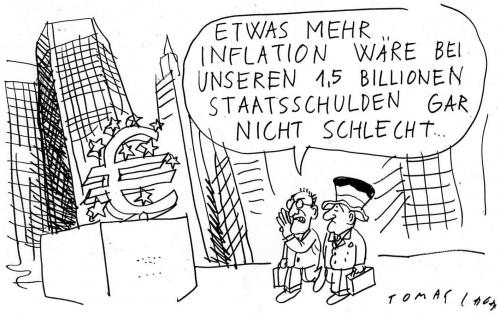
"Some more inflation would not be so bad
concerning our 1,5 billion of public debt"
Now why would the ECB want to print money? First of all, higher inflation means that the public debt of states would shrink. A quick example: I owe you hundred bucks and the rent is two percent, I have to pay you a 102. However, if in between inflation has risen from zero to three percent, those 102 are now worth 99 in real terms. I thus payed back less than I owed you. This isn't magic, but just a logical consequence of the inflation rate being higher than the rent. Additionally, high inflation allows the ECB to combat the speculators and strengthen Europe's concurrence position. Of course inflation is in the short run harmful to consumers and savers, common people already hit hardest by the economic crisis and budget austerity. Whilst not fair, it is paramount that we come clean. Inflation is in this a unique instrument. Sure, we need to handle it with care and no doubt that eventually we will need to get control back. But for now I can no longer agree with the neoliberal view that inflation is an ultimate evil. No wonder I was happy when the ECB reduced its most important rent from 1,25% to 1% yesterday - widening the inflation-rent gap with 25 percent points.

oktober 24, 2011

Turkish accession: some obstacles

Turkey has been a recurring topic in the past week's media. First there were attacks by the Kurdistan Working Party (PKK), then there was the retaliation of the Turkish army. Few days later there was an earthquake in the East of the country, a region were a lot of Kurds live. I first considered writing something on the Kurdish question, but that would require some research. Because I don't exactly have a lot of time right now, I will stick to more familiar terrain: what are the biggest obstacles for Turkish accession to the EU?

(1) The first issue to pop up in my mind would be the Turkish recognition of North Cyprus. In 1974 a coup d'état on Cyprus would have lead to annexation by Greece, so the Turks made a military intervention. The island has been divided ever since. The northern part declared itself independent in 1983; Turkey is the only country to have recognized it. Since Cyprus is a member of the European Union, this issue needs to be settled one way or another.

(2) Another obstacle on the road to accession is the Kurdish question I already mentioned. The EU already has talks with Turkey about accession since 2005. In the light of these talks, Turkey already expanded the rights of the Kurdish minority. At least on paper, Kurds have gained various right such as education in their own language, etc. However, relations between the Turkish authorities and Kurds remain difficult. And the EU doesn't think lightly of human right...

Do you think Turkey would make a great addition?
(3) The third, and perhaps most difficult problem to solve is one that lies with the EU itself. The public opinion in countries with notable Turkish minorities is not in favor of Turkish accession. I think of Belgium, France, Germany, etc. The governments of these countries are most sensitive to this. Strange enough, a lot of Turkish immigrants and their children aren't big fans of Turkish accession either. Promises have been made so if Turkey insists it will become a member state. But all the stalling might make that Turkey changes its mind.

I myself am a most fanatic supporter of Turkish accession. Turkey has a young and dynamic population, a growing economy and a (relatively) big army. Also, as a predominantly muslim country and gateway to the Middle East, it holds diplomatic and strategic importance. I honestly hope we can welcome Turkey in the EU within a matter of years!

oktober 16, 2011

Join the Banana War

I have recently joined a fight of a global scale; a war that involves some of the world's major economic powers: the Banana War! To fully understand this trade conflict, it is necessary to take a look at its history first. The European common market may be internally open to competition, it has a firm tradition of protectionism. The common market was born in 1957 when the European Economic Community (EEC) was formally erected. France however feared it couldn't face the German competition. Therefore it demanded that the principle of the common market was applied to the agrarian production too. France after all is one of the most agricultural countries on the continent. To safeguard European domestic food supply, the EEC also decided to pull up barriers against food imports.

Just five companies control 80% of the world wide banana
trade. These are Dole, Del Monte, Chiquita, Fyffes and
Noboa. Don't support their exploitation-based monopoly,
Buy Fair Trade!
Now what could this possibly have to do with bananas? Believe it or not, but Europe is a producer. Spain has a small share in the EU's banana production, but the major source is again France. Easily overlooked are the French overseas territories and they practically live from banana cultivation. A lot of Europe's trading partners don't like the tariffs we handle since they give an unfair advantage to French bananas. Luckily for American multinationals, Europe has a demand for bananas which surpasses the own production capacity. The war only commenced once Europe altered its protectionist policies in favor of fair trade...

In 2001 the EU approved the "Everything But Arms"-ordinance. This nice piece of legislation granted a reduction in trade tariffs for the ACP-countries (former European colonies). For the Least-Developed Countries, trade tariffs were abolished altogether. Europe didn't demand any compensations in return, this action was inspired by ethics only! The Commission wanted to stimulate the position of fair trade products to aid the developing world. And indeed, the competitive advantage greatly reduced the price gap between fair trade bananas and the so-called 'dollar bananas'. The difference in your purse between buying Oxfam or buying Chiquita became marginal.

The big American concerns, who grow their bananas at big plantations in Latin America using cheap labour, were not amused. Like an adult whining over some candy given to children, they demanded tariff reductions for themselves too. The World Trade Organization already ruled that the EU falsifies competition and this doesn't sort with their neoliberal dogma. Only free competition between exploitation and fair trade can lead to a better world, say the big boys. Europe has to give up on its supportive measures for fair trade. In the future the price gap will certainly rise. I urge you all to join this war, you can all help make a difference. Corporate exploiters haven't won yet; please stop buying dollar bananas and give the South a chance! Buy fair trade!